World Press Photo names its picture of the year and draws a line for generative AI
World Press Photo has chosen its photo of the year and, at the same time, drawn a hard line for the era of generative AI. The winner is Carol Guzy's "Separated by ICE", which shows children clinging to their father after an immigration hearing in New York. The contest's rule is simple: a photo must capture a real moment, and AI may not add, remove or synthesize the content of the frame.
AI-processed from The Verge; edited by Hamidun News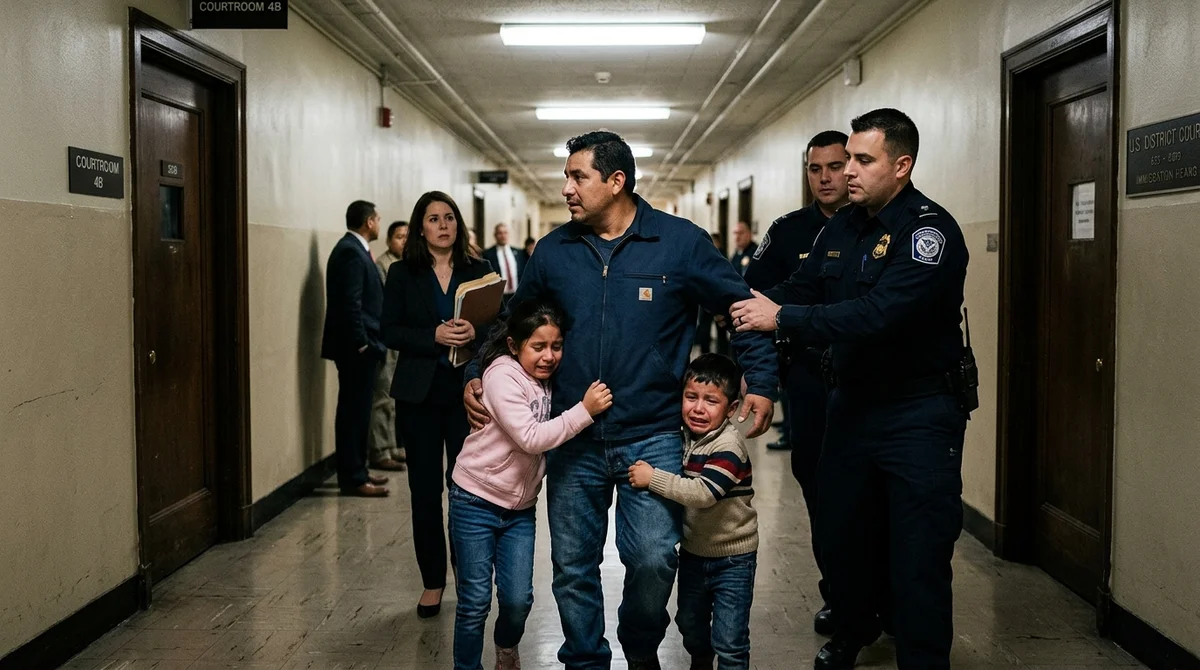
In 2026, the World Press Photo contest gave perhaps the clearest answer yet to the debate over what counts as a photograph in the age of generative AI: an image must be a record of a real, physical moment, not a synthetically assembled picture. The winner is Carol Guzy's "Separated by ICE", a scene after an immigration hearing in which children cling to their father as officers from ICE detain him. The winner was announced on 23 April 2026.
The photo was taken on 26 August 2025 at the Jacob K. Javits Federal Building in New York. It shows Luis, who was detained by agents of U.S. Immigration and Customs Enforcement (ICE) after an immigration court hearing. For the jury, this is not just an emotional frame but evidence of how government policy is lived by one specific family in one specific second. That documentary status is what became central to the discussion of the boundary between photography and AI.
The work has another dimension. The picture was taken inside one of the few federal buildings in the US where journalists were allowed to record such scenes at all. According to the contest organizers, photographers came there day after day to document the aftermath of immigration hearings. That turns Guzy's work from a single strong photograph into part of a systematic chronicle: it shows not an exception but a repeating mechanism in which a bureaucratic procedure ends in the separation of a family.
World Press Photo states its line on AI as directly as possible in the contest rules: images created by AI are not considered photography. In the contest's view, a photograph arises when a camera records light on a sensor or film and thereby preserves a physical moment. For that reason, synthetic images and generative fill added in post-processing are banned from the contest. The organization also acknowledges that modern capture and editing workflows already include computational tools, so it allows some AI-based enhancement tools, but only if they do not change the content of the frame, do not add new information and do not remove anything that actually reached the lens.
This caveat matters because the dispute long ago moved beyond art photography. In photojournalism, a picture works as testimony: editors, the people in the story and the audience must be able to tell what happened in front of the camera and what a machine filled in. That is why World Press Photo did not stop at general words about "authenticity". It demands original files from entries that reach the final stages, and it states separately that some AI tools, such as programs for "smart" image upscaling, automatically violate the rules. In other words, the question is no longer whether to use AI at all, but where technical processing ends and the substitution of reality begins.
The choice of finalists reinforces the message. The year's best entries also included pictures of the humanitarian catastrophe in Gaza and of the trials of Achi women in Guatemala. The subjects differ, but the principle is the same: an image is valuable not for its spectacle but because it holds the viewer in front of a difficult reality and gives it visual confirmation. In this sense, the contest is defending not "old photography" as a craft but the public function of visual testimony.
The rule does not arrive in a vacuum, given the contest's scale. In 2026, the jury chose from 57,376 photographs submitted by 3,747 photographers from 141 countries. The winner receives 10,000 euros, and an exhibition of the laureates' work opened in Amsterdam on 24 April and will then travel to dozens of venues around the world. So the World Press Photo decision is not an internal dispute of the professional community but a reference point for a large segment of the international media industry. When a contest like this says that generation is not photography, it quickly becomes a practical standard for newsrooms, agencies and photographers themselves.
The main takeaway is that the era of generative AI has not abolished photography but forced a more precise definition of its limits. If an image claims to be documentary, its value now depends increasingly not only on the strength of the frame but on the transparency of its origin. World Press Photo has effectively fixed a simple rule: you can improve technical quality, but you cannot synthesize an event. For news photography, this may be the most important benchmark for the coming years.
- Oct 31, 2026Author puts his script before an AI jury: the verdict cost 850 thousand tokens
- Oct 31, 2026SciGame Tests Five LLM Agents: Familiar Formulas Get in the Way of Finding Altered Laws
- Oct 30, 2026Agent traffic on Zocdoc is up 30x since July, and ChatGPT faces two health lawsuits
- Oct 29, 2026OvisOCR3: an 0.8B-parameter model that reads documents better than specialized systems
Test Frontier LLMs & Autonomous Agents in One Workspace
Run Claude Opus 5.5, GPT-6, Gemini 3.1, and DeepSeek side-by-side in Nomad AI (nomadnet.ai) — unified model routing, deep research, and multimodal workflows under one subscription.
The AI world, distilled — once a week
Seven stories that actually mattered, hand-picked. No noise, no reposts, no press releases.
Done! Check your inbox for a confirmation.