DeepSeek unveils V4: a Chinese open-source model takes on OpenAI and Google
DeepSeek has shown a preview of V4, a new open-source model the company places alongside systems from OpenAI, Google and Anthropic. The main focus is coding and agentic scenarios: Pro and Flash versions are available, with a context window of up to 1 million tokens. There is also a signal to the market in its support for Chinese Huawei chips, so the release matters not only as a model but as an infrastructure step.
AI-processed from The Verge; edited by Hamidun News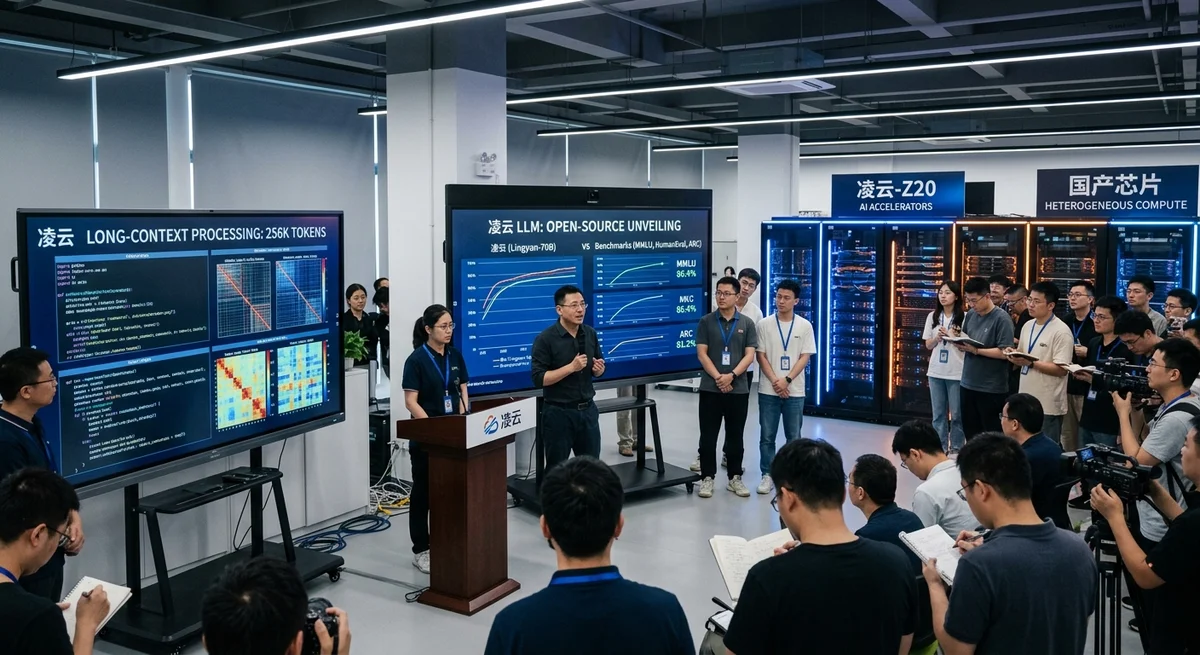
DeepSeek is again trying to move the AI market not with loud promises but with a release that hits several of the industry's pain points at once. On April 24, 2026, the Chinese company released a preview of the V4 series and said the new open-source model can compete with the closed systems of OpenAI, Google and Anthropic. The news matters for the market not only because of the models themselves, but because DeepSeek is betting on coding, agentic scenarios and its own Chinese compute base.
The series includes two versions: DeepSeek-V4-Pro and DeepSeek-V4-Flash. The first is the flagship, with 1.6 trillion parameters and 49 billion active parameters; the second is a more compact variant with 284 billion parameters and 13 billion active. Both support a context of up to 1 million tokens, and the weights are published under the MIT license, so the company is continuing its course of making its models as openly available as possible. By DeepSeek's own description, the V4 architecture has been substantially reworked: the company focused on long-context efficiency, training stability and stronger post-training alignment for different types of tasks.
The main emphasis in V4 is programming. DeepSeek says outright that the new generation is markedly stronger at coding, which is precisely the capability underlying AI agents that write, fix and run code. With tools such as ChatGPT Codex and Claude Code on the rise, this is no longer a secondary benchmark but one of the key indicators of how suitable a model is for real work.
In tests published by DeepSeek, V4-Pro Max mode scores 93.5% on LiveCodeBench and 80.6% on SWE Verified, and on some tasks it approaches the best closed models.
The company itself frames the result cautiously: V4 does not necessarily lead everywhere, but it noticeably narrows the gap between open and closed systems on complex reasoning and agentic tasks.
Hardware is a separate part of the story. DeepSeek stresses V4's compatibility with the Huawei Ascend line, which makes the launch more significant politically and industrially than an ordinary model update. Just a year ago, nearly all discussion of frontier AI models revolved around American chips, above all Nvidia. Now one of the most prominent Chinese players is trying to show that a competitive model can not only be run in China but also built into a local stack, from training and inference to optimization for domestic accelerators. For Huawei this is an important signal: its AI infrastructure is becoming not a fallback option but a platform for top-tier releases.
The context of this announcement is also strong. A year ago DeepSeek already shook the American AI market with its R1 model, saying it had managed to train it for far less money than industry leaders in the US spend. With V4, the company has so far not disclosed training costs and has not specified the full stack of hardware used, so many questions remain around the release. Political pressure continues as well: US officials previously accused DeepSeek of using banned Nvidia chips, and Anthropic claimed the company abused access to Claude to improve its own products. Proven transparency is still scarce here, and that will affect how V4 is received outside China.
The main takeaway is simple: V4 is not just another model in the long stream of AI releases. DeepSeek is trying to prove three things at once: the open-source approach can still catch up with frontier-class models, coding is becoming the central discipline for LLMs, and China's AI ecosystem increasingly wants to depend less on American hardware and closed APIs. If the claimed results are confirmed in practice, the market will gain not only a strong new open-source player but also one more argument that the AI race is now being run simultaneously at the level of models, tools and chips.
- Nov 2, 2026Meta's Muse assistant keeps dossiers on loved ones and gets root on Ubuntu by default
- Nov 1, 2026Local models lose to Opus and Codex: 0.21 on a MacBook versus 1.00 for Codex
- Nov 1, 2026Kimi scores 96.2% on a 1C database analytics test and emerges as a fallback if Claude access is blocked
- Nov 1, 2026OpenAI Rewrites GPT Behavior Rules: Five Values and a Chain of Command
Test Frontier LLMs & Autonomous Agents in One Workspace
Run Claude Opus 5.5, GPT-6, Gemini 3.1, and DeepSeek side-by-side in Nomad AI (nomadnet.ai) — unified model routing, deep research, and multimodal workflows under one subscription.
The AI world, distilled — once a week
Seven stories that actually mattered, hand-picked. No noise, no reposts, no press releases.
Done! Check your inbox for a confirmation.