OpenAI and Qualcomm reportedly preparing an AI phone where agents could replace apps
OpenAI appears to be getting serious about hardware. According to Ming-Chi Kuo, the company is building a smartphone whose main interface would be AI agents rather than conventional apps. Qualcomm and MediaTek are handling the chip, while Luxshare is helping with design and is expected to be the exclusive manufacturer. If the supply chain confirms the project, this is no longer a concept but a potential product.
AI-processed from TNW; edited by Hamidun News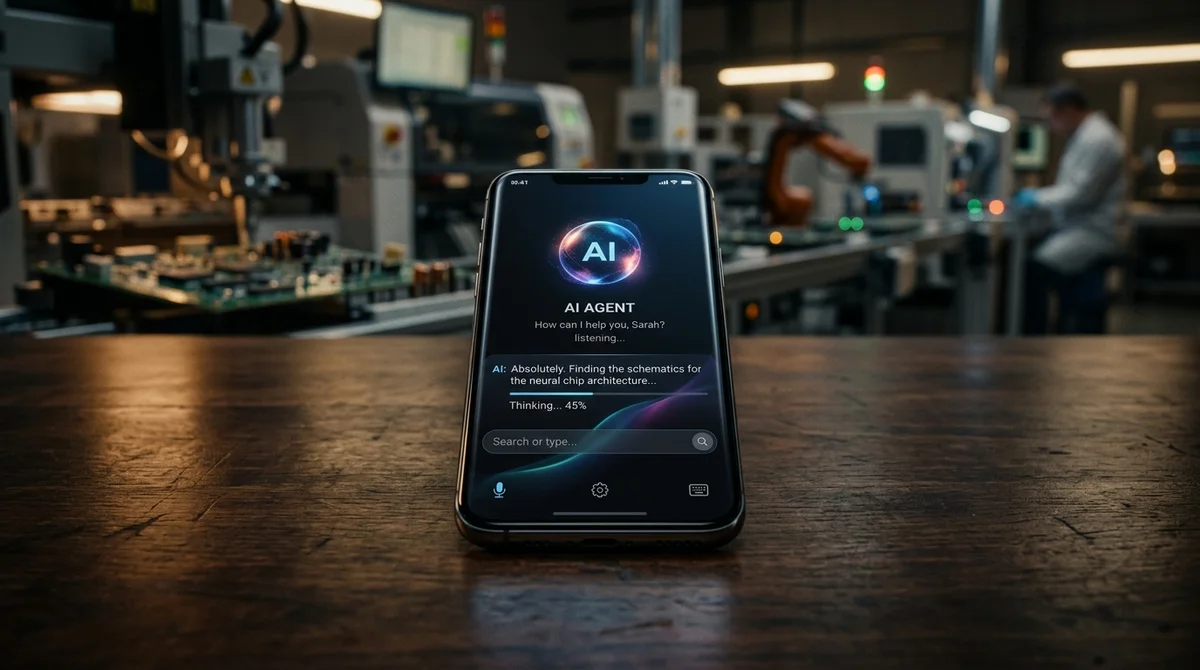
Judging by supply chain data, OpenAI is not just making another smartphone but a device with a different interaction logic: instead of the usual set of apps, AI agents would sit at the center of the system. If the project actually reaches release, the market could get one of the first mass-market phones where users don't open icons but give tasks to an intelligent assistant that picks the right service, action and sequence of steps on its own.
According to Ming-Chi Kuo, an analyst at TF International Securities, OpenAI is developing a smartphone built around an agent-based scenario. The key idea is that the phone's interface should shift from an app-first model to an agent-first model.
That is an important difference. Today even the most advanced AI features on mobile devices usually remain a layer on top of the existing app ecosystem. Users still switch between a messenger, a browser, notes, maps, delivery and other services. With OpenAI the idea seems to be the opposite: the agent becomes the main entry point, while apps either recede into the background or turn into invisible infrastructure altogether.
The lineup of partners indirectly signals how mature the project is. According to Kuo, Qualcomm and MediaTek are jointly involved in developing a custom processor for the device, and Luxshare Precision Industry will not only be the exclusive manufacturer but is also helping with co-design.
That alone looks unusual. Qualcomm and MediaTek typically compete with each other rather than work together on a mass-market mobile chip. If such a collaboration really exists, the project requires a non-standard architecture and possibly a new balance between on-device local computing, power efficiency and the constant operation of AI models. For a phone that has to keep an agent active most of the time, the chip is not a detail but the foundation of the whole product.
Luxshare's involvement brings the story closer to real hardware: when a manufacturing partner of that kind is engaged, it is usually no longer about a nice idea on slides but about design, components, assembly and scaling up production.
For OpenAI itself, such a step would look like a logical continuation of the fight for the interface to AI. Today the company controls the model and the app, but not the end device, the sensors, power consumption, background task execution or the rules of access to the operating system. Its own phone would give it far more room to experiment: from voice interaction by default to deep integration of memory, camera, search, shopping, navigation and personal scenarios.
In this design, the idea of making apps optional no longer sounds like a marketing slogan. If an agent can book, message, order, compare and launch the right actions on its own, users really do begin to think in terms of intentions rather than screens.
But this is also where the main risk lies. A smartphone without the familiar app logic must not merely be interesting but noticeably more convenient than today's iPhone or Android flagship. People put up with dozens of icons not because they like chaos but because apps are predictable: you know where to tap, what will open and how to undo an action.
The agent model promises to remove extra steps, but in return it must deliver transparency, control, privacy and very high reliability. One strong language model is not enough. The system has to work consistently in real everyday scenarios, not drain the battery in half a day and not turn every task into an endless dialogue with a bot.
If the supply chain leak is accurate, OpenAI is launching an offensive not only against the app market but against the very model of mobile computing. That does not guarantee success: the industry has already seen devices that tried to reinvent the interface and failed to become a habit. But the very fact that chipmakers and a contract manufacturer are backing the project changes the tone of the conversation. This is no longer a distant fantasy but a product that could theoretically reach store shelves and test in practice whether users are ready to entrust their phone not with a series of taps but with their own intentions.
- Nov 2, 2026Meta's Muse assistant keeps dossiers on loved ones and gets root on Ubuntu by default
- Nov 1, 2026Local models lose to Opus and Codex: 0.21 on a MacBook versus 1.00 for Codex
- Nov 1, 2026Kimi scores 96.2% on a 1C database analytics test and emerges as a fallback if Claude access is blocked
- Nov 1, 2026OpenAI Rewrites GPT Behavior Rules: Five Values and a Chain of Command
Test Frontier LLMs & Autonomous Agents in One Workspace
Run Claude Opus 5.5, GPT-6, Gemini 3.1, and DeepSeek side-by-side in Nomad AI (nomadnet.ai) — unified model routing, deep research, and multimodal workflows under one subscription.
The AI world, distilled — once a week
Seven stories that actually mattered, hand-picked. No noise, no reposts, no press releases.
Done! Check your inbox for a confirmation.