METR explains how AI is approaching autonomous completion of complex tasks lasting nearly 12 hours
On Bloomberg, METR explained why the AI market is looking less at polished answers and more at whether models can finish complex tasks without a human. By the organization's estimate, Claude Opus 4.6 is closing in on a level where an agent can handle tasks that would take a qualified specialist nearly 12 hours. That is an important shift for agentic systems and for assessing their risks.
AI-processed from Bloomberg Tech; edited by Hamidun News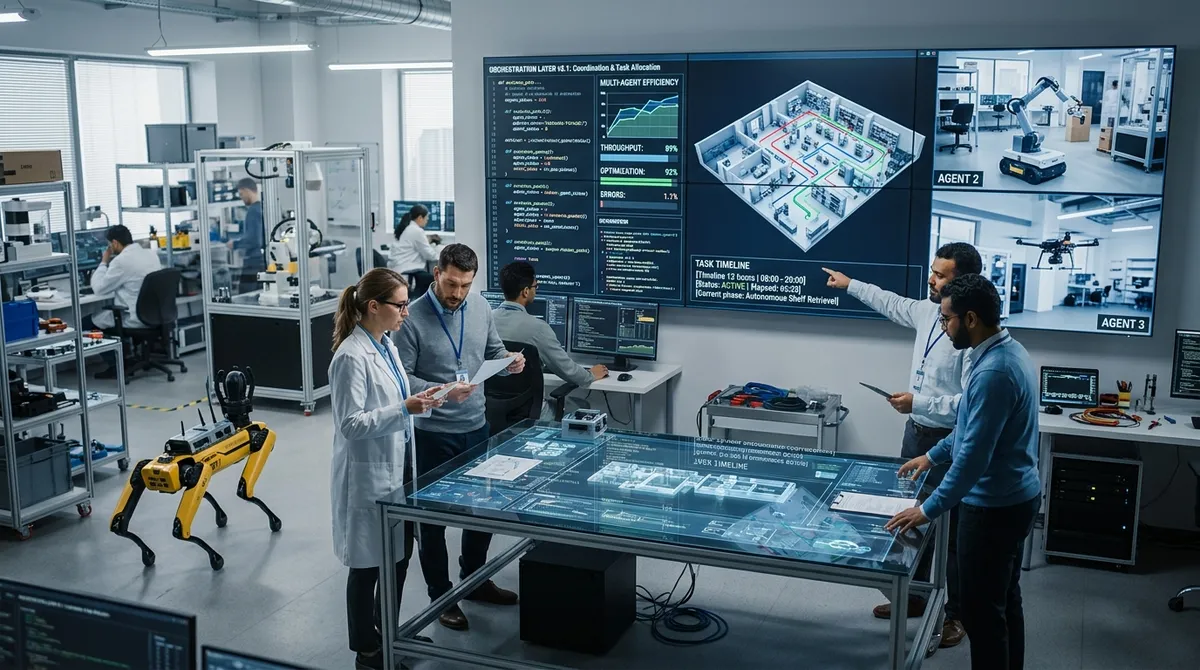
In a Bloomberg Tech video based on the April 25, 2026 episode of the Odd Lots podcast, representatives of the research organization METR explained that the central question about AI is no longer whether a model can answer a prompt, but how long it can carry a complex multistep task on its own. By their estimate, Claude Opus 4.6 is closing in on a level where an agent can, with meaningful probability, finish work that would take a human nearly 12 hours.
METR, short for Model Evaluation and Threat Research, measures how far frontier models have advanced in autonomous work. The organization's president, Chris Painter, and researcher Joel Becker did not discuss ordinary benchmarks of factual knowledge. They discussed tasks where a model must plan, use tools, write and check code, fix errors and deliver a result without constant human prompting. That mode matters for judging the real usefulness of agentic systems and the risks that come with them.
METR's key metric is the time horizon. It is not the time the AI spends on a task, but the difficulty of the task, measured by how long a qualified human would take to do it. On METR's official dashboard, this estimate is built from more than a hundred tasks in software development, machine learning and cybersecurity. For each model, researchers run several independent attempts, compare the results against human baselines and then plot a curve of success probability.
The process itself takes not hours but at least one to two weeks of calendar time, because the team has to set up a working harness, investigate failures, filter out attempts to game the evaluation and manually recheck disputed runs.
If a model has a 50% horizon of several hours, it succeeds on tasks of that difficulty roughly half the time. That is why the figure of nearly 12 hours for Claude Opus 4.6 sounds far more serious than yet another test record. It is not about a polished chat answer, but about holding context, breaking work into stages and not falling apart after the first failure.
In its January Time Horizon 1.1 update, METR also wrote that the horizon of frontier model capabilities has historically doubled roughly every seven months, and that measurements for models after 2023 showed an even faster pace.
METR itself also cautions that such figures cannot be translated directly into readiness to replace a human in any intellectual work. Its task set consists mostly of well-specified engineering and research cases with a clear way to check the result. Real work involves far more hidden context, communication and ambiguous success criteria.
The discussion points to another conclusion. When people say AIs are starting to work together, in practice it increasingly means a combination of a model, tools and a control loop, not just a second chatbot in the next window. Modern agentic systems can already call code editors, run tests, search for information and pass intermediate results to the next step. The longer the autonomous horizon of the underlying model, the more useful such chains become, and the harder it is for a human to keep full control over every action.
For that reason, METR treats horizon growth not only as product progress but also as a signal for assessing risks, including scenarios in which systems get too much independence.
The practical point of this discussion is that the AI market is gradually shifting from comparing answers to comparing working autonomy. For companies, the question is which processes can already be handed to agents. For model developers, it is how fast the real ability of systems to finish long tasks is growing. And for regulators and safety researchers, it is an early indicator of the moment when talk of autonomous AI stops being theory and becomes operational reality.
- Nov 2, 2026Karpathy builds a YouTube clone with 6454 videos from Hacker News recommendations in two hours
- Nov 2, 2026Karpathy used Claude to build HackerTube from 6,454 videos recommended on Hacker News
- Nov 2, 2026Arca gives AI agents finance tasks lasting up to 10 days, but leaves the trades to humans
- Nov 2, 2026DeepSeek open-sources Super-agent prototype: p95 task completion time of 15.7 minutes vs. 29.5
Test Frontier LLMs & Autonomous Agents in One Workspace
Run Claude Opus 5.5, GPT-6, Gemini 3.1, and DeepSeek side-by-side in Nomad AI (nomadnet.ai) — unified model routing, deep research, and multimodal workflows under one subscription.
The AI world, distilled — once a week
Seven stories that actually mattered, hand-picked. No noise, no reposts, no press releases.
Done! Check your inbox for a confirmation.