Elon Musk and Sam Altman Head to Court: The Trial Could Reshape OpenAI's Structure
A trial has begun in Oakland in which Elon Musk is trying to prove that OpenAI drifted from its original nonprofit mission and turned into a commercial machine. At stake is more than a personal feud with Sam Altman: the outcome could reshape the company's governance, its relationship with Microsoft and its IPO plans. The first substantive hearings are scheduled to begin on April 28.
AI-processed from Bloomberg Tech; edited by Hamidun News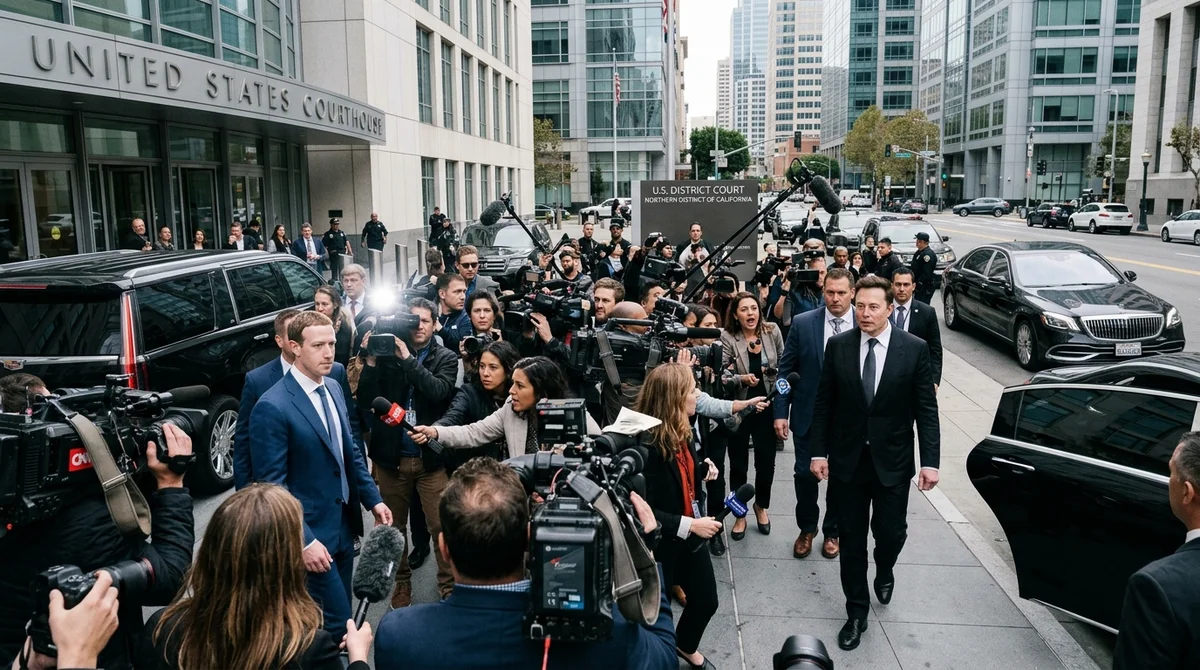
On April 27, 2026, a trial began in a federal court in Oakland that could become the most important corporate case in OpenAI's history. With jury selection complete, Elon Musk and Sam Altman move on to the next stage of a dispute over what OpenAI should actually be: a nonprofit with a mission to serve society, or a capital-hungry technology company that needs investors, revenue and hard commercial logic to survive. For OpenAI, the stakes include not only its reputation but also its governance structure, its relationship with Microsoft and its path to the public market.
Musk's claims boil down to this: he helped launch OpenAI in 2015 as a public-benefit project, put about $38 million into it and backed the idea of open research that would hold back big players such as Google. He now argues that the company abandoned those promises: first it created a commercial arm, then it fully reshaped itself into a model in which investors and the partnership with Microsoft play an enormous role.
In his lawsuit, Musk wants more than money. He seeks to unwind the key restructuring, remove Altman and Greg Brockman from leadership, and direct any damages not to himself but to OpenAI's charitable arm. Ahead of the trial, his team narrowed the suit and dropped some of its fraud claims, leaving at the center the question of whether the company violated its original nonprofit mission.
OpenAI's defense rests on the opposite account. The company says that as early as 2017 Musk himself discussed a move to a hybrid structure with nonprofit and for-profit parts, because without it OpenAI could not have competed in the race for computing power, researchers and data centers. According to OpenAI, the conflict was not about ideals but about control: Musk wanted more influence, including over the future structure, and after leaving the project he launched a rival, xAI.
The trial is especially sensitive for the company now, because the dispute no longer concerns a small lab. In March 2026, OpenAI closed a $122 billion round at an $852 billion valuation, and its leadership openly says further growth requires even more capital and infrastructure.
The trial is designed to settle the question of liability first and only then discuss consequences. Jury selection ended on April 27, opening statements are scheduled for April 28, and the proceedings are split into two phases. The first will involve an advisory jury, which will give the court its view on the merits, but Judge Yvonne Gonzalez Rogers will still make the final decision. If the case reaches the second phase, discussion of sanctions and a possible restructuring of OpenAI could begin on May 18 and, under the current schedule, run through May 22.
Expected witnesses include Musk himself, Altman and representatives of Microsoft. That matters because the dispute has long outgrown a personal feud between two co-founders: it touches the role of the largest partner, which became one of the main beneficiaries of OpenAI's commercialization.
The practical risk for OpenAI is that even a partial win for Musk could slow the company at a moment when it is scaling products, building new infrastructure and keeping a possible IPO in mind. If the court backs the demands to reverse the restructuring or change leadership, the company would face not just a legal problem but a governance shock. For Microsoft, too, this is no abstract dispute: its stake and its agreements with OpenAI are directly tied to the current corporate structure.
But a loss for Musk would also mean more than a personal defeat. The court would effectively confirm that an AI lab can start as a project with a public mission and then legally become a capital-intensive corporation while keeping its old rhetoric about benefiting humanity.
The main takeaway is not which of the two billionaires argues louder on X. The Oakland court is testing whether, in the era of generative AI, a charitable mission, control over a frontier technology and investors' appetites can be combined without a legal explosion. For OpenAI, this is a trial about the past, the present and the company's design for years to come. For the whole industry, it is a test of where the polished founder legend ends and ordinary corporate reality begins.
- Nov 2, 2026Arca gives AI agents finance tasks lasting up to 10 days, but leaves the trades to humans
- Nov 2, 2026Meta's Muse assistant keeps dossiers on loved ones and gets root on Ubuntu by default
- Nov 1, 2026Local models lose to Opus and Codex: 0.21 on a MacBook versus 1.00 for Codex
- Nov 1, 2026Kimi scores 96.2% on a 1C database analytics test and emerges as a fallback if Claude access is blocked
Ship AI Faster with Founders, Engineers & Weekly Architecture Reviews
Inside Vibe Club (hamidun.com/club) — weekly live masterminds with Zhemal Khamidun, Tech Radar, full LMS access, and 370+ production Claude Code skills.
The AI world, distilled — once a week
Seven stories that actually mattered, hand-picked. No noise, no reposts, no press releases.
Done! Check your inbox for a confirmation.