Meta reserves orbital solar power from Overview Energy for its data centers
Meta has signed an agreement with Overview Energy to reserve up to 1 GW of orbital solar power for its AI data centers. Satellites in geostationary orbit would collect sunlight and beam it to existing solar farms, extending their output into the night. The first orbital test is planned for January 2028, with commercial deliveries slated for 2030. *Meta is designated an extremist organization and banned in Russia.
AI-processed from TNW; edited by Hamidun News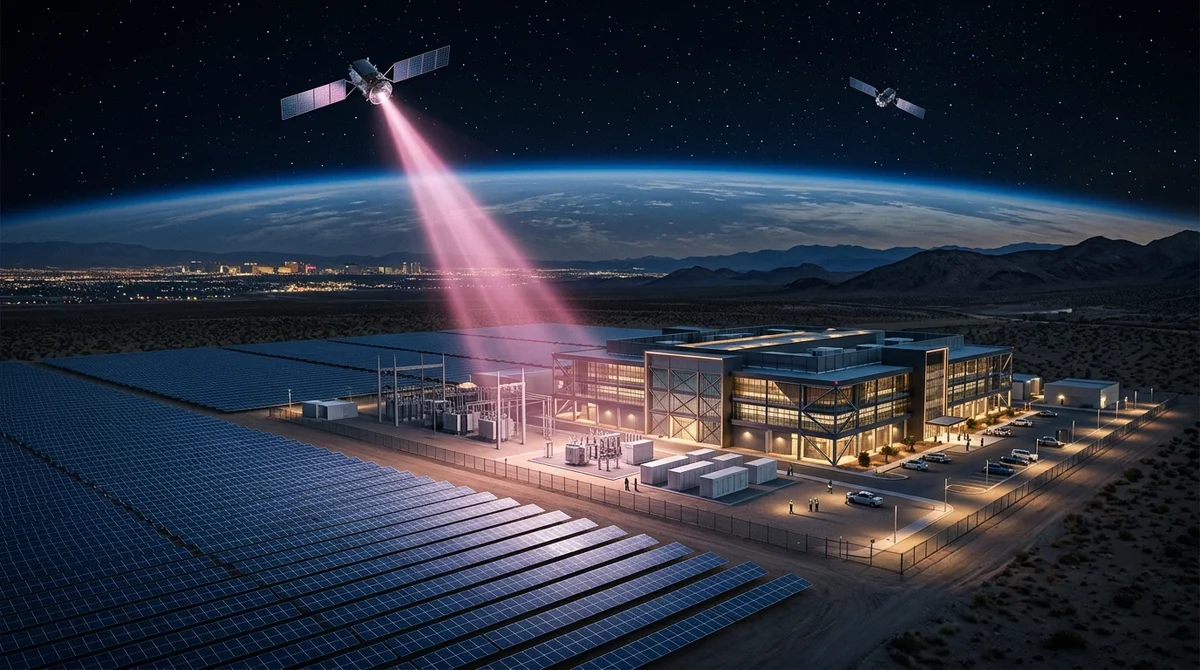
Meta is betting on one of the most ambitious energy ideas of the AI era: the company has agreed with startup Overview Energy to reserve up to 1 GW of capacity that is planned to be beamed to Earth from orbital solar satellites in the future. If the project works, existing ground-based solar plants could generate electricity not only by day but also at night, and Meta would gain another source of power for its growing data centers.
Overview's design differs from classic space-based solar concepts, which usually involve microwaves or powerful lasers and dedicated receiving stations. The startup proposes a more down-to-earth architecture: satellites in geostationary orbit would continuously collect sunlight and then transmit it to already operating solar farms as low-intensity near-infrared radiation. From there, existing photovoltaic infrastructure on the ground converts that flow into electricity and feeds it into the grid. The idea is to avoid building new ground infrastructure from scratch, to avoid taking up new land, and to avoid waiting for a separate grid connection.
For Meta, this is above all a question of energy for AI. Data centers must run around the clock, while conventional renewable sources are inherently unstable: the sun disappears at night, wind depends on the weather, large battery systems remain expensive, and new nuclear projects require lengthy approvals and years of construction. In 2024, Meta's data centers consumed more than 18,000 GWh of electricity, comparable to the annual consumption of roughly 1.
7 million American households. Against that backdrop, the company is expanding its AI infrastructure, including the Hyperion campus in Louisiana and the Prometheus campus in Ohio, and is looking for ways to increase its volume of carbon-free energy. Its goal is to bring its renewable portfolio to 30 GW.
The agreement with Overview does not yet mean that satellite power is close to industrial scale. It is a reservation of future capacity, not immediate deliveries. The company plans its first orbital demonstration for January 2028, and the start of commercial power delivery is expected in 2030. The parties did not disclose financial terms. Even so, the deal is already being called the first commercial reservation of space solar capacity by a major company, and probably the most visible signal that big tech companies are ready to fund even very early-stage energy technologies if they could potentially solve the problem of round-the-clock power.
Overview Energy was founded in 2022 in Ashburn, Virginia, and emerged from stealth only in late 2025. The company says it has already demonstrated power transmission from a moving aerial platform to the ground, and that its beam will be invisible and less intense than sunlight; the startup presents safety for people, animals and aviation as one of the approach's key advantages. But many technical questions remain: launching and maintaining powerful spacecraft in geostationary orbit, achieving stable power transmission at a commercial level, and proving that the entire chain makes economic sense compared with batteries, ground-based generation and nuclear power.
Notably, Meta also announced a partnership with Noon Energy on ultra-long-duration energy storage, another way to cover nighttime and weather-related gaps in generation.
The main takeaway is simple: the energy race around AI is becoming as important as the race for models and chips. Meta is not buying a finished solution but placing an option on a technology that looks experimental today but, if it succeeds, could sharply raise the output of solar plants already built. If Overview reaches an orbital demonstration in 2028 and confirms the project's economics, the market will gain a new class of infrastructure: not a replacement for ground-based energy, but its round-the-clock extension.
*Meta is designated an extremist organization and banned in Russia.
- Nov 2, 2026Meta's Muse assistant keeps dossiers on loved ones and gets root on Ubuntu by default
- Nov 2, 2026The Verge reviewer builds a $50 Meta Muse Charm alternative with Claude Code
- Nov 1, 2026MoneyGate safety layer blocked all 42 fraudulent requests to local AI models
- Oct 31, 2026Open-source LLM gateway KTMS 1.0 plugs your own GPUs into the cloud and survives outages
Test Frontier LLMs & Autonomous Agents in One Workspace
Run Claude Opus 5.5, GPT-6, Gemini 3.1, and DeepSeek side-by-side in Nomad AI (nomadnet.ai) — unified model routing, deep research, and multimodal workflows under one subscription.
The AI world, distilled — once a week
Seven stories that actually mattered, hand-picked. No noise, no reposts, no press releases.
Done! Check your inbox for a confirmation.