MIT Technology Review: OpenAI, Anthropic and the Whole AI Market Are Stuck Between Hype and Profit
The hype around AI is already sold as a path to profit, but the key intermediate step is still unclear. Companies promise to transform the economy, yet the real data is more modest: Anthropic sees no clear spike in unemployment, and a Mercor test showed that AI agents fail most complex office tasks. The industry needs proof, not new promises.
AI-processed from MIT Technology Review; edited by Hamidun News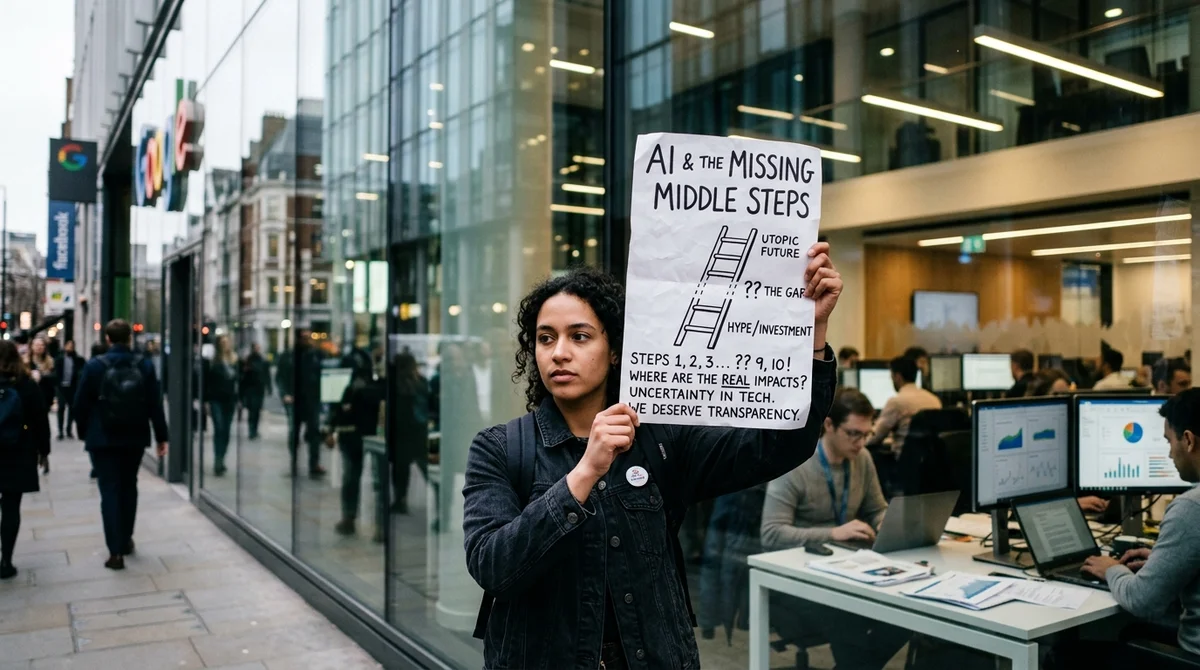
The hype around AI has created a sense of inevitable revolution, but between the loud promises and real profit there is still a gap. The industry has mastered the step of building impressive models, yet it still cannot clearly show how they fit reliably into company workflows and change the economy.
The author recalls a February anti-AI march in London, where Pause AI activists handed out a flyer with a near-meme diagram: step one, grow a digital superintelligence; step two, a question mark; step three, also a question mark. It is a nod to the gnomes in South Park, whose business plan went like this: collect underpants, then an unknown step, then profit. In the author's view, that is exactly where the entire AI market stands now: the technology exists, the promise of transformation exists, but the mechanism in between remains murky.
For AI opponents, the missing second step most often means regulation: first you must work out which rules should limit adoption, who will write them and who will enforce them. Supporters of the technology see the opposite picture. In their minds they already stand at the point where AI saves the economy, raises productivity and reshapes the labor market. As OpenAI chief scientist Jakub Pachocki told the author, this is an economically transformative technology. The problem is that everyone sees a different road to that future, and nobody has a proven map.
One study, published by Anthropic on March 5, 2026, tries to assess AI's impact on the labor market. The company introduced a metric called observed exposure, which combines the theoretical capabilities of language models with real data on how they are used. The conclusion cuts both ways: managers, architects, media workers and other white-collar professions are most at risk, but actual AI penetration is still far below its theoretical potential.
According to Anthropic, in the Computer and Math category Claude actually covers only 33 percent of tasks, and about 30 percent of workers have zero exposure. The researchers have not found a clear rise in unemployment in the most exposed occupations since ChatGPT launched, although hiring of young employees in such roles may already be slowing.
The second example cools the market even more. In February, Mercor researchers tested leading AI agents from OpenAI, Anthropic and Google DeepMind on 480 long office tasks drawn from the work of investment bankers, consultants and corporate lawyers. The agents got a realistic environment with files, documents, spreadsheets and applications, so the test would measure real working routine rather than a polished demo. The result was harsh: no system could consistently handle most of the duties. Even the best models produced useful partial results, but fully completing complex work remained the exception rather than the norm.
This is the missing step. It is not enough to build models into a product or seat them next to an employee. They have to work inside tangled processes, among people, rules, checks, legacy software and accountability for mistakes. Sometimes adding AI does not speed up work but complicates it. Companies can, of course, rebuild their processes around new tools, but that takes time, money and managerial courage.
For now, the gap in understanding is filled by loud weekly announcements, and a single successful social media post can move expectations, and even the market, faster than careful data.
The main conclusion is simple: the AI market does not need another capability demo but evidence from real-world use. It needs more transparency from model developers, collaboration between researchers and business, and new ways of measuring that show not lab magic but what happens after deployment. Until then, promises of an imminent economic revolution remain a nice third step without a convincing second.
- Nov 2, 2026Arca gives AI agents finance tasks lasting up to 10 days, but leaves the trades to humans
- Nov 2, 2026Meta's Muse assistant keeps dossiers on loved ones and gets root on Ubuntu by default
- Nov 1, 2026Local models lose to Opus and Codex: 0.21 on a MacBook versus 1.00 for Codex
- Nov 1, 2026Kimi scores 96.2% on a 1C database analytics test and emerges as a fallback if Claude access is blocked
Test Frontier LLMs & Autonomous Agents in One Workspace
Run Claude Opus 5.5, GPT-6, Gemini 3.1, and DeepSeek side-by-side in Nomad AI (nomadnet.ai) — unified model routing, deep research, and multimodal workflows under one subscription.
The AI world, distilled — once a week
Seven stories that actually mattered, hand-picked. No noise, no reposts, no press releases.
Done! Check your inbox for a confirmation.