Nvidia's Jensen Huang calls DeepSeek's move to Huawei chips a threat to the US
Nvidia CEO Jensen Huang warned that DeepSeek's bet on Huawei chips and its move from CUDA to CANN could strike a strategic blow to US positions in AI. The Chinese lab is preparing its V4 model for the Ascend 950PR processor. The dispute is no longer only about hardware speed, but about control over the entire software ecosystem.
AI-processed from TNW; edited by Hamidun News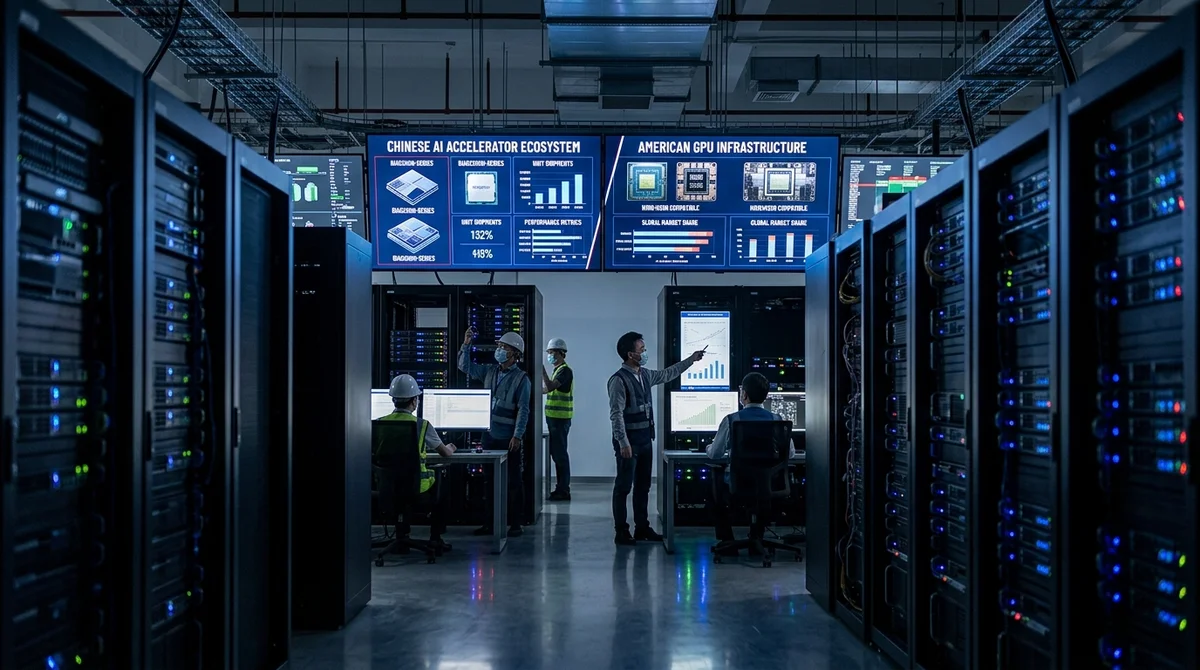
DeepSeek's move from Nvidia's ecosystem to Huawei chips is not a local story about one Chinese developer for the US. It risks costing Washington a key lever of influence over the global AI market. That is how Nvidia CEO Jensen Huang described the situation: if strong Chinese models start optimizing for a Chinese stack rather than an American one, the consequences will be strategic. On the Dwarkesh podcast, Huang said such a scenario would be a "terrible outcome" for the US.
The trigger is DeepSeek's preparation to launch V4, a new multimodal foundation model expected to be presented before the end of April 2026. According to published reports, the model is supposed to run on the Huawei Ascend 950PR processor. It is important to distinguish training from inference: the model could have been trained on one set of accelerators and serve user requests on another. The second part is now the main field for the experiment.
The key threat to Nvidia, and more broadly to US technology policy, lies not just in the hardware but in the software stack. DeepSeek spent several months rewriting its core code for CANN, Huawei's software environment, and in doing so moved away from the CUDA world that Nvidia built over almost two decades. Until now, even restrictions on chip shipments to China did not fully break the dependence: if labs wrote code for CUDA, they stayed tied to the American ecosystem. Moving to CANN is an attempt to cut that link and build a parallel infrastructure in which Nvidia is not a mandatory layer.
For DeepSeek, this is a logical continuation of its earlier strategy. Its V3 model, released in late 2024, was trained on 2,048 Nvidia H800 accelerators, chips built specifically for the Chinese market that were later banned too. The company then showed R1, a reasoning model that managed to compete with noticeably more expensive American systems. If V4 succeeds on Huawei Ascend, it will be the next demonstration that a Chinese lab can build strong models not only more cheaply but also with less dependence on American hardware.
On raw performance, Huawei still lags. The Ascend 910C, the previous generation, delivered roughly 60% of the Nvidia H100's performance in inference tasks, and the H100 is itself no longer the best accelerator in Nvidia's lineup. According to estimates cited in the source article, American chips are currently about five times more powerful than Chinese equivalents, and by 2027 the gap could grow to seventeen times. Huawei plans to ship about 750,000 AI chips in 2026, but in total that is only 3–5% of Nvidia's aggregate computing power.
Still, what worries Huang is not the current gap but the trajectory: China can make up for weaker hardware with the scale of its energy resources, the number of its researchers and the quality of its optimization. This has already shown up with DeepSeek R2. The model was delayed several times because of problems training on Huawei hardware, and the company ultimately had to return to Nvidia accelerators for training, leaving Chinese chips mainly for inference. The episode shows that in heavy training the gap is still real.
But commercial value does not arise only at the training stage. If inference on Huawei proves stable enough and economically sensible, the market may accept a setup in which American accelerators are no longer mandatory, at least on the operations side.
Against this backdrop, the paradox of export restrictions stands out. Nvidia resumed production of the more powerful H200 for the Chinese market, but according to the company, the Chinese side is blocking their import to protect its domestic producer, Huawei. Nvidia's chief financial officer said earlier that the company had effectively received no H200 sales in China. At the same time, political pressure is growing in the US: lawmakers are discussing whether to add DeepSeek, Moonshot AI and MiniMax to the export restriction list. It turns out that measures designed to slow China down may instead be accelerating the assembly of its own AI stack.
For the market, this shifts the very logic of competition. The question is no longer only who has the fastest chips, but who controls the standard environment for developing and deploying models. If DeepSeek proves that a large multimodal system can run competitively on Huawei Ascend and CANN, several pillars of the American advantage will come under pressure at once: the world's dependence on CUDA, the case for export controls, and the habit of building AI infrastructure around Nvidia by default.
This, it seems, is exactly what Huang fears: not today's defeat, but a scenario in which the Chinese alternative stops being an experiment and becomes a working route for the whole industry.
- Nov 2, 2026TensorFold 1.2.0 boosts Qwen3.8-27B throughput on M3 Ultra by 44.2% at 16 streams
- Nov 1, 2026Local models lose to Opus and Codex: 0.21 on a MacBook versus 1.00 for Codex
- Nov 1, 2026Habr author fine-tunes YOLOv8l on dental X-rays and pushes mAP50 to 0.642
- Nov 1, 2026Voice bots built on LLMs turn to Jev, a fast classifier, for decisions in 200–500 ms
Test Frontier LLMs & Autonomous Agents in One Workspace
Run Claude Opus 5.5, GPT-6, Gemini 3.1, and DeepSeek side-by-side in Nomad AI (nomadnet.ai) — unified model routing, deep research, and multimodal workflows under one subscription.
The AI world, distilled — once a week
Seven stories that actually mattered, hand-picked. No noise, no reposts, no press releases.
Done! Check your inbox for a confirmation.