GPTunneL and the Forbes trend: why AI super apps are becoming the market's new growth engine
GPTunneL says the audience has changed since it grew to 2 million users: people increasingly come not for answers but to get tasks done, and demand is shifting toward multimodal products. Against this backdrop, AI super apps are emerging as a distinct segment. Corporate clients want ready-made scenarios, the market is running into limits on GPUs and sovereign models, and reselling tokens is ceasing to be the core business model.
AI-processed from Habr AI; edited by Hamidun News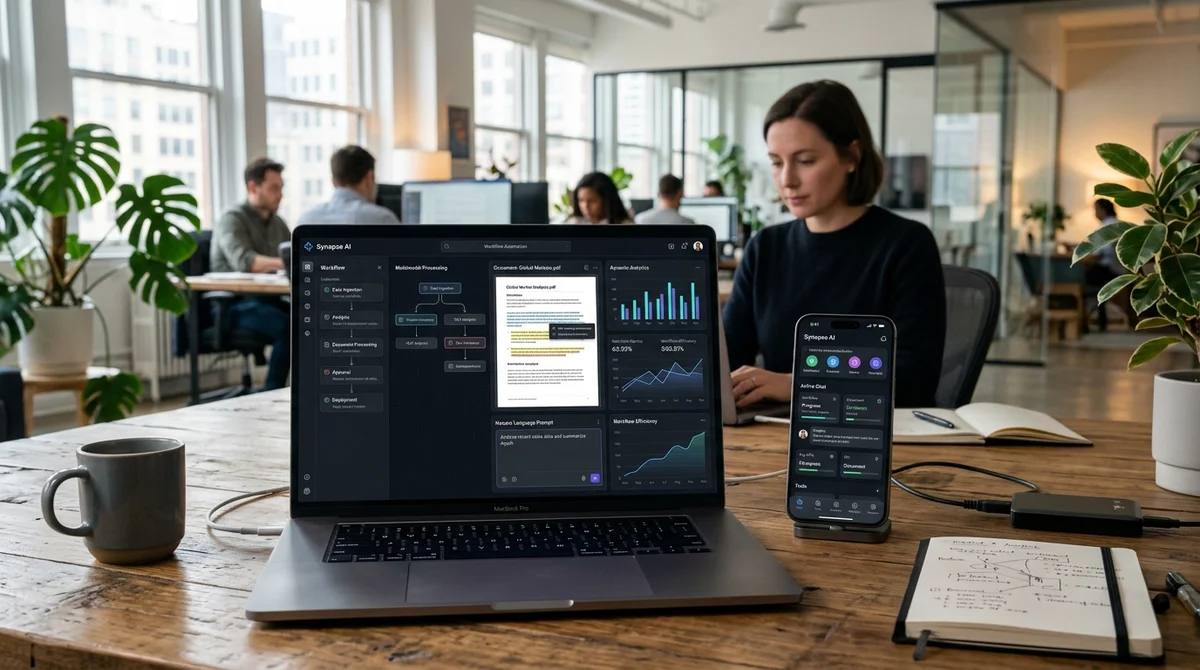
The generative AI market is moving quickly from standalone models to the AI super app format, where users come not for an "answer from a chatbot" but to get an entire task done: write a text, process a file, generate an image, analyze data or assemble a working scenario from several tools. The GPTunneL team, which grew from 1.5 million to 2 million users in a few months, believes this shift best explains why super apps are not a fashionable label but a new market logic. As outside confirmation of the trend, the team points to Forbes' February forecast, which named AI super apps one of the main directions of 2026.
But the forecast matters less than the applied statistics: during 2025, traffic to multimodal tools inside GPTunneL tripled. That means the audience is less and less likely to stick to text prompts and more likely to combine modes of work: text, images, documents, voice scenarios and automation.
The type of request is changing in parallel. Where users once mostly "asked" the model something, they now formulate tasks: prepare a presentation, analyze a document, create a visual, rewrite an email, assemble a draft report. For a product this is a fundamental difference, because value moves from access to the model to the quality of the finished action.
Globally, the shift looks different from market to market, but the overall direction is the same. In China, the super app idea has long been familiar to users, so AI services fit naturally into broader digital ecosystems. In the US, competition centers on universal work interfaces that combine several models, agents and content types in a single window.
In Turkey and other fast-growing markets, there is visible demand for more applied products, where localization, entry price and a clear use case matter more than the technological "purity" of the chosen model. Against this background, the AI super app becomes a compromise between the complexity of modern AI infrastructure and the user's expectation of getting one clear service instead of a set of scattered tools.
For Russia, this transition is complicated by several factors at once. First, the market is looking ever more toward sovereign models and local control over critical infrastructure. Second, large players are already rolling out enterprise solutions, including GigaChat Enterprise, which accelerates business demand not for "yet another chat" but for integrable corporate products. Third, the GPU shortage remains a hard constraint on scaling, especially if a company wants not only to resell access to other providers' APIs but also to build its own technology layer.
It is in this logic that GPTunneL is developing its GROM model: not as a prestige project, but as an attempt to gain more control over quality, cost and use cases.
Notably, according to the team, token resale accounts for less than 20% of revenue. That is an important signal: the economics of such services depend less and less on a simple markup on a model, and more on product packaging, interfaces, tool orchestration and industry-specific scenarios.
The main takeaway is that the AI market is maturing faster than the everyday language around it. Users may still say they "use a model," but what they buy is no longer a model; it is a result: a document, an analysis, automation, a ready workflow. For startups, this means building not a showcase of dozens of LLMs but a cohesive product with its own layer of value. For corporations, it means moving from experiments to integration into business processes. For the Russian market, it means added pressure toward its own infrastructure, compute capacity and local models.
If this vector holds, the winners in 2026 will not be those with the longest list of connected neural networks, but those who package them best into a single working tool.
Test Frontier LLMs & Autonomous Agents in One Workspace
Run Claude Opus 5.5, GPT-6, Gemini 3.1, and DeepSeek side-by-side in Nomad AI (nomadnet.ai) — unified model routing, deep research, and multimodal workflows under one subscription.
The AI world, distilled — once a week
Seven stories that actually mattered, hand-picked. No noise, no reposts, no press releases.
Done! Check your inbox for a confirmation.