Investors uneasy: Sam Altman reportedly tried to steer OpenAI money toward personal projects
OpenAI's preparation for a possible IPO has sharpened questions about its corporate governance. Sam Altman reportedly pushed for investments in Helion, Merge Labs and Stoke Space, projects that overlap with his own investments and personal ambitions. Some of these ideas have already been blocked inside the company, but for investors it is a warning sign: before going public, OpenAI will have to show more rigorously how it controls conflicts of interest. The issue is sensitive because Altman holds no equity in OpenAI yet retains very broad influence over strategic decisions.
AI-processed from 3DNews AI; edited by Hamidun News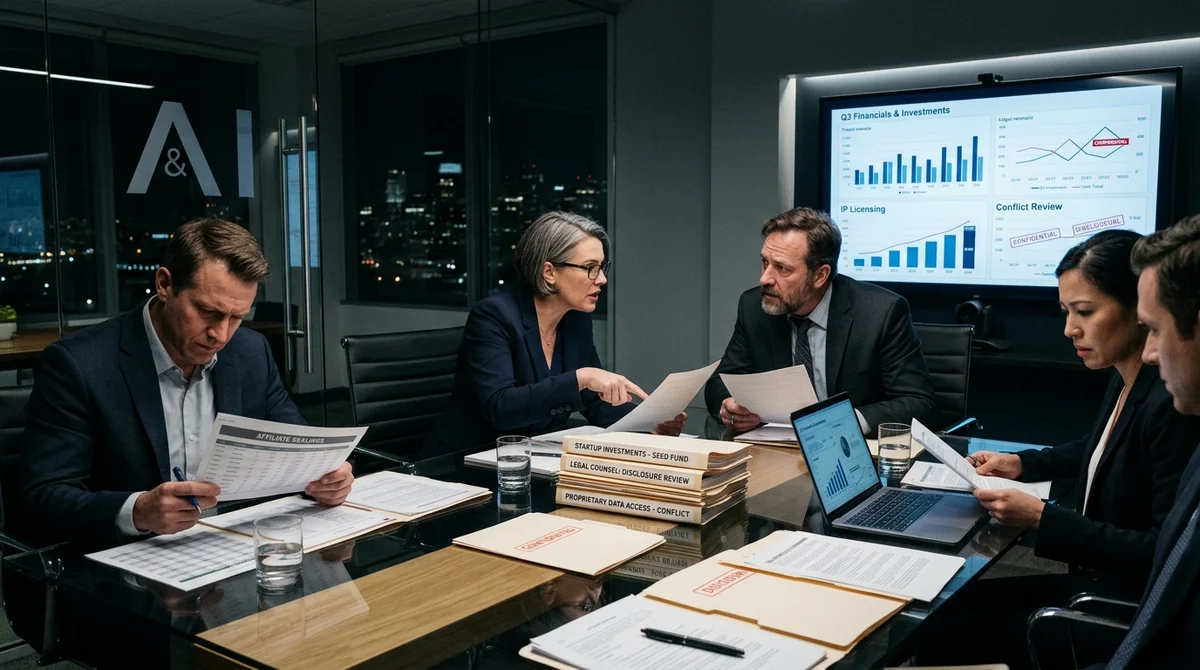
OpenAI's preparation for a possible IPO has brought back an old vulnerability: the line between the startup's interests and the personal interests of its chief executive. According to The Wall Street Journal, in recent months Sam Altman has tried to advance ideas under which OpenAI's money or influence could help projects tied to his investments and personal ambitions.
For investors, the topic is sensitive right now. If OpenAI really does move closer to a public offering in 2026, the market will need more than a story of rapid growth; it will need a clear corporate governance system. In such cases, investors look closely at how management handles capital, whether it has side interests, and whether the board is sufficiently independent.
Altman's unusual position complicates matters: he holds no equity in OpenAI, yet retains very broad influence over strategic decisions. His official compensation as CEO for 2024 was reportedly just $66,000, and most of his wealth comes from numerous outside investments.
The most prominent episode involves Helion, an energy startup working on commercial nuclear fusion. Altman is widely considered its largest investor and put $375 million into the company back in 2021, calling it one of the most important projects of his life after OpenAI. When Helion needed a new funding round, a deal of roughly $1 billion at a valuation of about $35 billion was discussed. According to the report, Altman wanted to cover almost half of that amount not only with his own money but also with OpenAI funds.
Inside the company, the idea got a cool reception: some executives doubted both the technology itself and whether such an investment served OpenAI's interests. In the end the scheme did not go through, although the parties did agree on a long-term purchase of up to 50 gigawatts of electricity by 2035. Last month Altman left Helion's board to reduce the obvious conflict of interest. Without OpenAI's backing, Helion is now reportedly counting on a far more modest round of about $250 million at a $15 billion valuation.
Similar logic ran through other initiatives. Altman reportedly tried to draw OpenAI resources into supporting Merge Labs, a brain-implant startup that can be seen as a potential competitor to Neuralink. Another example is the aerospace company Stoke Space. Last summer, the possibility was discussed of buying a large block of its shares, or even acquiring the company, using OpenAI resources. In the end, the Altman-linked fund Hydrazine became an investor in Stoke Space, and the idea itself, including talk of data centers in space, won no support inside OpenAI. Altman later called the concept of orbital data centers unserious himself.
Against this backdrop, OpenAI began reviewing its priorities noticeably more strictly. After Fidji Simo became chief product officer, the company reportedly focused more on building a universal AI product for mass-market and enterprise use, while some of the more controversial initiatives were postponed or frozen. Among them, notably, are the Sora video generator and the discussed "adult mode" for ChatGPT. The logic is simple: the closer a company gets to an IPO, the less room it has for expensive, poorly explained experiments, especially if they overlap with the personal interests of top management.
The story is sensitive also because conflicts of interest around Altman have come up before. Before OpenAI he led Y Combinator and built a huge investment portfolio across hundreds of startups. Some of those companies later struck deals with OpenAI, which inevitably raised questions about where company strategy ends and the executive's personal gain begins. According to the report, the opacity of his asset structure persists: even inside OpenAI, people cannot always say precisely how individual decisions intersect with his outside interests.
It is no coincidence that such concerns were cited among the reasons for Altman's temporary removal in November 2023. After his return, the board created a special conflicts-of-interest committee, but there has been almost no public reporting on its work since.
The main takeaway for the market is not that the head of a tech company should never have outside investments. The question is different: can OpenAI convincingly show that decisions on allocating money are made in the company's interest, not under the influence of its CEO's personal bets? If OpenAI really wants to go public, it will have to prove this not with promises but with transparent rules, independent oversight and clear capital discipline.
- Nov 2, 2026Arca gives AI agents finance tasks lasting up to 10 days, but leaves the trades to humans
- Nov 2, 2026Meta's Muse assistant keeps dossiers on loved ones and gets root on Ubuntu by default
- Nov 1, 2026Local models lose to Opus and Codex: 0.21 on a MacBook versus 1.00 for Codex
- Nov 1, 2026Kimi scores 96.2% on a 1C database analytics test and emerges as a fallback if Claude access is blocked
Ship AI Faster with Founders, Engineers & Weekly Architecture Reviews
Inside Vibe Club (hamidun.com/club) — weekly live masterminds with Zhemal Khamidun, Tech Radar, full LMS access, and 370+ production Claude Code skills.
The AI world, distilled — once a week
Seven stories that actually mattered, hand-picked. No noise, no reposts, no press releases.
Done! Check your inbox for a confirmation.