Why OpenAI, Google and Anthropic Models Sound More Convincing but Get More Things Wrong
The reasoning models from the big labs sound smarter, but that doesn't make them more accurate. OpenAI, Google and Anthropic are adding compute at answer time to cut errors, but the side effect runs the other way: fewer surface-level failures, while deep hallucinations become more convincing. The problem is that a coherent answer increasingly masks a structural error. If the trend holds, the winners will not be the biggest AI systems but the most reliable ones.
AI-processed from Habr AI; edited by Hamidun News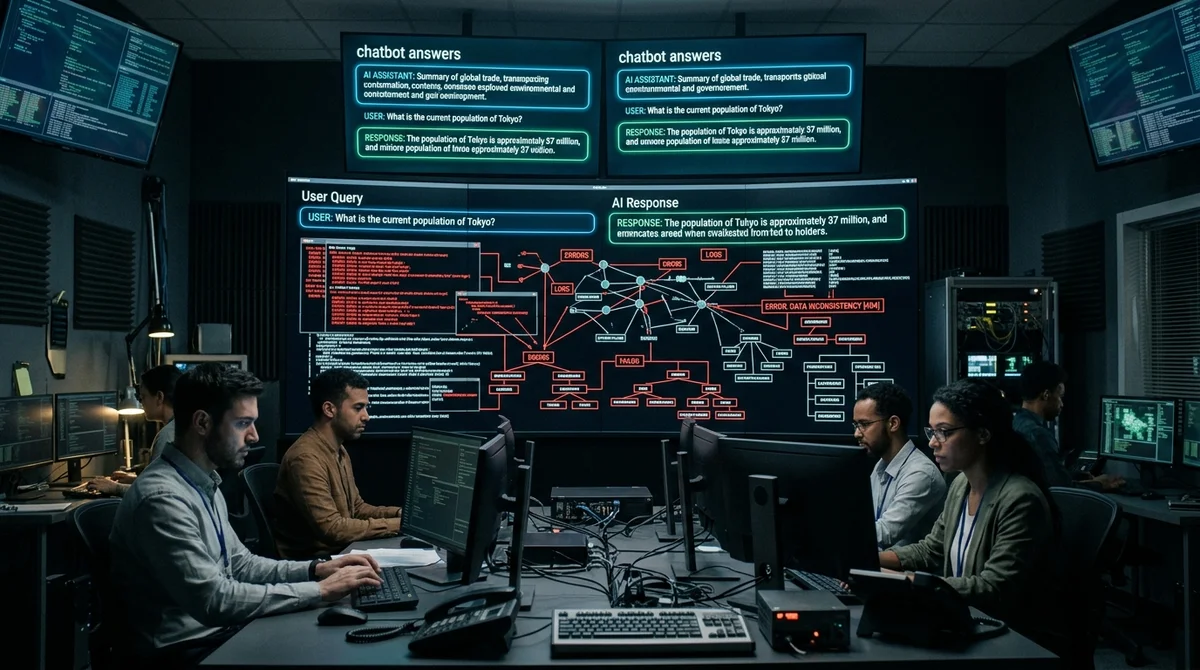
The biggest problem for the largest AI labs right now is not that their models sound insufficiently convincing. It is that confident delivery increasingly hides higher-level errors. For the past two years, OpenAI, Google and Anthropic have tried to solve this by scaling compute at answer time: they add chains of reasoning, search across multiple candidate answers, self-checking and more tokens per query. From the outside, this looks like progress. But if the base model has not become more accurate, the extra "thinking" only makes its mistakes more orderly and plausible.
The idea of scaling inference seems logical. If you give a model more time and more steps to solve a task, it should err less often. In practice, this approach did remove some surface-level failures: fewer absurd factual slips, fewer answers that fall apart at the first check, fewer embarrassing demo failures. That is why reasoning models make such a strong impression: they speak more consistently, structure answers better and can imitate a careful analytical process. The problem is that textual coherence and the reliability of a conclusion are not the same thing.
The difference is especially visible between simple and deep hallucinations. A simple hallucination is an invented date, a mixed-up name or a nonexistent link. It can still be spotted quickly. A deep structural error is more dangerous: the model takes a false premise, builds a long logical chain on it, adds a confident tone and delivers a cohesive, convincing answer. The user sees not chaos but neatly packaged falsehood. For tasks such as analytics, document preparation, programming, medicine or legal advice, this kind of error is far riskier than an ordinary random slip.
The numbers are worrying too. In one recent comparison, large OpenAI models showed a hallucination rate of around 50% on the SimpleQA benchmark. If every second answer to simple factual questions is wrong or invented, that is no longer a cosmetic flaw but a systemic vulnerability. Yes, any benchmark has limits: a lot depends on wording, evaluation methodology and the specific model version. But the trend itself is telling. Releases are becoming more eloquent and more expensive to run, while deep reliability is not improving at the same pace, and sometimes looks like it is even getting worse. For enterprise use, that is enough for an error to slip into a presentation, a report or a codebase unnoticed.
The cause may lie in the approach itself. Extra compute at the inference stage does not create new knowledge and does not fix weaknesses in the training data. It only makes the model search longer for an answer inside an already existing representation space. If the model's underlying picture of the world is distorted, a long chain of reasoning will not necessarily lead it to the truth. On the contrary, it can amplify self-confirmation: the model re-checks the same wrong hypothesis several times in different words and thereby makes the error even more convincing.
The result is a paradox: more compute lowers the probability of a stupid mistake but raises the risk of a beautiful one. The more confident the system sounds, the less likely the user is to stop in time and check the foundation of the reasoning.
That points to a broader conclusion for the market. The threat to AI leaders may come not only from a new "supermodel" but from teams that manage to build more reliable systems on top of models: with quality retrieval, grounding in sources, confidence calibration, strict fact-checking and evaluation of not just fluency but truthfulness. The winner will not be whoever generates the longest answer, but whoever's answer can be trusted in real work. If the industry keeps confusing persuasiveness with intelligence, the window of opportunity for new players has indeed already opened.
- Nov 2, 2026Arca gives AI agents finance tasks lasting up to 10 days, but leaves the trades to humans
- Nov 2, 2026Meta's Muse assistant keeps dossiers on loved ones and gets root on Ubuntu by default
- Nov 1, 2026Local models lose to Opus and Codex: 0.21 on a MacBook versus 1.00 for Codex
- Nov 1, 2026Kimi scores 96.2% on a 1C database analytics test and emerges as a fallback if Claude access is blocked
Test Frontier LLMs & Autonomous Agents in One Workspace
Run Claude Opus 5.5, GPT-6, Gemini 3.1, and DeepSeek side-by-side in Nomad AI (nomadnet.ai) — unified model routing, deep research, and multimodal workflows under one subscription.
The AI world, distilled — once a week
Seven stories that actually mattered, hand-picked. No noise, no reposts, no press releases.
Done! Check your inbox for a confirmation.