Anthropic updates Claude Code with Routines, parallel sessions and autonomous tasks on Mac
Anthropic has updated Claude Code with Routines for recurring tasks and a new desktop interface that supports parallel sessions. Automations can be triggered on a schedule, through an API or by GitHub events, and they run on Anthropic's side even when the user's computer is offline. The app also gains a built-in terminal, a file editor, and HTML and PDF preview.
AI-processed from 3DNews AI; edited by Hamidun News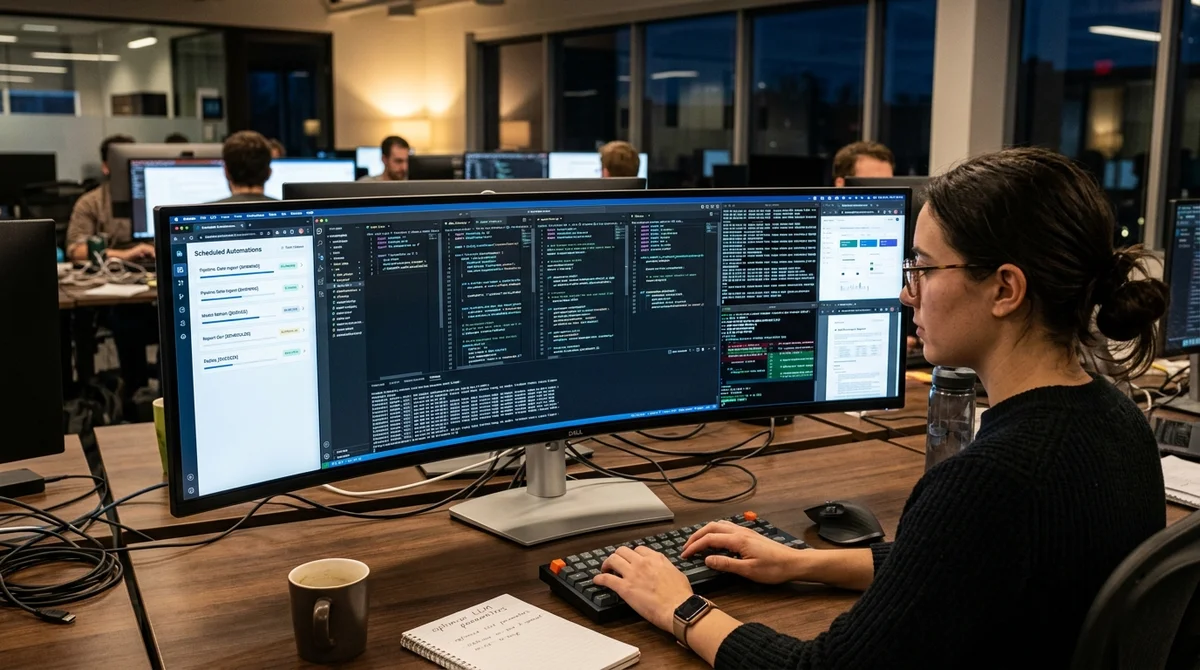
On April 14, 2026, Anthropic announced two major Claude Code updates at once: it added Routines for recurring tasks and completely redesigned the desktop interface. The core idea is simple: Claude Code is gradually shifting from an assistant for one-off requests into a tool that is always running, one that can launch agentic workflows on a schedule, react to events and handle several work sessions in parallel.
The new Routines feature is launched as a research preview, meaning an early-access release for experimentation. In essence, these are saved Claude Code automations: the user defines a prompt once and connects a repository and the necessary connectors, after which the workflow can be triggered on a schedule, through an API call or by an event.
An important shift is that these tasks run not on the local computer but on Anthropic's web infrastructure. That means a laptop does not have to stay on, and the team no longer needs to maintain cron jobs, trigger plumbing and some of the supporting infrastructure separately.
The company also cites fairly practical use cases. Routines can be used for regular backlog work, nightly triage of new bugs and drafting pull requests, for API workflows, deployment checks, alert analysis and automated code review. Anthropic is placing a particular bet on GitHub scenarios: a routine can be triggered by repository events, open a new session for every matching pull request and keep working as comments arrive or CI runs fail. In other words, this is no longer just a "scheduled request to a model" but an always-available agent built into a team's engineering workflow.
Access comes with subscription limits. Pro users can run up to five routines per day, Max users up to fifteen, and Team and Enterprise users up to twenty-five. These runs consume subscription limits in the same way as regular interactive sessions, and users can buy extra usage beyond the daily limit. This approach shows that Anthropic is not yet positioning Routines as a fully unlimited background orchestrator, but rather as a managed automation layer on top of the existing Claude Code.
At the same time, Anthropic has updated the desktop client itself. The new interface adds a sidebar for managing several active and recent sessions, so you can now keep multiple tasks in one window: for example, a refactor in one project, debugging in another and test generation in a third. The app now includes a built-in terminal, a file editor, faster diff viewing, and HTML and PDF preview. The workspace is customizable: panes can be dragged and arranged to fit your workflow. The idea is the same as with Routines: Claude Code is increasingly being adapted not for a single chat but for a mode in which a developer orchestrates several streams of agentic work at once.
The update fits into Anthropic's broader direction. In March, the company added auto mode, which lets Claude Code work with a greater degree of autonomy within predefined boundaries, and in early April it expanded the enterprise capabilities of Claude Cowork. Against that backdrop, the Routines release and the desktop redesign look less like isolated cosmetic improvements and more like the steady assembly of a single working environment in which Claude can carry out tasks on request, act in a semi-autonomous mode and plug into team processes through repositories, connectors and remote events.
This is an important signal for the AI tools market. Competition among coding assistants is shifting from the quality of a single answer to a system's ability to fit into real team processes: living next to repositories, connecting to GitHub, working on events and not requiring constant manual launches. If Anthropic can maintain the reliability and transparency of such automations, Claude Code will be seen no longer as a convenient CLI add-on but as a full environment for semi-autonomous development.
- Nov 2, 2026Karpathy builds a YouTube clone with 6454 videos from Hacker News recommendations in two hours
- Nov 2, 2026Karpathy used Claude to build HackerTube from 6,454 videos recommended on Hacker News
- Nov 2, 2026Arca gives AI agents finance tasks lasting up to 10 days, but leaves the trades to humans
- Nov 2, 2026Anthropic needs to grow revenue 32% a year to cover $850 billion in contracts
Build & Ship Production AI Agents Without Boilerplate Code
Start your free 72-hour trial at Hamidun Academy (academy.hamidun.com) — interactive lessons on Claude Code & Cursor, live Tech Radar, and production agent templates.
The AI world, distilled — once a week
Seven stories that actually mattered, hand-picked. No noise, no reposts, no press releases.
Done! Check your inbox for a confirmation.