How a Habr author turned seven n8n workflows into an autonomous AI news system
A developer has shown how, in about six weeks, he replaced a fragile news pipeline built on seven n8n workflows with a nearly autonomous AI system. Instead of manual oversight, it now runs on 11 workers, 5 agents, a local LLM and a Telegram orchestrator. The database already holds 7127 records, and the system pulls from 160 unique sources without constant intervention. The core idea is to move away from a pile of disconnected automations toward one managed system that you can assign tasks to directly in a chat.
AI-processed from Habr AI; edited by Hamidun News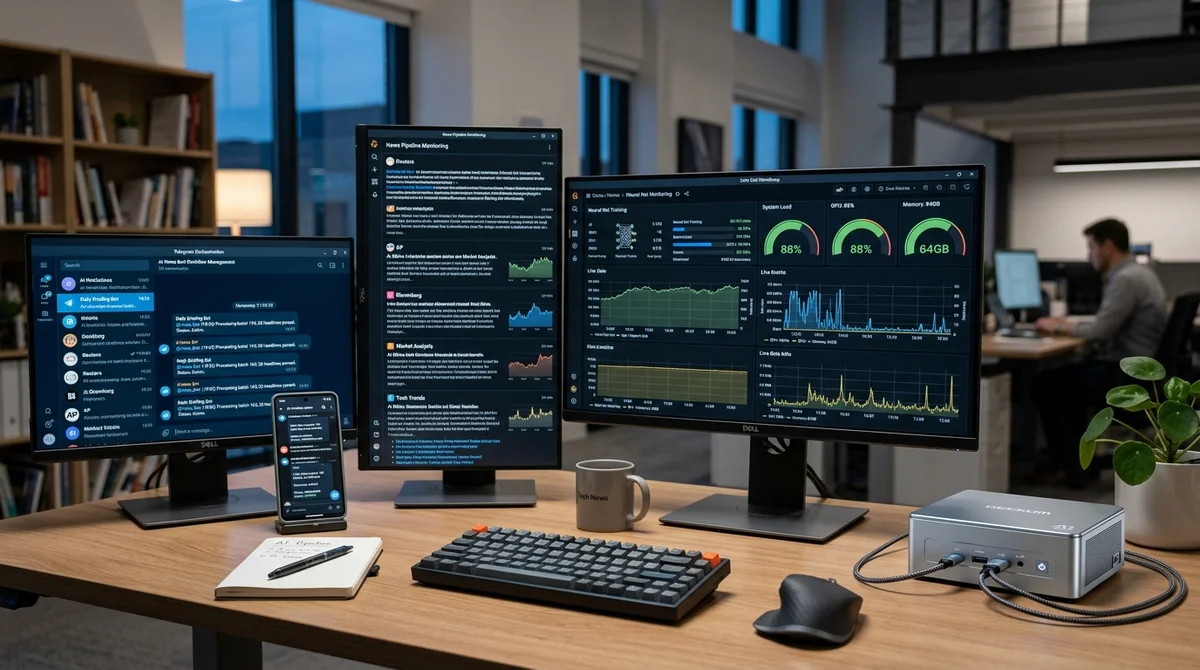
The story shows how a fragile no-code setup can grow into a full editorial system in a few weeks. The author dropped seven separate n8n workflows and built a single Python pipeline that collects, filters, translates, formats and publishes AI news with almost no manual involvement.
The starting point was classic automation chaos. Each n8n workflow handled one stage: news collection, duplicate cleanup, translation, image preparation and publishing. Formally, everything worked, but any error turned into a long hunt for the fault. One workflow could finish "successfully" and produce nothing, and the whole chain would collapse. At some point the author realized the main problem was not the individual functions but the architecture: seven processes meant seven different points of failure and almost zero observability.
He built the new version as a single project. By his account, AI tools sped up the transition: Cursor helped set up the home mini-PC and local infrastructure, Perplexity helped him discuss architectural decisions, and Claude Code helped port the set of workflows to Python and deploy a containerized service.
The result is a pipeline in which 11 workers each do one job. The basic chain looks like this: collector gathers data from the RSS feeds and APIs of roughly 160 sources every 15 minutes, scraper fetches the full text, deduplicator removes semantic duplicates, ai_filter scores relevance, translator translates materials into Russian, llm_editor brings texts into the required style, image_worker finds or generates illustrations, and publisher releases posts on a schedule. Background processes additionally handle GitHub repository discovery, video work and manual moderation.
The local model gets special emphasis. Instead of paying ongoing cloud API costs for translation, the author moved this task to a home mini-PC running Qwen 3.5 through llama.cpp, optimized for Vulkan. This solved two problems at once: it lowered the cost of processing a large volume of news and kept the data inside his own infrastructure.
According to current figures, the system has accumulated 7127 records in its database, and the weekly incoming stream reaches roughly 1000 items. The output, however, is not an endless feed: after filtering by relevance_score, editorial review and slot allocation, only eight posts a day are published. In the author's words, this proved more effective than the earlier 28 posts per day, when the audience saw too much noise and ignored most of the channel.
Another important layer is agent orchestration. Publishing decisions and operational settings live in OpenClaw, where a coordinator and several other AI agents work: an editor, a pipeline manager, a source auditor and an analyst. You can simply message the coordinator in Telegram, for example asking it to lower the daily publication limit, and it calls the API, changes the configuration and confirms the result.
A full dashboard has grown around this. It shows worker statuses, each news item's progress through the stages, source effectiveness, queues, the slot schedule and published materials. This level of transparency makes it quick to see exactly where content got stuck and which sources should be switched off. For example, in the very first week it became clear that about 20 sources provided no useful signal, and the pass rate helps separate noisy sources from truly valuable ones.
The main takeaway is not that no-code is bad and Python is good. It is rather an example of how fast the barrier to entry for complex AI systems is changing. The author does not write code himself, yet he managed to build a working product by setting tasks, checking solutions and steering the architecture. The combination of AI coding, local LLMs, cheap home infrastructure and clear orchestration turns a personal news project into a nearly autonomous newsroom. For independent media and niche channels, this is a signal: value now comes not from automation itself, but from the quality of selection, the observability of the system and the ability to assemble a sturdy pipeline from available tools.
- Nov 2, 2026Karpathy builds a YouTube clone with 6454 videos from Hacker News recommendations in two hours
- Nov 2, 2026Karpathy used Claude to build HackerTube from 6,454 videos recommended on Hacker News
- Nov 2, 2026Arca gives AI agents finance tasks lasting up to 10 days, but leaves the trades to humans
- Nov 2, 2026DeepSeek open-sources Super-agent prototype: p95 task completion time of 15.7 minutes vs. 29.5
Test Frontier LLMs & Autonomous Agents in One Workspace
Run Claude Opus 5.5, GPT-6, Gemini 3.1, and DeepSeek side-by-side in Nomad AI (nomadnet.ai) — unified model routing, deep research, and multimodal workflows under one subscription.
The AI world, distilled — once a week
Seven stories that actually mattered, hand-picked. No noise, no reposts, no press releases.
Done! Check your inbox for a confirmation.