Anthropic, OpenAI and LangChain explain why AI agents need a harness
Major AI companies increasingly compete less on models alone and more on the quality of their agent harness. Orchestration, memory, context control and reliable tool execution are what turn an LLM from a demo bot into a working agent. Tellingly, LangChain climbed sharply in TerminalBench 2.0 by improving not the model weights but the infrastructure around the model. That changes the rules for product teams.
AI-processed from Habr AI; edited by Hamidun News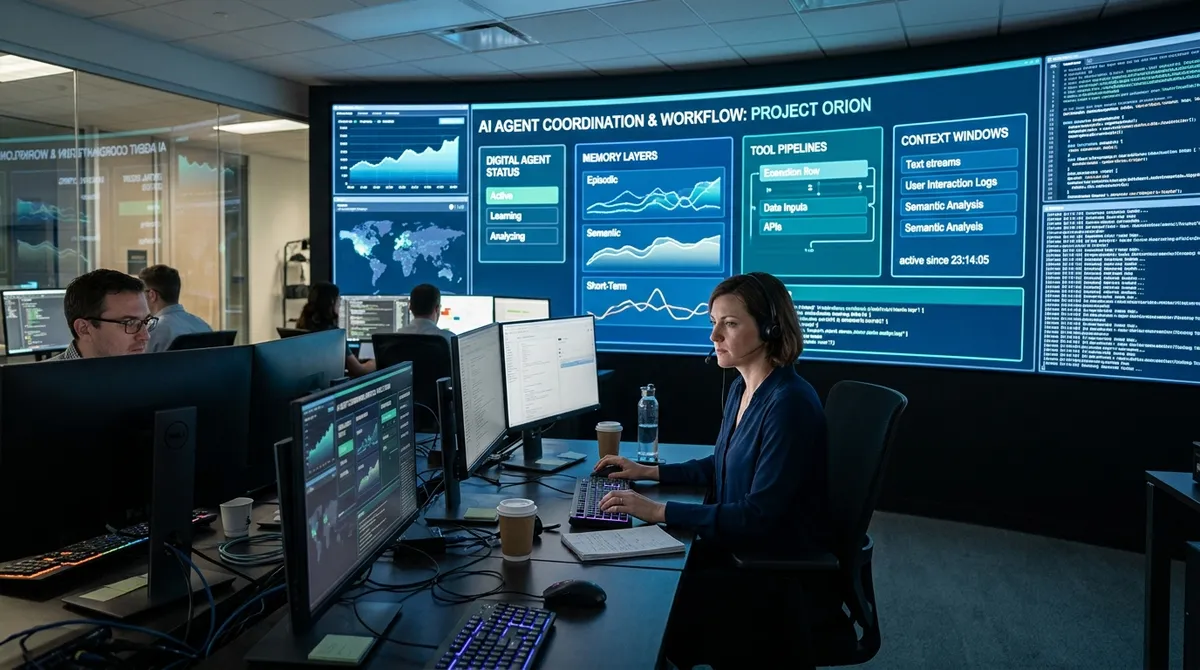
The main problem with today's AI agents is not the quality of the base model but the layer around it: orchestration, memory, context management and reliable tool execution. This layer, increasingly called the agent harness, turns a stateless LLM from an impressive demo into a system that can run long chains of actions consistently, survive errors and carry a task through to a result.
Early on, many teams settle for a chat interface, a few tool calls and a simple ReAct loop. That is enough for a prototype: the model reasons, picks a tool, gets a response and continues the dialogue. But in production, systemic failures surface quickly.
The agent forgets what it did two or three steps back, repeats the same calls, loses intermediate results, and the context window fills with random noise. Tools are a separate problem: they can return an unexpected format, respond slowly or fail for no clear reason. Without a layer of control, logging and recovery on top, the quality of the system is determined not by the model's intelligence but by the fragility of the wiring around it.
That is why major players such as Anthropic, OpenAI, Perplexity and LangChain are building not just new models but full-fledged agent infrastructure. At the center of that infrastructure is the orchestration loop. It decides when the model needs to think again, when to call a tool, what to save to memory, what to return to the user and when to stop. In effect, the harness acts as an operating system for the agent. It sets the execution rules, tracks session state, routes actions between the model and external services, and lowers the chance that the agent spirals into an endless loop or loses sight of the task's goal.
Several components of this approach can already be considered mandatory. First, tool management: interface descriptions, input validation, retries, timeouts and error handling. Second, memory in several layers: short-term for the current task, working memory for intermediate results, and longer-term memory for preferences, rules and accumulated experience. Third, context control: selecting the fragments that really matter, compressing history, removing junk and passing the model only what affects the next step. Without these mechanisms, even a strong LLM degrades as the task grows longer. With them, the same model works noticeably more reliably.
Another important layer of the harness covers observability and quality evaluation. It is not enough for a developer to know that an answer was bad; they need to see the agent's entire route: which prompt went to the model, which tool was called, what response came back, where the error occurred and why the next step was chosen. Without this, it is impossible to debug an agent's behavior properly or improve the system iteratively. That is why mature stacks add tracing, metrics, sandboxed execution, manual checkpoints and human-in-the-loop mechanisms for risky actions.
The practical effect is telling. The source material cites a LangChain example: the company improved not the model weights but the infrastructure around the model, and that was enough to jump sharply in TerminalBench 2.0, from a position outside the top thirty to fifth place. Another result is even more interesting: in a research project, an LLM was used to optimize its own agent infrastructure, and the system reached a 76.4% pass rate, outperforming hand-built solutions.
This is an important signal for the market. Competition is shifting from the question of "which model is smarter" to "which execution environment best helps the model think, remember, plan and correct itself." For developers and product teams, the conclusion is straightforward: if you want a working agent rather than a toy bot, you need to invest not only in choosing a model but also in the harness. The winners will be those who better organize the execution loop, memory, context, observability and fault tolerance. In the near term, the quality of this harness, rather than the next jump in benchmarks, will be the main difference between a pretty demo and a system you can trust with real work.
- Nov 2, 2026Meta's Muse assistant keeps dossiers on loved ones and gets root on Ubuntu by default
- Nov 1, 2026Local models lose to Opus and Codex: 0.21 on a MacBook versus 1.00 for Codex
- Nov 1, 2026Kimi scores 96.2% on a 1C database analytics test and emerges as a fallback if Claude access is blocked
- Nov 1, 2026OpenAI Rewrites GPT Behavior Rules: Five Values and a Chain of Command
Test Frontier LLMs & Autonomous Agents in One Workspace
Run Claude Opus 5.5, GPT-6, Gemini 3.1, and DeepSeek side-by-side in Nomad AI (nomadnet.ai) — unified model routing, deep research, and multimodal workflows under one subscription.
The AI world, distilled — once a week
Seven stories that actually mattered, hand-picked. No noise, no reposts, no press releases.
Done! Check your inbox for a confirmation.