Foxconn's quarterly revenue jumps nearly 30% on demand for Nvidia AI servers
Foxconn ended the first quarter with revenue of $66.5 billion, up 29.7% from a year earlier. One of the main growth drivers is demand for server components for Nvidia systems, where the Taiwanese company has become the largest contract manufacturer. The figure nearly matched market expectations and confirms that AI infrastructure remains one of the hottest areas in electronics.
AI-processed from 3DNews AI; edited by Hamidun News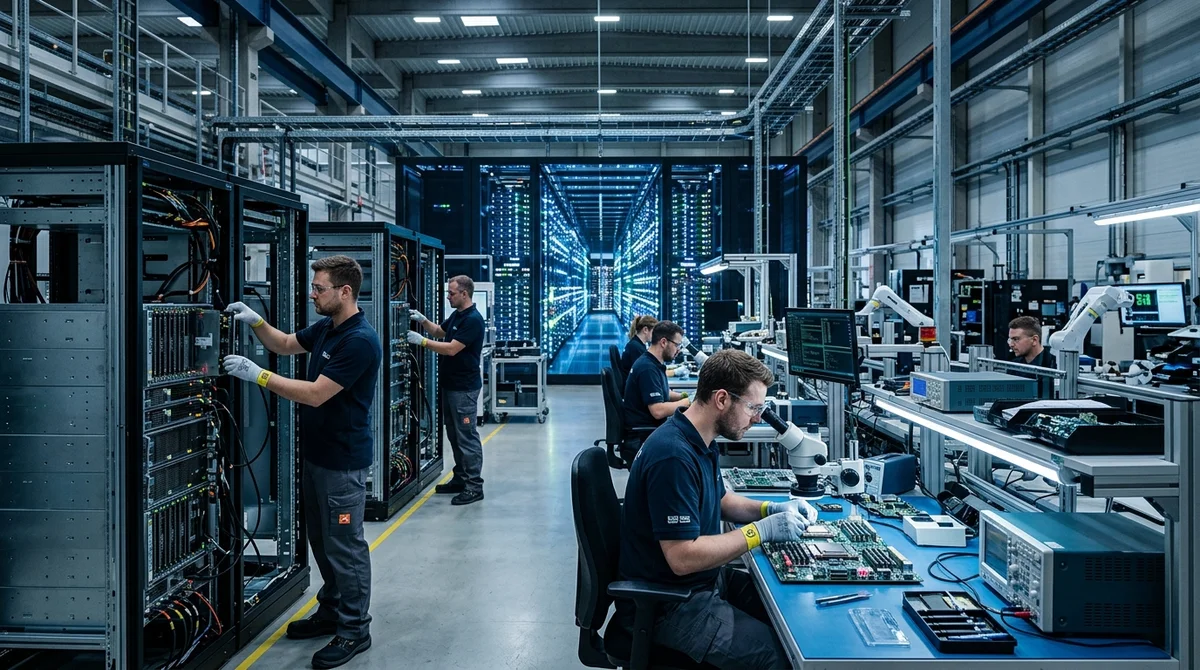
Foxconn closed the first quarter with strong revenue growth, showing how quickly AI is reshuffling the balance of power in electronics manufacturing. The Taiwanese company said its quarterly revenue rose 29.7% to $66.5 billion. For the market, it is an important signal: one of the world's largest contract manufacturers is winning more and more not only in consumer electronics, but also in infrastructure for artificial intelligence.
The key driver is the server business tied to Nvidia hardware. Over the past few years, Foxconn has built particularly strong positions here and become the largest contract manufacturer of server components for Nvidia solutions. Amid the generative AI boom, these shipments have become one of the fastest-growing segments of the entire semiconductor and server supply chain. As big tech companies ramp up spending on data centers and accelerators, the winners include not only chip designers but also manufacturing partners able to scale production of complex hardware quickly.
The $66.5 billion figure nearly matched market expectations, which lowers the risk that such sharp growth turns out to be a one-off spike. For investors and partners, what matters is not only the growth itself but its quality: when a company reports results close to forecasts, it usually means demand is already built into production plans and the supply chain is running without serious disruptions. For Foxconn this is especially important, because the company operates at the intersection of several sensitive markets, from consumer electronics assembly to server infrastructure for the largest AI platforms. Foxconn's quarterly results are increasingly read as an indirect indicator of the health of the entire AI hardware ecosystem.
For Foxconn itself, the quarter confirms that its bet on AI infrastructure is starting to deliver a systemic effect. Historically, the company is best known as a contract assembly giant, primarily in mass-market devices. But demand for smartphones and other consumer gadgets tends to be cyclical and depends more heavily on end-market sentiment. AI servers, by contrast, are currently fed by a long investment cycle: cloud providers, model developers and enterprise customers keep buying computing capacity, because competition in generative AI demands ever more accelerators, racks, cooling systems and related electronics.
Foxconn's growth also points to a broader shift in the industry. The AI boom is creating a new hierarchy of value: the focus is no longer only on those who design chips, but also on those who can turn them into finished server solutions at industrial volumes. This is where the role of contract manufacturers grows sharply. As long as demand for Nvidia accelerators stays high, companies like Foxconn get a steady flow of orders for components and assembly, and with it the chance to strengthen their negotiating position in the supply chain and invest in expanding capacity.
Still, the current result is more a confirmation of a trend than a finish line. The market will watch whether Foxconn can hold this pace in coming quarters without running into constraints on components, logistics and production resources. Just as important is how the revenue mix evolves: if the share of AI servers keeps growing, the company could further reduce its dependence on more mature and volatile electronics segments.
The main takeaway is simple: the AI boom is showing up increasingly not only in chip designers' reports but also in the numbers of their manufacturing partners. Foxconn's results show that the infrastructure side of the AI market remains extremely hot, and the supply chain around Nvidia is already bringing large contract manufacturers tens of billions of dollars in revenue.
- Nov 2, 2026Anthropic needs to grow revenue 32% a year to cover $850 billion in contracts
- Nov 2, 2026TensorFold 1.2.0 boosts Qwen3.8-27B throughput on M3 Ultra by 44.2% at 16 streams
- Nov 1, 2026Local models lose to Opus and Codex: 0.21 on a MacBook versus 1.00 for Codex
- Nov 1, 2026Habr author fine-tunes YOLOv8l on dental X-rays and pushes mAP50 to 0.642
Test Frontier LLMs & Autonomous Agents in One Workspace
Run Claude Opus 5.5, GPT-6, Gemini 3.1, and DeepSeek side-by-side in Nomad AI (nomadnet.ai) — unified model routing, deep research, and multimodal workflows under one subscription.
The AI world, distilled — once a week
Seven stories that actually mattered, hand-picked. No noise, no reposts, no press releases.
Done! Check your inbox for a confirmation.