Japan Airlines Brings Humanoid Baggage Robots to Haneda Airport to Ease Labor Shortage
Starting in May, Japan Airlines is running a pilot project in which humanoid robots will work in the baggage handling area of Tokyo's Haneda Airport. The experiment comes amid a chronic labor shortage in Japan and a sharp rise in inbound tourism. The new "employees" will need regular breaks to recharge, but the airline is already considering permanent deployment as a systemic fix for its staffing problem.
AI-processed from Guardian; edited by Hamidun News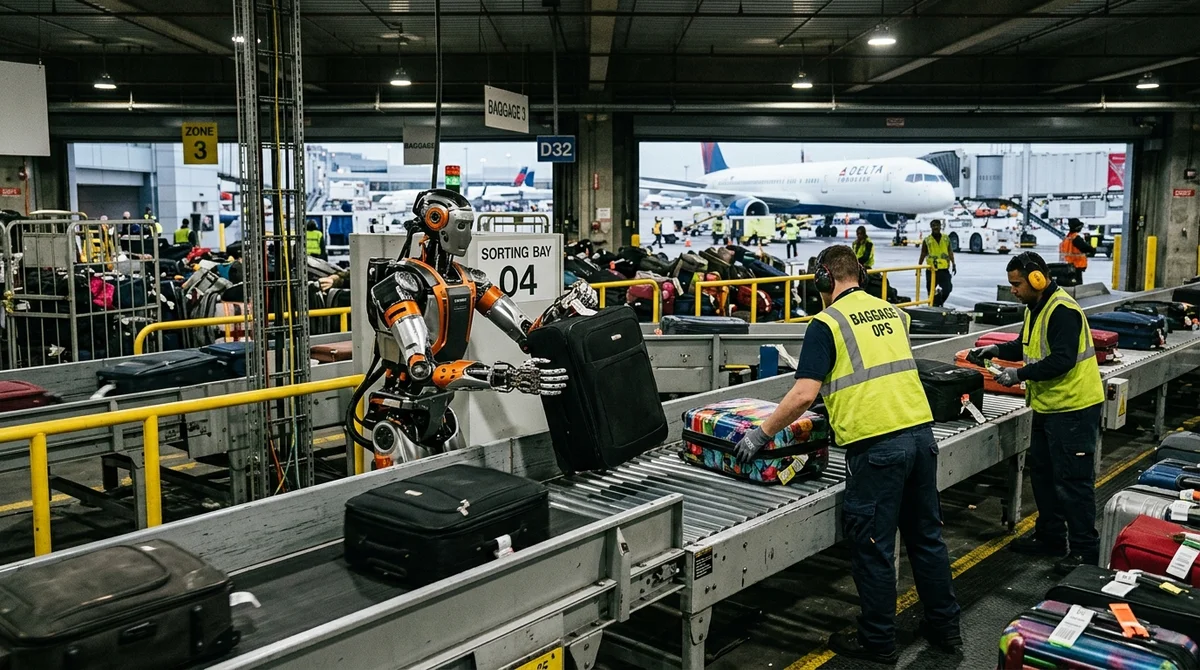
From early May, Japan Airlines is launching a pilot project with humanoid robots in the baggage handling area of Tokyo's Haneda Airport. The airline sees it as a first step toward permanent deployment of humanoid machines, in response to one of the most acute structural problems in the Japanese economy.
Japan is taking a double hit. On one side, inbound tourism has surged and is straining airport infrastructure. The number of foreign tourists has been setting records in recent years: Japan's popularity has multiplied, partly because of the weak yen. Haneda and Narita cannot cope with the flow, and queues, delays and overloaded staff have become the norm. On the other side, a structural labor deficit has built up over decades because of an aging population and traditionally low immigration. The country is losing working-age citizens faster than it can adapt.
Baggage handlers are among the most vulnerable professions. The work is physically demanding, done in shifts, in cramped technical areas, and is not especially attractive in terms of pay. Young people increasingly avoid such jobs, and Japan is not yet ready to fill the gap with foreign workers on the necessary scale: it is a politically sensitive topic.
Japan Airlines, one of the country's two flagship carriers, decided not to wait for a demographic reversal and bet on technology. The robots arriving at Haneda in May are humanoid machines able to perform tasks that traditionally require hands and legs: moving suitcases, loading and unloading carts, and working in a space originally designed for people. The humanoid form has a practical purpose here: such robots fit into existing infrastructure without costly rebuilding.
The pilot launches with clear limitations. The robots need regular breaks to recharge, and their battery life is still measured in hours rather than full shifts. The airline does not aim to replace all employees: the robot is meant as an assistant that takes over the most monotonous and physically taxing operations while humans handle tasks that require judgment, communication and non-standard decisions. If the experiment proves viable, Japan Airlines will consider permanent deployment of the robots as a long-term solution to its staffing problem.
Haneda is one of the busiest airports in the world. Even partial automation of baggage handling can reduce the load on staff and speed up aircraft turnaround at peak hours.
Japan as a whole is moving toward broad use of robots, out of necessity rather than love of technology. The country has led the world in industrial robot density in manufacturing for decades, and is now gradually carrying that experience into services. Restaurants, hotels, hospitals, shops: humanoid and specialized machines are appearing where there are physically not enough people, or where people do not want to work.
The Japan Airlines experiment is a signal not only for the Japanese industry. Staff shortages at airports are a global problem, familiar to Europe, the United States and the Gulf states. If baggage-handling robots prove reliable in real conditions, with peak-hour overloads, unusual suitcases and unplanned situations, the technology will gain a strong argument for scaling worldwide. Tokyo risks becoming not just a pioneer but also the one that sets a new operational standard for aviation.
Test Frontier LLMs & Autonomous Agents in One Workspace
Run Claude Opus 5.5, GPT-6, Gemini 3.1, and DeepSeek side-by-side in Nomad AI (nomadnet.ai) — unified model routing, deep research, and multimodal workflows under one subscription.
The AI world, distilled — once a week
Seven stories that actually mattered, hand-picked. No noise, no reposts, no press releases.
Done! Check your inbox for a confirmation.