Microsoft unveils three models for speech, voice and image generation
Microsoft AI has introduced three new models: MAI-Transcribe-1 for converting speech to text, MAI-Voice-1 for voice synthesis and MAI-Image-2 for image generation. The company is betting on its own multimodal infrastructure and promises competitive economics: transcription from $0.36 per hour and voice synthesis at $22 per million characters. All three solutions are already available in Microsoft Foundry.
AI-processed from 3DNews AI; edited by Hamidun News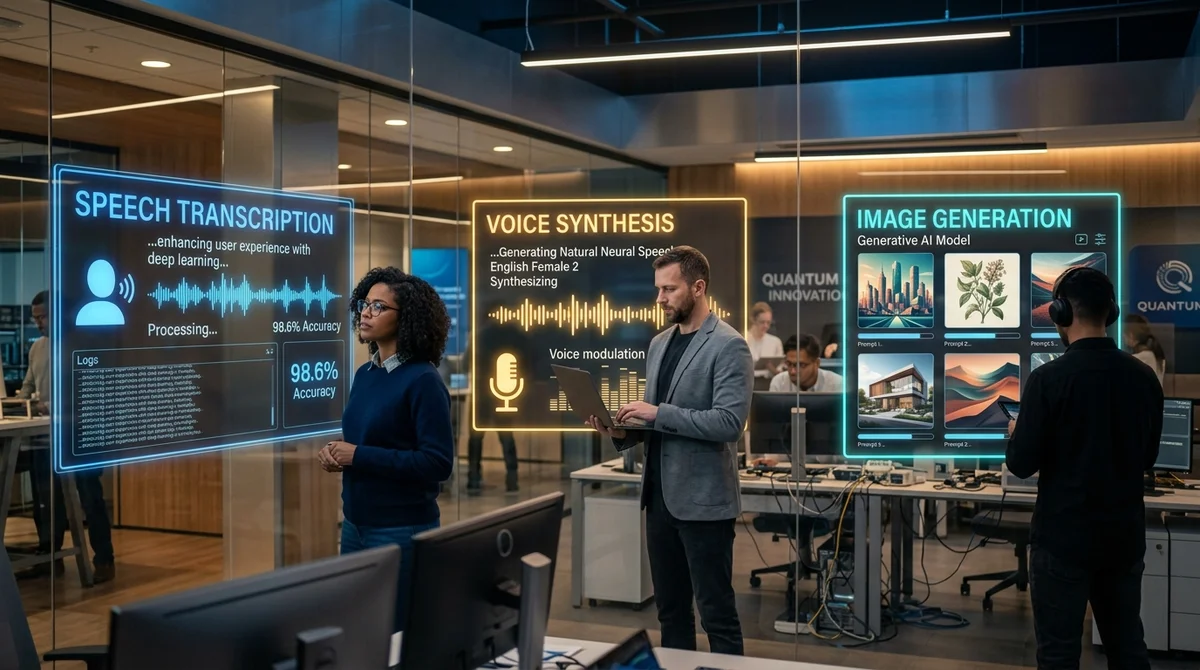
Microsoft AI is expanding its own lineup of generative services, signaling that it no longer wants to rely solely on partner models. The company's research division has launched three new products at once: MAI-Transcribe-1 for converting speech to text, MAI-Voice-1 for voice synthesis and MAI-Image-2 for generating images from text descriptions. For Microsoft, this is not just another launch but a claim to a more independent role in the race among AI platforms.
The new lineup covers several key scenarios in demand in enterprise products and cloud services. MAI-Transcribe-1 can convert speech to text in 25 languages and, according to Microsoft, runs 2.5 times faster than the Azure Fast service. That matters for call centers, meeting transcription, customer conversation analytics and real-time content localization. MAI-Voice-1 generates a one-minute audio track in roughly one second and supports voice customization for different tasks, from interface voiceovers to voice assistants and automated media production. MAI-Image-2 creates visual content from a text prompt, adding a full visual module to the text and voice features.
Launching three models at once shows that Microsoft is betting not on standalone demo products but on its own multimodal infrastructure. Inside the company, the work is led by the MAI Superintelligence team, which researches advanced AI systems. The division is headed by Mustafa Suleyman, who joined to strengthen Microsoft's AI efforts and build a more independent technology stack.
The logic is clear: with its own models for text, voice and images, the company gets more control over quality, speed, price and the pace of product development. For a corporation of this size it is also a matter of negotiating leverage: the less it depends on an outside model supplier, the more flexibly it can shape its product and cloud strategy.
Pricing gets special emphasis. Microsoft is trying to compete not only on quality but also on compute economics against alternatives from Google and OpenAI. Transcription pricing starts at $0.36 per hour. Speech synthesis is priced at $22 per 1 million characters. For image generation, the listed prices are $5 per 1 million input tokens and $33 per 1 million output tokens. This matters especially for businesses that count not only model capabilities but also the unit cost of each scenario, from call processing to automated media creation. If the stated figures hold up in practice, Microsoft will be able to pitch the new models as a working tool for mass-scale tasks, not just experimental ones.
All three models are already deployed on the Microsoft Foundry platform, and the transcription and speech synthesis models are also available in MAI Playground. That means the company did not stop at a research announcement but moved the models straight to practical use by developers and enterprise customers. This matters because the market has little interest in standalone lab demos: value emerges where a model can be quickly built into a product, tested on your own workload and costed out. Foundry and Playground cover exactly that path from announcement to deployment.
At the same time, Microsoft is not abandoning its partnership strategy. The company continues to work with OpenAI and keeps its multiyear contract, even though it has already invested more than $13 billion in the partner. In effect, Microsoft is building a diversified stack in which its own solutions complement partner ones rather than instantly replacing them. It resembles a strategy from the hardware business, where critical components are bought from several suppliers to reduce risk and avoid dependence on a single technology line.
The main takeaway is that Microsoft is reshaping its AI strategy toward greater autonomy. The company remains one of OpenAI's main allies, but it is now developing its own models and the infrastructure around them far more actively. For the market, it is a signal that competition among the big AI players will be fought not only over generation quality but also over speed, cost and depth of integration into workflows. For Microsoft customers, this most likely means a wider choice of tools within a single ecosystem and less dependence on a single model supplier.
- Nov 2, 2026Anthropic needs to grow revenue 32% a year to cover $850 billion in contracts
- Nov 2, 2026Microsoft releases 4B model Mage-VL-Cowork, which solves 66.0% of OSWorld-Verified tasks
- Nov 1, 2026Google's StreamVibe video agent beats other models by 10.7% on response timing and quality
- Oct 30, 2026Mistral opens Large 4 weights: strong at code, but Chinese models score 32 to its 26
Test Frontier LLMs & Autonomous Agents in One Workspace
Run Claude Opus 5.5, GPT-6, Gemini 3.1, and DeepSeek side-by-side in Nomad AI (nomadnet.ai) — unified model routing, deep research, and multimodal workflows under one subscription.
The AI world, distilled — once a week
Seven stories that actually mattered, hand-picked. No noise, no reposts, no press releases.
Done! Check your inbox for a confirmation.