Z.ai releases GLM-5V-Turbo, a natively multimodal model for visual programming
Z.ai (Zhipu AI) has released GLM-5V-Turbo, a multimodal model that turns images directly into code. Unlike typical VLMs, it doesn't just describe screenshots and diagrams: it generates working Python, TypeScript or SQL from them. The model is optimized for OpenClaw and built for agentic engineering pipelines, in which an AI writes code autonomously from visual artifacts.
AI-processed from MarkTechPost; edited by Hamidun News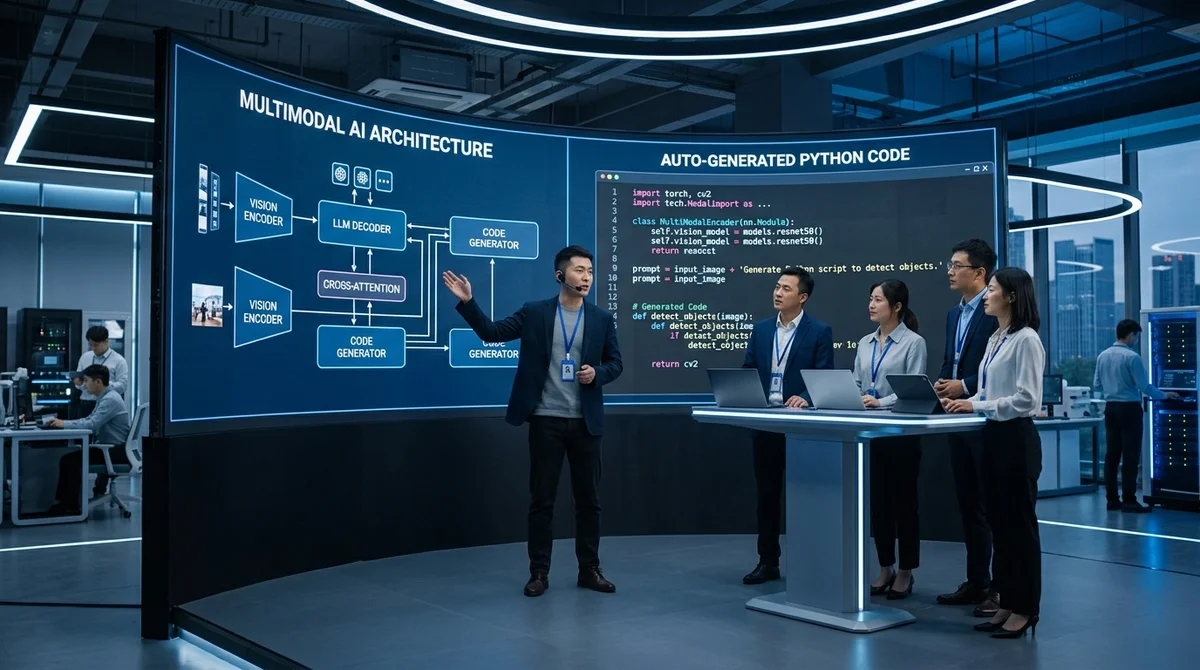
Zhipu AI, which operates under the Z.ai brand, has released GLM-5V-Turbo, a new class of model that combines computer vision and software engineering in a single native architecture. Unlike most multimodal systems, GLM-5V-Turbo doesn't just describe images: it can translate visual information directly into working code. The model is optimized for the OpenClaw platform and aimed at high-load agentic workflows in software engineering.
The problem with vision-language models
The traditional problem with vision-language models (VLMs) is the gap between perception and execution. Most such systems describe image contents well but struggle when they must turn visual context into the strict syntax of program code. This is a serious barrier to practical use of AI in development: an engineer cannot simply show a model a screenshot of a user interface, a database ERD or an architecture diagram and get working code back. The intermediate step, manually translating the visual into text, still fell to a human, which substantially reduced the value of multimodal systems in real engineering scenarios.
How GLM-5V-Turbo tackles it
GLM-5V-Turbo attacks the problem head-on. Architecturally, the model is designed to be natively multimodal: visual and text contexts are processed together, without intermediate decoding steps. This lets the system look at a diagram, a UI mockup or a data schema and immediately generate matching code, whether in Python, TypeScript, SQL or another language. The gap between "what is depicted" and "how to implement it" shrinks considerably, and the quality of the generated code is kept at a level suitable for real projects.
Agentic engineering pipelines
The key use case for GLM-5V-Turbo is agentic engineering pipelines. In such systems, an AI agent carries out a series of interdependent tasks: it analyzes requirements, designs the architecture, writes and verifies code, and iterates on test results. Multimodal input radically widens the range of tasks the agent can handle autonomously: instead of text descriptions, the engineer passes screenshots, wireframe prototypes, ERD diagrams or data charts, and gets code back rather than a retelling. GLM-5V-Turbo is positioned as a component of such pipelines, not as a standalone chat assistant for one-off queries.
Optimization for OpenClaw
The optimization for OpenClaw is a significant point in its own right. OpenClaw is infrastructure for running large language models in production, popular with teams that need low latency and high throughput. That Zhipu AI adapted GLM-5V-Turbo specifically for this platform points to a focus on enterprise deployment rather than academic benchmarks. For practicing engineers, this means the model was developed with the operational constraints of real systems in mind: requirements for speed, stability and scalability.
The race for multimodal coding models
The release of GLM-5V-Turbo fits into a broader race for multimodal coding models. In 2025–2026, leading labs, American, European and Chinese, declared multimodal coding a priority as the next frontier in AI capabilities. Chinese players, Zhipu AI among them, have steadily expanded their presence in this segment, offering models tightly integrated with their own infrastructure platforms.
This approach creates an ecosystem advantage: a model optimized for a specific stack performs better than a general-purpose solution deployed on the same hardware. For engineering teams, the arrival of GLM-5V-Turbo is another signal that the line between "seeing" and "doing" in AI is rapidly blurring. Systems that can take an architecture diagram as input and return ready-to-run code change the very process of designing software.
This is not just a better user experience; it is a potential rethink of the developer's workflow at every stage of the product lifecycle, from initial concept to deployment.
In brief:
- Zhipu AI (the Z.ai brand) has released GLM-5V-Turbo, a natively multimodal model that translates visual information directly into code.
- The model processes visual and text contexts together and generates code from a diagram, UI mockup or data schema.
- The key use case is agentic engineering pipelines; the model is optimized for the production platform OpenClaw.
- Nov 2, 2026DeepSeek open-sources Super-agent prototype: p95 task completion time of 15.7 minutes vs. 29.5
- Nov 2, 2026Bun creator uses Claude Code to port 750K lines from Zig to Rust in 11 days
- Nov 2, 2026Microsoft releases 4B model Mage-VL-Cowork, which solves 66.0% of OSWorld-Verified tasks
- Nov 2, 2026Meta's Muse assistant keeps dossiers on loved ones and gets root on Ubuntu by default
Key Questions Answered
What are the key details on The problem with vision-language models?
The traditional problem with vision-language models (VLMs) is the gap between perception and execution. Most such systems describe image contents well but struggle when they must turn visual context into the strict syntax of program code. This is a serious barrier to practical use of AI in development: an engineer cannot simply show a model a screenshot of a user interface, a database ERD or an architecture diagram and get working code back. The intermediate step, manually translating the visual into text, still fell to a human, which substantially reduced the value of mult
How GLM-5V-Turbo tackles it?
GLM-5V-Turbo attacks the problem head-on. Architecturally, the model is designed to be natively multimodal: visual and text contexts are processed together, without intermediate decoding steps. This lets the system look at a diagram, a UI mockup or a data schema and immediately generate matching code, whether in Python, TypeScript, SQL or another language. The gap between "what is depicted" and "how to implement it" shrinks considerably, and the quality of the generated code is kept at a level suitable for real projects.
What are the key details on Agentic engineering pipelines?
The key use case for GLM-5V-Turbo is agentic engineering pipelines. In such systems, an AI agent carries out a series of interdependent tasks: it analyzes requirements, designs the architecture, writes and verifies code, and iterates on test results. Multimodal input radically widens the range of tasks the agent can handle autonomously: instead of text descriptions, the engineer passes screenshots, wireframe prototypes, ERD diagrams or data charts, and gets code back rather than a retelling. GLM-5V-Turbo is positioned as a component of such pipelines, not as a standalone ch
Build & Ship Production AI Agents Without Boilerplate Code
Start your free 72-hour trial at Hamidun Academy (academy.hamidun.com) — interactive lessons on Claude Code & Cursor, live Tech Radar, and production agent templates.
The AI world, distilled — once a week
Seven stories that actually mattered, hand-picked. No noise, no reposts, no press releases.
Done! Check your inbox for a confirmation.