OpenAI slows down, and the market punishes AMD, Oracle and SoftBank for betting on AI
News of weaker-than-expected growth at OpenAI hit its partners on the stock market. SoftBank lost about 11%, while CoreWeave, Oracle and AMD dropped roughly 3%. The trigger was concern that user and revenue growth is stalling under pressure from competitors, even as spending on computing infrastructure keeps climbing fast.
AI-processed from 3DNews AI; edited by Hamidun News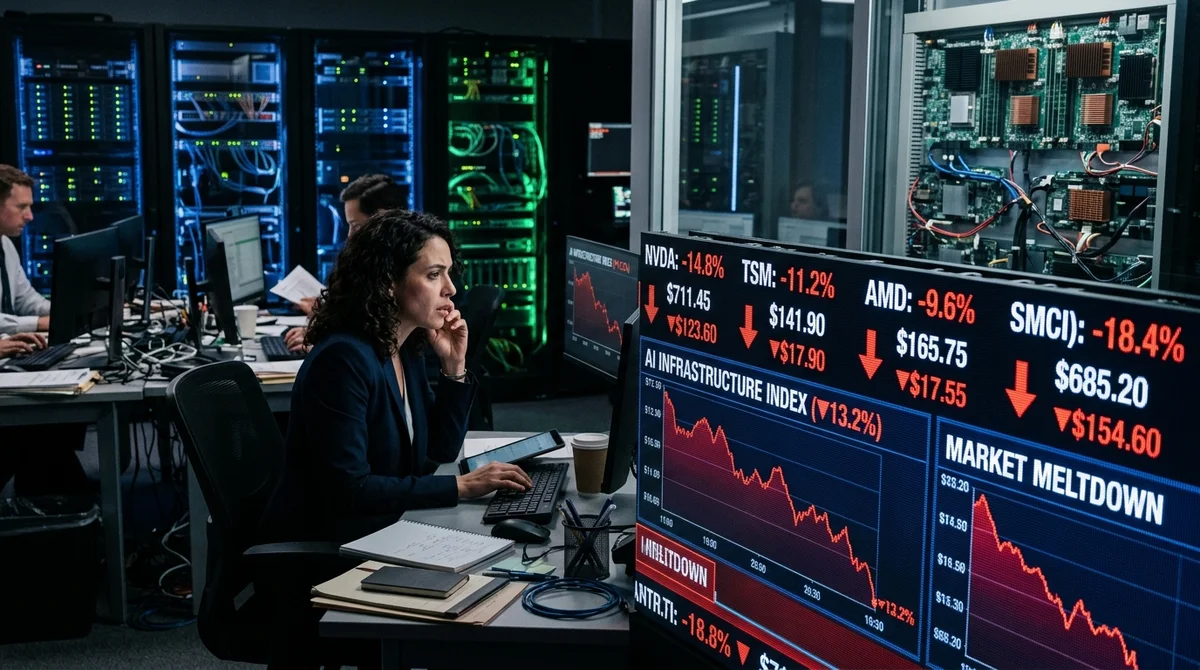
OpenAI is at the center of a fresh bout of market jitters: reports of slowing revenue and user growth hit not the company itself but its publicly traded partners, which are building AI infrastructure around it. In premarket trading and in Asia, investors began dumping shares of companies tied to the generative AI boom.
Why the market flinched
The trigger was reports that even OpenAI's chief financial officer, Sarah Friar, has started to voice concern about a more moderate pace of growth than the market expected. With computing capacity expanding aggressively and the race costing so much, even a small doubt about the company's trajectory quickly becomes a problem for the whole chain of suppliers and investors.
While OpenAI remains private, its business is not being repriced directly. But the stock market instantly recalculates expectations for those who earn money from its infrastructure needs. The investors' logic is simple: if the main consumer of AI capacity may grow more slowly, future orders for chips, servers, cloud resources and data centers are in question.
The market is used to valuing a whole group of companies through the lens of OpenAI demand. So even news without an official earnings report or a forecast revision can set off a chain reaction. That is especially true in a sector where, over the past year and a half, share prices have risen largely on expectations rather than confirmed financial results.
Who took the hit
The reaction was most visible in companies that investors see as direct beneficiaries of OpenAI's appetite for computing infrastructure. The decline hit strategic investors, suppliers and cloud partners alike. For the market, it is a reminder: when one source of demand becomes too important, any turbulence around it quickly spills over to neighboring stocks.
- SoftBank lost about 11% amid fears over its multibillion-dollar investments in OpenAI.
- CoreWeave, Oracle and AMD each fell roughly 3% in premarket trading.
- Since the end of 2024, shares of companies linked to OpenAI projects have risen about 75%.
- By comparison, stocks of Alphabet's partners gained more than 300% over the same period.
This gap matters beyond the trading statistics. It shows the market has begun to view the OpenAI ecosystem not as the unconditional leader of the AI cycle but as a group of companies with elevated execution risk. Where investors were once ready to buy almost any story tied to the company, they now demand proof that AI spending actually converts into sustainable business growth.
Weak points of the strategy
OpenAI's problem goes beyond one bad trading session for its partners. The company simultaneously faces pressure from competitors, enormous scaling costs and questions about how quickly the consumer market can pay back such spending. Against this backdrop, management is trying to cut secondary projects and strengthen its position in the enterprise segment, where revenue at AI startups usually grows more predictably and monetizes better.
Inside the company, the expectation is that by the end of the year enterprise customers will account for up to half of revenue.
Another risk is that OpenAI has structured its relationships with infrastructure partners so that it bears almost no public market damage itself from such shifts in expectations. A private company has no share price that investors could punish on the spot. Instead, AMD, Oracle, CoreWeave, SoftBank and other ecosystem players take the blow. As a result, any doubt about OpenAI's growth rate now automatically becomes a stress test for the entire AI sector, which is tied to its demand and ambitions.
What it means
The episode shows the AI market maturing and separating hype from economics more sharply. For OpenAI, it is a signal to prove the efficiency of its growth faster. For its partners, it is a dangerous reminder that a bet on one big customer can lift shares as fast as it sends them tumbling at the first sign of a slowdown.
- Nov 2, 2026Meta's Muse assistant keeps dossiers on loved ones and gets root on Ubuntu by default
- Nov 1, 2026Local models lose to Opus and Codex: 0.21 on a MacBook versus 1.00 for Codex
- Nov 1, 2026Kimi scores 96.2% on a 1C database analytics test and emerges as a fallback if Claude access is blocked
- Nov 1, 2026OpenAI Rewrites GPT Behavior Rules: Five Values and a Chain of Command
Key Questions Answered
Why the market flinched?
The trigger was reports that even OpenAI's chief financial officer, Sarah Friar, has started to voice concern about a more moderate pace of growth than the market expected. With computing capacity expanding aggressively and the race costing so much, even a small doubt about the company's trajectory quickly becomes a problem for the whole chain of suppliers and investors. While OpenAI remains private, its business is not being repriced directly. But the stock market instantly recalculates expectations for those who earn money from its infrastructure needs. The investors' log
Who took the hit?
The reaction was most visible in companies that investors see as direct beneficiaries of OpenAI's appetite for computing infrastructure. The decline hit strategic investors, suppliers and cloud partners alike. For the market, it is a reminder: when one source of demand becomes too important, any turbulence around it quickly spills over to neighboring stocks. SoftBank lost about 11% amid fears over its multibillion-dollar investments in OpenAI. CoreWeave, Oracle and AMD each fell roughly 3% in premarket trading. Since the end of 2024, shares of companies linked to OpenAI pro
What are the key details on Weak points of the strategy?
OpenAI's problem goes beyond one bad trading session for its partners. The company simultaneously faces pressure from competitors, enormous scaling costs and questions about how quickly the consumer market can pay back such spending. Against this backdrop, management is trying to cut secondary projects and strengthen its position in the enterprise segment, where revenue at AI startups usually grows more predictably and monetizes better. Inside the company, the expectation is that by the end of the year enterprise customers will account for up to half of revenue. Another ris
Test Frontier LLMs & Autonomous Agents in One Workspace
Run Claude Opus 5.5, GPT-6, Gemini 3.1, and DeepSeek side-by-side in Nomad AI (nomadnet.ai) — unified model routing, deep research, and multimodal workflows under one subscription.
The AI world, distilled — once a week
Seven stories that actually mattered, hand-picked. No noise, no reposts, no press releases.
Done! Check your inbox for a confirmation.