Bank of England warns rapid AI adoption in finance risks systemic failures
The Bank of England has warned that AI at banks, funds and lending platforms could quickly turn from an efficiency tool into a source of systemic risk. The regulator singled out private credit: if models start making mass errors, assess risk in the same way or amplify panic, the damage could reach far beyond a single segment. Geopolitical fallout from the war with Iran adds further pressure.
AI-processed from Bloomberg Tech; edited by Hamidun News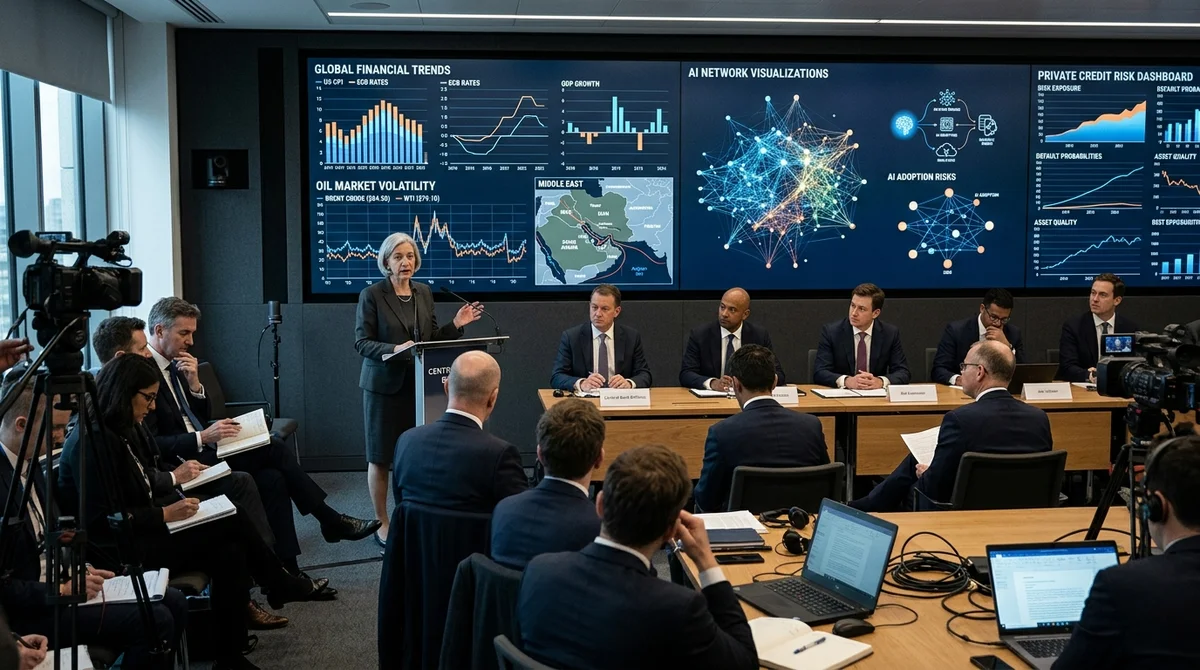
The Bank of England has warned that the rapid adoption of AI in the financial sector could turn from an efficiency tool into a threat to the whole system. The regulator also pointed to the risk of broader shocks if technology failures coincide with strain in the private credit market and the consequences of the war with Iran.
Why the regulator is worried
For the central bank, the problem is not the use of AI itself but the speed at which it is spreading. If banks, funds, brokers and lending platforms all start relying on similar models, the same data and the same external services, their decisions will become too synchronized. In normal times this speeds up operations and cuts costs, but in a stress scenario such synchronization can amplify an error: a wrong risk assessment, a model failure or a false signal would repeat across the whole chain almost instantly.
For financial stability this is dangerous for a simple reason: markets rest not only on capital but also on the diversity of participants' behavior. When everyone looks at the market through the same algorithmic filter, the spread of opinion that often softens volatility disappears. The Bank of England is in effect warning about a new type of systemic risk: not one bank with a bad balance sheet, but mass automation of decisions that may turn out to be wrong at the same time.
Why private credit is vulnerable
The regulator paid particular attention to private credit, the market for private lending outside the classic exchange-traded arena. The segment grew amid high interest rates and caution among traditional banks, but it remains less transparent and less liquid than public debt markets. If AI models are used aggressively for scoring, collateral valuation, borrower monitoring and capital allocation, errors in those calculations may not become visible right away. That is why a local failure can turn into a broader blow to the system.
- Overstated borrower quality
- Identical decisions to reassess risk
- A sharp contraction in new financing
- Transmission of the shock to banks, insurers and funds
The danger is not only defaults. In an opaque market, problems often surface late: first the models paint a calm picture, then investors suddenly realize there is less liquidity than it seemed and the portfolio is of worse quality than expected. At that point there is no smooth adjustment but a sharp repricing of assets. If banks, pension funds or insurers are tied to private credit, the blow easily spills beyond one segment and hits the entire financial ecosystem.
War increases the pressure
In the same assessment, the Bank of England linked technological risks to broader instability caused by the consequences of the war with Iran. A geopolitical shock usually travels through familiar channels: energy prices, funding costs, risk appetite and investor behavior. But in an environment where decisions are increasingly automated, the reaction can be faster and harsher. Algorithms do not create a crisis out of nothing, but they can speed its spread if they begin reacting to external signals in the same way and rebalancing positions at the same time.
It is the combination of factors that makes the central bank's warning notable. The point is not that AI has already triggered a financial crisis, but that it is becoming an amplifier of existing vulnerabilities. When technological concentration overlaps with an opaque credit segment and geopolitical stress, the cost of error rises sharply. For regulators, this is a signal to look not at individual instruments but at how new patterns of behavior affect the system as a whole.
What this means
For the market, this is a direct reminder: AI adoption in finance is now discussed not only as a question of productivity but as a question of macro stability. Banks, lending platforms and investors will have to prove that their models are manageable, verifiable and do not lead to herd effects. The deeper AI goes into financial decision-making, the more important stress tests, transparency and control over dependence on the same technology providers become.
Key Questions Answered
Why the regulator is worried?
For the central bank, the problem is not the use of AI itself but the speed at which it is spreading. If banks, funds, brokers and lending platforms all start relying on similar models, the same data and the same external services, their decisions will become too synchronized. In normal times this speeds up operations and cuts costs, but in a stress scenario such synchronization can amplify an error: a wrong risk assessment, a model failure or a false signal would repeat across the whole chain almost instantly. For financial stability this is dangerous for a simple reason:
Why private credit is vulnerable?
The regulator paid particular attention to private credit, the market for private lending outside the classic exchange-traded arena. The segment grew amid high interest rates and caution among traditional banks, but it remains less transparent and less liquid than public debt markets. If AI models are used aggressively for scoring, collateral valuation, borrower monitoring and capital allocation, errors in those calculations may not become visible right away. That is why a local failure can turn into a broader blow to the system. Overstated borrower quality Identical decisi
What are the key details on War increases the pressure?
In the same assessment, the Bank of England linked technological risks to broader instability caused by the consequences of the war with Iran. A geopolitical shock usually travels through familiar channels: energy prices, funding costs, risk appetite and investor behavior. But in an environment where decisions are increasingly automated, the reaction can be faster and harsher. Algorithms do not create a crisis out of nothing, but they can speed its spread if they begin reacting to external signals in the same way and rebalancing positions at the same time. It is the combina
Test Frontier LLMs & Autonomous Agents in One Workspace
Run Claude Opus 5.5, GPT-6, Gemini 3.1, and DeepSeek side-by-side in Nomad AI (nomadnet.ai) — unified model routing, deep research, and multimodal workflows under one subscription.
The AI world, distilled — once a week
Seven stories that actually mattered, hand-picked. No noise, no reposts, no press releases.
Done! Check your inbox for a confirmation.