OpenAI speeds up Stargate and expands its data center network to meet surging AI demand
OpenAI says Stargate has passed its target for US AI computing infrastructure ahead of plan. In the last 90 days alone, the project added more than 3 GW of capacity. The company is scouting new sites for data centers. Its showcase example is Abilene, Texas, where GPT-5.5 was trained and which uses a closed-loop cooling system.
AI-processed from OpenAI Blog; edited by Hamidun News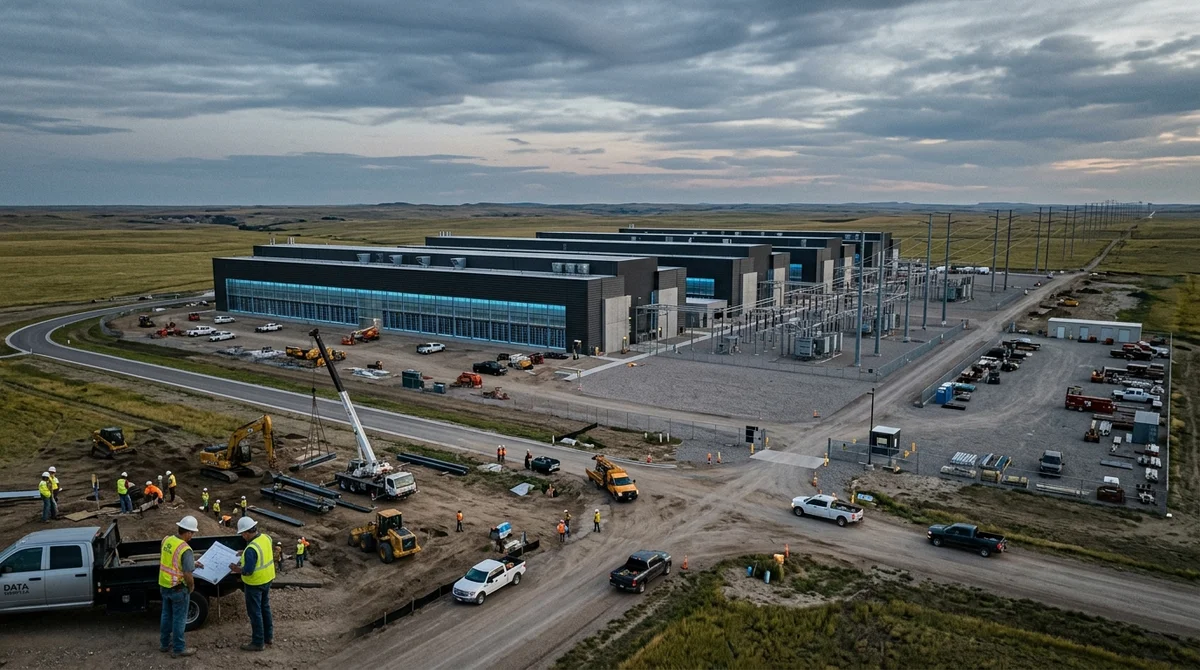
OpenAI says it has already passed Stargate's key target for US AI computing infrastructure ahead of schedule, and is now accelerating the rollout of new capacity. The company sees this data center network as the foundation for stronger models and, down the road, for AGI-level systems.
Ahead of schedule
When OpenAI announced Stargate in January 2025, the goal was 10 gigawatts of AI infrastructure in the US by 2029. The company now says it has already cleared that mark: in the last 90 days alone, more than 3 GW of new capacity was added to the project.
For the market, this is an important signal: demand for AI compute is growing so fast that even multi-year plans are shrinking to a horizon of a few quarters.
OpenAI explicitly calls compute the main input for advanced AI. More capacity means it can train stronger models, serve them more reliably, improve performance and gradually bring down the cost of use. The company describes this as a closed loop: infrastructure improves models, better models drive demand, growing demand brings in revenue, and that revenue flows back into building new sites.
How the network is expanding
OpenAI stresses that this kind of infrastructure cannot be built alone. Stargate is developing as a partner ecosystem that includes cloud providers, chipmakers, energy companies, construction contractors, investors, local authorities and data center operators. The logic is simple: the more participants cover their own parts of the chain, the faster sites can come online, and the lower the risk that the project stalls on a single scarce resource.
When choosing new sites, the company and its partners weigh several conditions at once:
- access to electricity in the required volume
- land, permits and approval timelines
- quality of grid and transmission infrastructure
- availability of a trained workforce
- local community support and partner readiness
OpenAI is already looking for additional locations across the country beyond the original 10 GW target. That means Stargate is no longer a one-off build toward a single milestone, but a long-term network of sites that can be expanded as demand grows. In this approach, financing matters, but so does flexibility: the company separately stresses that the partnership structure may change if that gets capacity online faster.
From sites to models
OpenAI places particular emphasis on what such projects should look like for the regions that host them. The company promises not just to bring in servers but to create local benefits: jobs, new tax revenue, support for schools, more careful energy planning and attention to water resources. The first public example is a community engagement program in Wisconsin: together with Vantage Data Centers and Oracle, OpenAI directed funds to the Port Washington-Saukville education foundation, which supports students, teachers and workforce training programs.
As a model, OpenAI points to the Stargate site in Abilene, Texas. According to the company, GPT-5.5 was trained there. The site runs on Oracle Cloud Infrastructure and uses NVIDIA GB200 systems.
OpenAI also highlights the environmental side of the project: instead of conventional evaporative cooling towers, the facility uses a closed-loop cooling system. After the initial fill, water circulates through a sealed loop rather than being consumed continuously. For a single building, the starting volume is roughly equal to two Olympic swimming pools, and the annual consumption of the whole system at full scale is expected to be comparable to an average office building, or about four households.
"The age of intelligence will not arrive on its own.
It has to be built."
What this means
OpenAI is shifting the AI conversation from models to industrial infrastructure. Competition is no longer only about the best algorithms, but also about land, electricity, networks, construction and regional alliances. If Stargate really keeps growing at this pace, the advantage will go to the companies that can turn compute capacity into available products and services faster than everyone else.
- Nov 2, 2026Meta's Muse assistant keeps dossiers on loved ones and gets root on Ubuntu by default
- Nov 1, 2026Local models lose to Opus and Codex: 0.21 on a MacBook versus 1.00 for Codex
- Nov 1, 2026Kimi scores 96.2% on a 1C database analytics test and emerges as a fallback if Claude access is blocked
- Nov 1, 2026OpenAI Rewrites GPT Behavior Rules: Five Values and a Chain of Command
Key Questions Answered
What are the key details on Ahead of schedule?
When OpenAI announced Stargate in January 2025, the goal was 10 gigawatts of AI infrastructure in the US by 2029. The company now says it has already cleared that mark: in the last 90 days alone, more than 3 GW of new capacity was added to the project. For the market, this is an important signal: demand for AI compute is growing so fast that even multi-year plans are shrinking to a horizon of a few quarters. OpenAI explicitly calls compute the main input for advanced AI. More capacity means it can train stronger models, serve them more reliably, improve performance and grad
How the network is expanding?
OpenAI stresses that this kind of infrastructure cannot be built alone. Stargate is developing as a partner ecosystem that includes cloud providers, chipmakers, energy companies, construction contractors, investors, local authorities and data center operators. The logic is simple: the more participants cover their own parts of the chain, the faster sites can come online, and the lower the risk that the project stalls on a single scarce resource. When choosing new sites, the company and its partners weigh several conditions at once: access to electricity in the required volu
What are the key details on From sites to models?
OpenAI places particular emphasis on what such projects should look like for the regions that host them. The company promises not just to bring in servers but to create local benefits: jobs, new tax revenue, support for schools, more careful energy planning and attention to water resources. The first public example is a community engagement program in Wisconsin: together with Vantage Data Centers and Oracle, OpenAI directed funds to the Port Washington-Saukville education foundation, which supports students, teachers and workforce training programs. As a model, OpenAI point
Test Frontier LLMs & Autonomous Agents in One Workspace
Run Claude Opus 5.5, GPT-6, Gemini 3.1, and DeepSeek side-by-side in Nomad AI (nomadnet.ai) — unified model routing, deep research, and multimodal workflows under one subscription.
The AI world, distilled — once a week
Seven stories that actually mattered, hand-picked. No noise, no reposts, no press releases.
Done! Check your inbox for a confirmation.