Google adds new Gemini features to Google TV, including photo, video and Shorts
Google is updating Google TV with more Gemini features. On compatible TCL TVs in the US, Nano Banana for photo editing and Veo for video generation are already rolling out. Later, voice search in Google Photos, Remix with styles such as watercolor, Dynamic Slideshows and a new YouTube Shorts row on the home screen will follow.
AI-processed from TechCrunch; edited by Hamidun News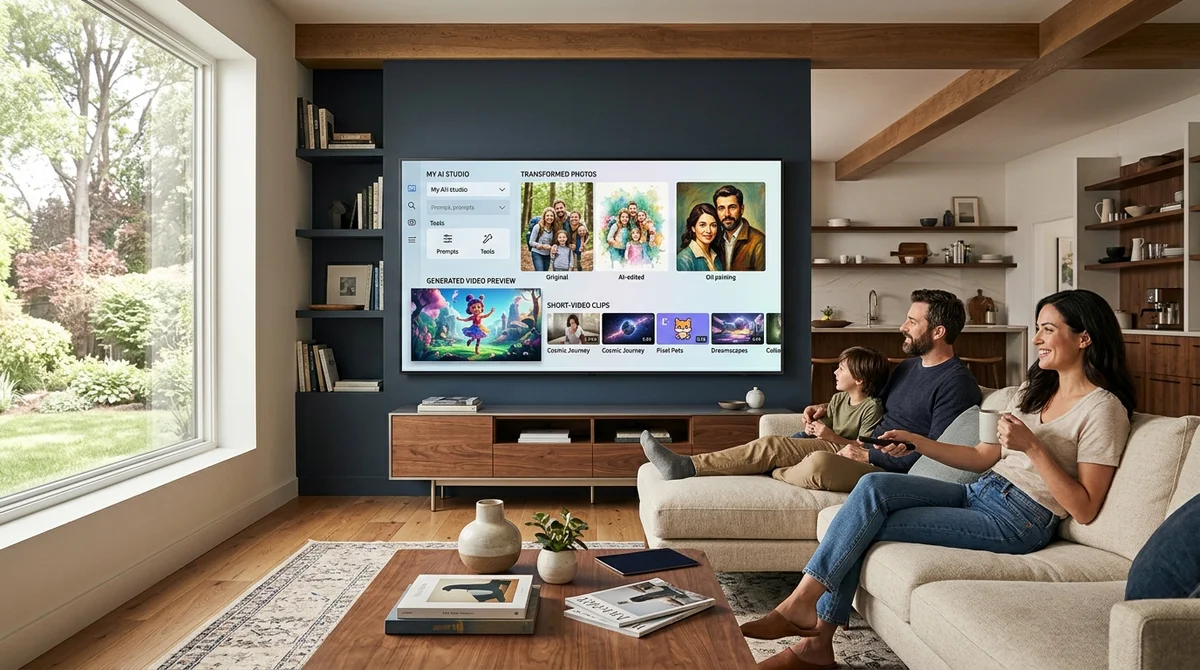
Google is expanding its set of Gemini features for Google TV, turning the television from a screen for watching into a place to generate images and videos and work with a personal photo archive. The update began rolling out on April 29, 2026, and compatible TCL models with Gemini support in the US get it first.
Generation on screen
The main addition is a Create button in the Gemini tab. Through it, Google TV can launch Nano Banana to generate and edit images and Veo to create short clips. The idea is simple: the TV becomes a shared family screen where you can not only search for a movie or series, but also try AI scenarios together by voice. Google clearly pitches this as living-room entertainment, not as a professional editing tool.
- Nano Banana can change clothes in a photo
- It can replace the background and rebuild the scene
- Veo creates clips from scratch based on a text description
- Veo also animates existing images
- All of this launches directly from the Gemini tab on the TV
Google gives deliberately playful examples: you can ask the system to "put Dad in a ridiculous costume" or make Grandpa moonwalk through space. The point is not editing precision but making generative AI part of shared home leisure.
There is also an important limitation: at launch, the features are available only on Gemini-enabled TCL Google TV devices in the US, and a broader launch for other devices is promised later. This suggests the rollout is, for now, more of a pilot expansion than a mass release across the whole ecosystem.
Photos and slideshows
The second part of the update concerns Google Photos. Gemini on the TV can now search for photos by voice based on meaning, not just by date or album. If you say something like "show photos from my recent vacation" or "find pictures from the birthday party," the system displays a separate results page where you can quickly scroll through shots, open them full screen or instantly build a slideshow for the whole family.
Google is also adding Remix, a tool for stylizing photos right on the TV. You can apply an artistic style such as watercolor or oil painting to a found photo and then show the result on the big screen. Alongside it, Dynamic Slideshows launch: livelier screensavers and collages for Google Photos albums.
According to Google, photo search and Remix first arrive on Gemini-compatible devices in the US, while Dynamic Slideshows will be available on suitable Google TV devices worldwide. This mode requires at least 2 GB of RAM.
"Make my grandpa moonwalk through space."
For Google, this is a logical step: the TV has long been the main screen in the home, but the interfaces around personal photos stayed fairly passive. Now the company is trying to turn the photo archive into an interactive layer, with search, quick remixing and a decorative mode that works even when you are not watching anything. Where the TV used to simply show selected albums, it is now starting to understand the context of a request and return results in a livelier, more conversational way.
Shorts on the home screen
The third change is about distribution of short video rather than generation. In the coming months, a separate Short videos for you row will appear on the Google TV home screen. It will show a personalized feed of short clips, with YouTube Shorts as the first source. In the US, the row is due to begin rolling out in summer 2026.
Google's wording suggests it sees this as a new permanent element of the home screen, not a temporary experiment.
The move matters also because short video has long been considered a format almost exclusively for smartphones. Google is trying to prove the opposite: that it fits a TV scenario too, letting you quickly watch a couple of clips without picking feature-length content, then just as quickly return to a series or to generation. Against this background, it is especially clear that the company is betting on mixing consumption modes: long video, short clips, the photo archive and AI tools now live in one shell.
What this means
Google is consistently turning Google TV from a streaming shell into a home AI hub. If the rollout does not stall at a few models, the TV will become another entry point into the Gemini ecosystem, not for work but for everyday scenarios: finding family photos, quickly making a funny remix, generating a short clip and showing it to everyone in the room right away. For Google, it is also a way to anchor Gemini in the most visible part of home electronics.
- Nov 2, 2026Karpathy builds a YouTube clone with 6454 videos from Hacker News recommendations in two hours
- Nov 2, 2026Karpathy used Claude to build HackerTube from 6,454 videos recommended on Hacker News
- Nov 2, 2026Anthropic needs to grow revenue 32% a year to cover $850 billion in contracts
- Nov 2, 2026Bun creator uses Claude Code to port 750K lines from Zig to Rust in 11 days
Key Questions Answered
What are the key details on Generation on screen?
The main addition is a Create button in the Gemini tab. Through it, Google TV can launch Nano Banana to generate and edit images and Veo to create short clips. The idea is simple: the TV becomes a shared family screen where you can not only search for a movie or series, but also try AI scenarios together by voice. Google clearly pitches this as living-room entertainment, not as a professional editing tool. Nano Banana can change clothes in a photo It can replace the background and rebuild the scene Veo creates clips from scratch based on a text description Veo also animates
What are the key details on Photos and slideshows?
The second part of the update concerns Google Photos. Gemini on the TV can now search for photos by voice based on meaning, not just by date or album. If you say something like "show photos from my recent vacation" or "find pictures from the birthday party," the system displays a separate results page where you can quickly scroll through shots, open them full screen or instantly build a slideshow for the whole family. Google is also adding Remix, a tool for stylizing photos right on the TV. You can apply an artistic style such as watercolor or oil painting to a found photo
What are the key details on Shorts on the home screen?
The third change is about distribution of short video rather than generation. In the coming months, a separate Short videos for you row will appear on the Google TV home screen. It will show a personalized feed of short clips, with YouTube Shorts as the first source. In the US, the row is due to begin rolling out in summer 2026. Google's wording suggests it sees this as a new permanent element of the home screen, not a temporary experiment. The move matters also because short video has long been considered a format almost exclusively for smartphones. Google is trying to pro
Test Frontier LLMs & Autonomous Agents in One Workspace
Run Claude Opus 5.5, GPT-6, Gemini 3.1, and DeepSeek side-by-side in Nomad AI (nomadnet.ai) — unified model routing, deep research, and multimodal workflows under one subscription.
The AI world, distilled — once a week
Seven stories that actually mattered, hand-picked. No noise, no reposts, no press releases.
Done! Check your inbox for a confirmation.