Apple is preparing a major update to its built-in photo editor with Apple Intelligence
Apple is preparing a major update to its built-in photo editing tools. The company wants to build Apple Intelligence directly into the system photo editor rather than keep AI features as a separate layer. Details are scarce, but the direction is clear: Apple is strengthening its core apps and making smart photo processing part of everyday use on its devices. The bet is likely on quick edits that need no third-party services.
AI-processed from Bloomberg Tech; edited by Hamidun News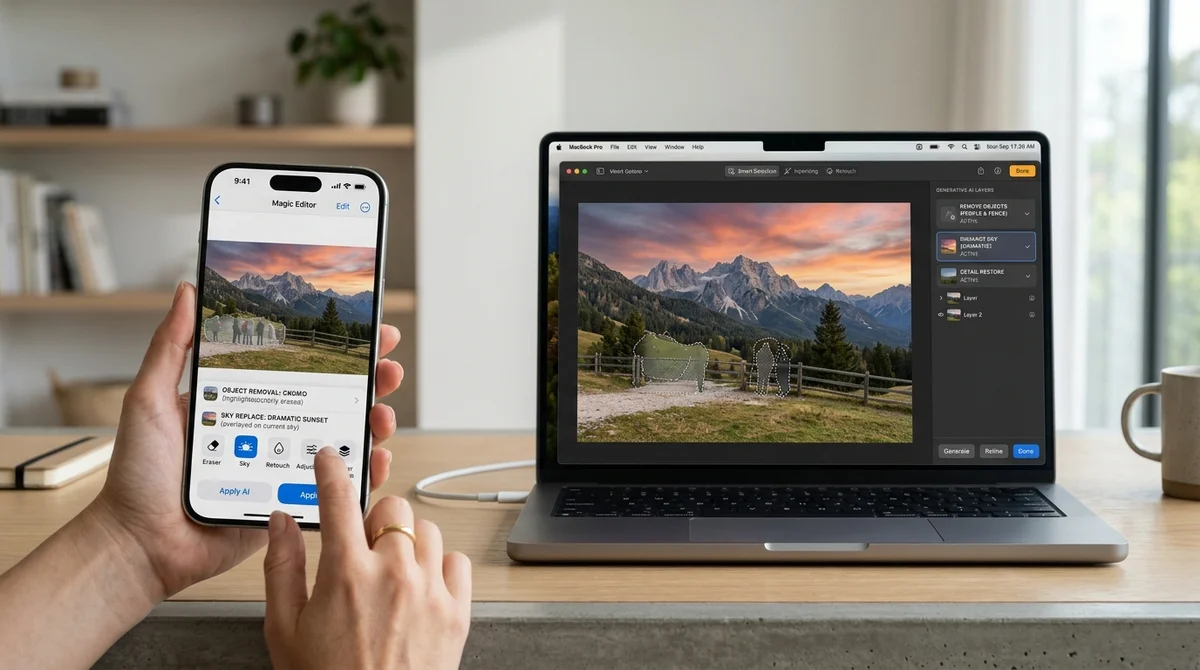
Apple is preparing a major overhaul of its built-in photo editing tools, built on the Apple Intelligence platform. If the plans hold, AI features will stop being a showcase demo and become part of everyday image work on the company's devices.
What Apple is preparing
According to Bloomberg, this is not a point update but a notable rethink of how photos are edited. Apple wants to strengthen its built-in tools so that basic edits that once required third-party apps are done inside the ecosystem.
The wording about a major overhaul suggests the company is updating not just individual buttons but the whole user workflow: from quick fixes to smarter automation powered by Apple Intelligence.
Which features will ship has not been disclosed, but the general direction is clear. Apple is betting on AI that helps not in abstract chats but in concrete actions: fix the framing, remove what doesn't belong, improve the result in a couple of taps. For the company this is a logical step: photos remain one of the most common content types on Apple devices, so this is where the convenience of AI is felt fastest.
What is still unclear
For now the story has more framework than detail. Bloomberg reports plans and a tie to Apple Intelligence, but does not name an exact list of tools, a release date, or which devices will get the update first. This is typical for Apple at the leak stage: the strategy is visible, but product boundaries may still shift before an official announcement. It is also unclear whether we will see a single package of features at once or a phased launch across different products.
- When exactly the update will be shown and in which release it will debut
- Whether all compatible devices will get the new features or only newer models
- How deep the AI processing will go: auto-correction, local edits or generative tools
- Whether editing will run entirely on the device or partly through Apple's cloud services
Where the processing happens is an especially important question. Apple builds Apple Intelligence around the image of a private, personal AI platform, so it is critical for the company to show a balance between quality of results, speed and protection of user data. If the new tools prove fast and clear without sending sensitive content off the device, that will be a strong argument for mass adoption. If some features depend on the cloud, users will start comparing the convenience with competitors' local solutions.
Why photos
Photo editing is one of the clearest ways to show the value of AI to an ordinary user. Unlike abstract assistants, the result is visible immediately: the frame is cleaner, an object is gone, the color is balanced, the composition looks better. That is why almost all major players turn image processing into a showcase for their models.
Apple seems to want the same, but in its own style: not through a separate experimental service, but through a system tool already open for millions of users.
For Apple itself it is also a way to strengthen the ecosystem. The more useful tasks are handled inside standard apps, the less often users leave for third-party services, and the higher the value of the devices as a single environment. If the company really embeds AI editing deeply into basic workflows, it will raise expectations across the whole market: users will start seeing smart photo processing not as a bonus but as a required part of the camera and gallery.
What it means
Apple is gradually moving AI from presentation mode to everyday features. If the update ships at the stated scale, the fight for users will shift from talk about models to a simpler question: how quickly and unobtrusively your smartphone can improve photos without extra apps.
These are the scenarios that usually turn AI from an option for enthusiasts into a standard feature of a mass-market device.
- Nov 2, 2026TensorFold 1.2.0 boosts Qwen3.8-27B throughput on M3 Ultra by 44.2% at 16 streams
- Nov 1, 2026Local models lose to Opus and Codex: 0.21 on a MacBook versus 1.00 for Codex
- Oct 29, 2026Claude Code Edits Video From a Transcript: How the video-use Skill With 30 000 Stars Works
- Oct 29, 2026Stanford AI tool verifies part of Signal's code in half a day for under $500, versus five months of expert work
Key Questions Answered
What Apple is preparing?
According to Bloomberg, this is not a point update but a notable rethink of how photos are edited. Apple wants to strengthen its built-in tools so that basic edits that once required third-party apps are done inside the ecosystem. The wording about a major overhaul suggests the company is updating not just individual buttons but the whole user workflow: from quick fixes to smarter automation powered by Apple Intelligence. Which features will ship has not been disclosed, but the general direction is clear. Apple is betting on AI that helps not in abstract chats but in concre
What is still unclear?
For now the story has more framework than detail. Bloomberg reports plans and a tie to Apple Intelligence, but does not name an exact list of tools, a release date, or which devices will get the update first. This is typical for Apple at the leak stage: the strategy is visible, but product boundaries may still shift before an official announcement. It is also unclear whether we will see a single package of features at once or a phased launch across different products. When exactly the update will be shown and in which release it will debut Whether all compatible devices wil
Why photos?
Photo editing is one of the clearest ways to show the value of AI to an ordinary user. Unlike abstract assistants, the result is visible immediately: the frame is cleaner, an object is gone, the color is balanced, the composition looks better. That is why almost all major players turn image processing into a showcase for their models. Apple seems to want the same, but in its own style: not through a separate experimental service, but through a system tool already open for millions of users. For Apple itself it is also a way to strengthen the ecosystem. The more useful tasks
Ship AI Faster with Founders, Engineers & Weekly Architecture Reviews
Inside Vibe Club (hamidun.com/club) — weekly live masterminds with Zhemal Khamidun, Tech Radar, full LMS access, and 370+ production Claude Code skills.
The AI world, distilled — once a week
Seven stories that actually mattered, hand-picked. No noise, no reposts, no press releases.
Done! Check your inbox for a confirmation.