OpenAI, Google and Anthropic speed up the AI model race, but the market is already tired of the noise
In February 2026, OpenAI, Google, Anthropic, xAI and Chinese labs released dozens of new models almost back to back. But the real shift isn't an extra 2% on benchmarks. It's cheaper queries, pressure from open source, and the fact that most companies are still stuck between pilot and production. Usefulness is growing, but there is still far too much noise around AI.
AI-processed from Habr AI; edited by Hamidun News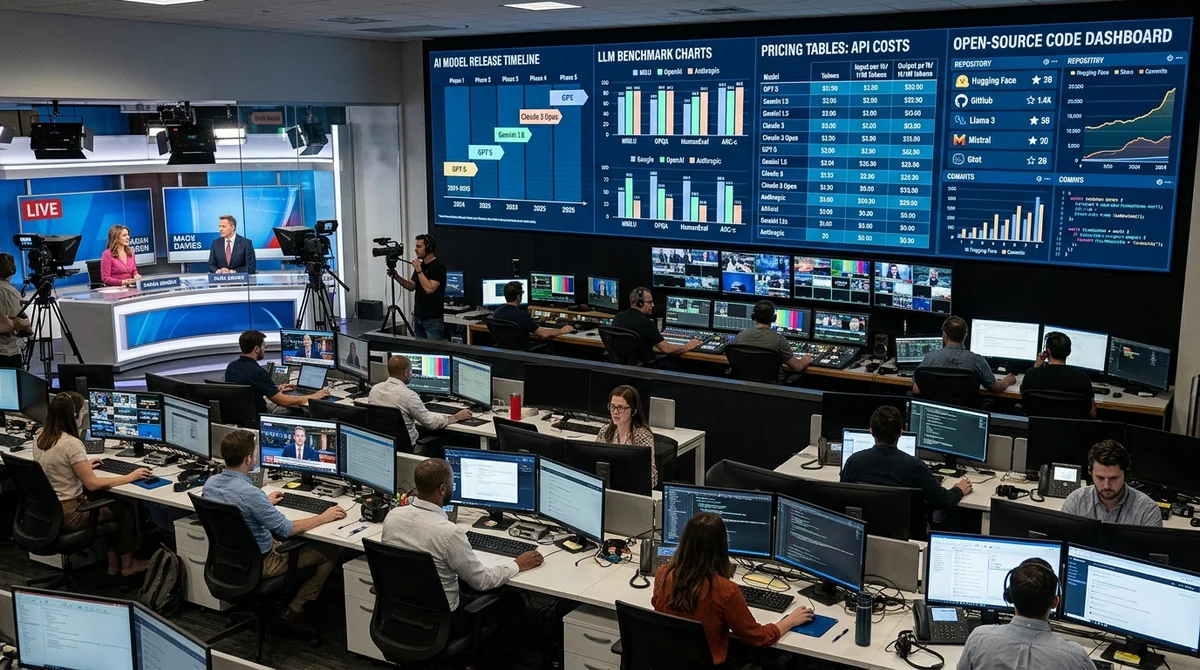
February 2026 turned into a release assembly line: OpenAI, Google, Anthropic, xAI and Chinese labs shipped new models days apart, and the market now counts hundreds of LLMs from dozens of organizations. Against that backdrop, the announcement itself matters less than a different question: what in this race actually changes how people and companies work?
Why everything sped up
Three years ago, major releases were months apart. Now they are sometimes just two days apart, as between GPT-5.3 and GPT-5.4. The market already has more than 500 language models from 30+ organizations, which shows the scale of the acceleration.
There are several reasons. First, the race is no longer a duel between OpenAI and Google: Anthropic, xAI, Meta*, Mistral and Chinese players such as DeepSeek, Qwen, Zhipu and ByteDance have all joined in earnest. Second, compute got cheaper: efficient architectures and new hardware cut the cost of training and inference. Third, the leaders now have enormous sums of money, which lets them run several teams at once and develop different model lines in parallel.
Open source is a separate accelerator. When Meta*, Mistral and DeepSeek publish models with open weights, proprietary labs have to prove more often what users are paying a subscription for. Chinese companies stand out here: because of chip restrictions, they are forced to look for more economical training methods, and those solutions quickly land in the open ecosystem.
As a result, the market lives under constant mutual pressure: closed models ship faster, open ones catch up faster, and users get ever cheaper and stronger tools.
Benchmarks are not the same as usefulness
On paper, everything looks impressive. Gemini 3.1 Pro sets records on GPQA and ARC-AGI-2, Claude Sonnet 4.6 beats even the more expensive Opus 4.6 on office-work tests, and GPT-5.4 leads in coding and agentic scenarios. But the gap between the best models is no longer as dramatic as in the GPT-4 era. On most practical tasks it is not a chasm but a few percentage points, which end users rarely notice.
For a team building a product, the choice increasingly comes down not to absolute answer quality but to token price, latency, stability and API convenience.
There is a more unpleasant problem too: benchmarks measure only the conditions built into them. Solving a physics exam question or passing a code-generation test is a useful signal, but it doesn't mean a model handles the murky, incomplete, context-dependent tasks of business well. So a 2% record is not the same as doubling practical value. It is no accident that the main advice in this race goes:
Don't chase the latest model — chase the result.
Then production reality begins. There are many pilots and few mature deployments: only 11% of companies have taken AI agents to full production, although 38% are already experimenting with pilots. Executives acknowledge productivity gains, but far less often can they show strong ROI or a change in business model. General-purpose agents still make mistakes, get stuck in loops and work poorly without oversight. Hence the growing AI fatigue: the market is tired of promises that look better in demos than in real operations.
Where the effect is already visible
Usefulness does exist, and it is quite measurable. In development, specialized models speed up code generation and refactoring, and assistants inside the IDE have long been a working tool rather than a toy. In document analysis, large context windows let models work through contracts, reports and research materials in a single pass, leaving the final check to a human. Science is a separate front: reasoning models help find new structures in mathematics and speed up drug discovery and materials analysis. The market is also moving sharply toward cost efficiency: today the model record matters less than the price per useful result.
- Code generation and review
- Parsing long documents and reports
- Scientific calculations and hypothesis discovery
- Cheap lite models for mass-market scenarios
The most underrated shift of 2026 is the falling cost of strong models. When Sonnet-class solutions approach Opus, and fast versions like Flash-Lite cut price and latency by an order of magnitude, AI stops being a privilege of large teams. That opens scenarios that previously did not add up economically: mass processing of customer requests, a cheap first pass for lawyers and analysts, automation of internal documentation, custom assistants built on company data. And this is where real competition for usefulness begins, rather than marketing.
What this means
The 2026 model race is both real progress and a layer of loud marketing on top of it. The thing to watch is not who is first in the table today, but which models are cheaper, more reliable and better at solving a specific task in production.
*Meta has been designated an extremist organization and banned in Russia.
- Nov 2, 2026Arca gives AI agents finance tasks lasting up to 10 days, but leaves the trades to humans
- Nov 2, 2026Meta's Muse assistant keeps dossiers on loved ones and gets root on Ubuntu by default
- Nov 1, 2026Local models lose to Opus and Codex: 0.21 on a MacBook versus 1.00 for Codex
- Nov 1, 2026Kimi scores 96.2% on a 1C database analytics test and emerges as a fallback if Claude access is blocked
Key Questions Answered
Why everything sped up?
Three years ago, major releases were months apart. Now they are sometimes just two days apart, as between GPT-5.3 and GPT-5.4. The market already has more than 500 language models from 30+ organizations, which shows the scale of the acceleration. There are several reasons. First, the race is no longer a duel between OpenAI and Google: Anthropic, xAI, Meta, Mistral and Chinese players such as DeepSeek, Qwen, Zhipu and ByteDance have all joined in earnest. Second, compute got cheaper: efficient architectures and new hardware cut the cost of training and inference. Third, the
What are the key details on Benchmarks are not the same as usefulness?
On paper, everything looks impressive. Gemini 3.1 Pro sets records on GPQA and ARC-AGI-2, Claude Sonnet 4.6 beats even the more expensive Opus 4.6 on office-work tests, and GPT-5.4 leads in coding and agentic scenarios. But the gap between the best models is no longer as dramatic as in the GPT-4 era. On most practical tasks it is not a chasm but a few percentage points, which end users rarely notice. For a team building a product, the choice increasingly comes down not to absolute answer quality but to token price, latency, stability and API convenience. There is a more unp
Where the effect is already visible?
Usefulness does exist, and it is quite measurable. In development, specialized models speed up code generation and refactoring, and assistants inside the IDE have long been a working tool rather than a toy. In document analysis, large context windows let models work through contracts, reports and research materials in a single pass, leaving the final check to a human. Science is a separate front: reasoning models help find new structures in mathematics and speed up drug discovery and materials analysis. The market is also moving sharply toward cost efficiency: today the mod
Test Frontier LLMs & Autonomous Agents in One Workspace
Run Claude Opus 5.5, GPT-6, Gemini 3.1, and DeepSeek side-by-side in Nomad AI (nomadnet.ai) — unified model routing, deep research, and multimodal workflows under one subscription.
The AI world, distilled — once a week
Seven stories that actually mattered, hand-picked. No noise, no reposts, no press releases.
Done! Check your inbox for a confirmation.