Bloomberg Tech: How AI is reshaping the battlefield and setting off an autonomous arms race
The latest episode of Bloomberg Tech: Asia examines how AI is changing military logic. Missiles still matter, but algorithms, sensors, autonomous platforms and data-processing speed are becoming decisive too. The central risk grows alongside them: who is responsible for a machine's decision if a target-recognition error leads to a strike, and a human has only seconds to check and cancel the command?
AI-processed from Bloomberg Tech; edited by Hamidun News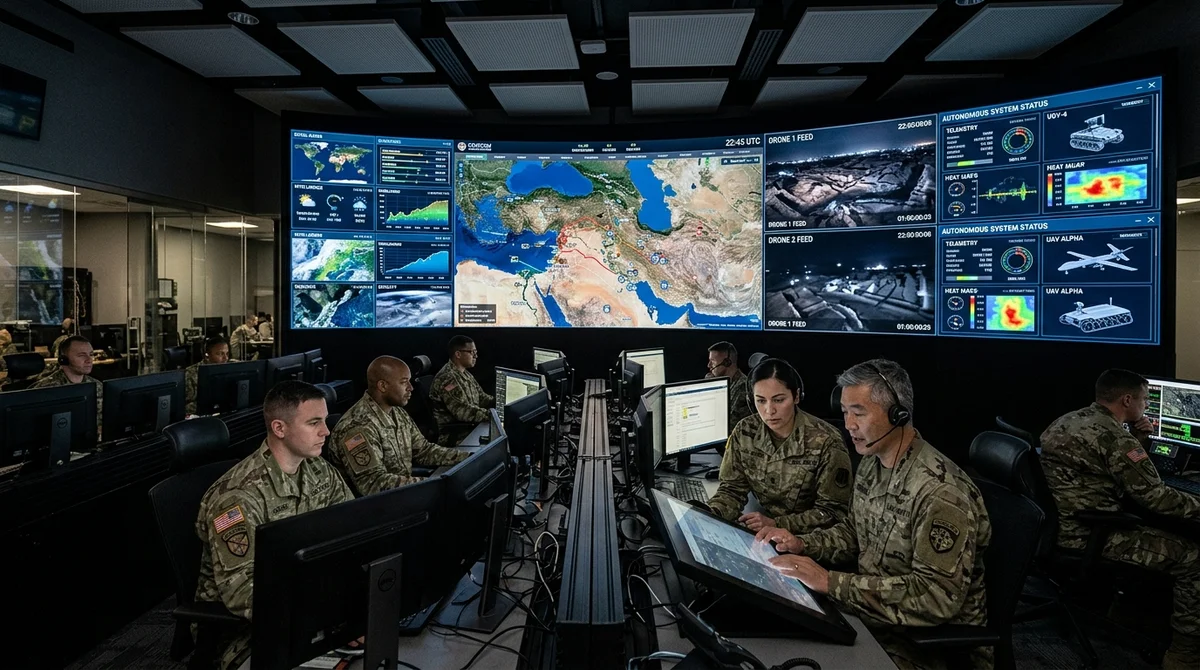
In the March 27, 2026 episode of Bloomberg Tech: Asia, the hosts break down how AI is becoming one of the main drivers of military power. Algorithms, sensor networks and autonomous systems are moving to the forefront, and with them comes a new round of the technology race between states.
A new logic of conflict
The question is no longer just who has more hardware or ammunition. Increasingly, the advantage goes to whoever collects data faster, interprets it more accurately and makes decisions sooner. AI here is not a standalone tool but a connective layer that links intelligence, command, communications and strike platforms. The more tightly an army fuses sensors, software and autonomous machines into a single system, the faster it can react, and the smaller the human pause between detecting a target and acting on it.
This is changing geopolitics itself. Competition now extends beyond weapons to compute, chips, communication links, satellite infrastructure and access to the datasets that models are trained on. AI makes military power dependent on the civilian tech stack, from cloud providers and semiconductors to drone makers and algorithm developers. As a result, the line between the defense industry and Big Tech is getting thinner, and the global arms race is becoming more distributed and more digital.
What the systems change
When Bloomberg talks about war increasingly shaped by algorithms, sensors and autonomous systems, it means a practical shift in how armies see the battlefield and operate on it. AI speeds up the cycle from observation to decision and lightens the load on operators, who previously had to manually cross-reference too many signals at once. Commanders get a more coherent picture of the situation and can act within a window that used to close too quickly.
- Merges data from satellites, radar, cameras and drones into a single stream
- Helps find targets, anomalies and changes in the situation faster
- Coordinates autonomous platforms in the air, on land and at sea
- Suggests likely scenarios and the consequences of choices to commanders
- Automates parts of intelligence, logistics and operational planning
This does not mean humans disappear from the decision-making loop. But their role shifts: more and more, they monitor, confirm, constrain or cancel actions the system has already proposed or prepared. This approach raises the tempo of operations, but it also puts a premium on model reliability, data quality and the resilience of communication links. An object-classification error, a sensor failure or a vulnerability in the software layer can now scale much faster than in traditional systems.
The core dispute
The more autonomy machines get, the sharper the question of accountability becomes. If a system misidentifies a target, who bears responsibility: the developer, the operator, the commander or the state that deployed it? That is why the conversation about AI on the battlefield quickly moves beyond engineering and into law, ethics and the international rules on the use of force. Machine speed looks like an advantage only as long as there is a clear control mechanism and a way for humans to intervene.
The second point of contention is escalation risk. When decisions are made faster and responses are increasingly automated, each side has less time to verify, hesitate and de-escalate. That raises the cost of any mistake and makes situations especially dangerous when autonomous systems operate at the edge of trusting incomplete data. So today's debate about AI in defense runs on two tracks at once: how to use the technology for advantage, and how to keep that same advantage from making conflict less predictable.
What it means
AI is becoming for defense what radar, satellites and precision-guided munitions once were: a technology that changes the basic logic of power. For states, that means a new race for compute, data and autonomous platforms. For industry, it means a tighter link between military contracts and the civilian AI market. And for everyone else, it means an urgent need to agree on rules before the speed of these systems outpaces political control in the coming years.
- Nov 2, 2026Karpathy builds a YouTube clone with 6454 videos from Hacker News recommendations in two hours
- Nov 2, 2026Karpathy used Claude to build HackerTube from 6,454 videos recommended on Hacker News
- Nov 2, 2026Arca gives AI agents finance tasks lasting up to 10 days, but leaves the trades to humans
- Nov 2, 2026DeepSeek open-sources Super-agent prototype: p95 task completion time of 15.7 minutes vs. 29.5
Key Questions Answered
What are the key details on A new logic of conflict?
The question is no longer just who has more hardware or ammunition. Increasingly, the advantage goes to whoever collects data faster, interprets it more accurately and makes decisions sooner. AI here is not a standalone tool but a connective layer that links intelligence, command, communications and strike platforms. The more tightly an army fuses sensors, software and autonomous machines into a single system, the faster it can react, and the smaller the human pause between detecting a target and acting on it. This is changing geopolitics itself. Competition now extends bey
What the systems change?
When Bloomberg talks about war increasingly shaped by algorithms, sensors and autonomous systems, it means a practical shift in how armies see the battlefield and operate on it. AI speeds up the cycle from observation to decision and lightens the load on operators, who previously had to manually cross-reference too many signals at once. Commanders get a more coherent picture of the situation and can act within a window that used to close too quickly. Merges data from satellites, radar, cameras and drones into a single stream Helps find targets, anomalies and changes in the
What are the key details on The core dispute?
The more autonomy machines get, the sharper the question of accountability becomes. If a system misidentifies a target, who bears responsibility: the developer, the operator, the commander or the state that deployed it? That is why the conversation about AI on the battlefield quickly moves beyond engineering and into law, ethics and the international rules on the use of force. Machine speed looks like an advantage only as long as there is a clear control mechanism and a way for humans to intervene. The second point of contention is escalation risk. When decisions are made f
Test Frontier LLMs & Autonomous Agents in One Workspace
Run Claude Opus 5.5, GPT-6, Gemini 3.1, and DeepSeek side-by-side in Nomad AI (nomadnet.ai) — unified model routing, deep research, and multimodal workflows under one subscription.
The AI world, distilled — once a week
Seven stories that actually mattered, hand-picked. No noise, no reposts, no press releases.
Done! Check your inbox for a confirmation.