Alphabet, Amazon, Meta and Microsoft push 2026 AI spending plans to $725 billion
US Big Tech is raising the stakes in the AI race again: combined capex at Alphabet, Amazon, Meta and Microsoft could now reach $725 billion in 2026. Google and Meta raised their forecasts, Microsoft gave a $190 billion target for the first time, and Amazon kept its $200 billion plan. The money is going primarily into data centers, servers, chips and power. *Meta is designated an extremist organization and banned in Russia.
AI-processed from Bloomberg Tech; edited by Hamidun News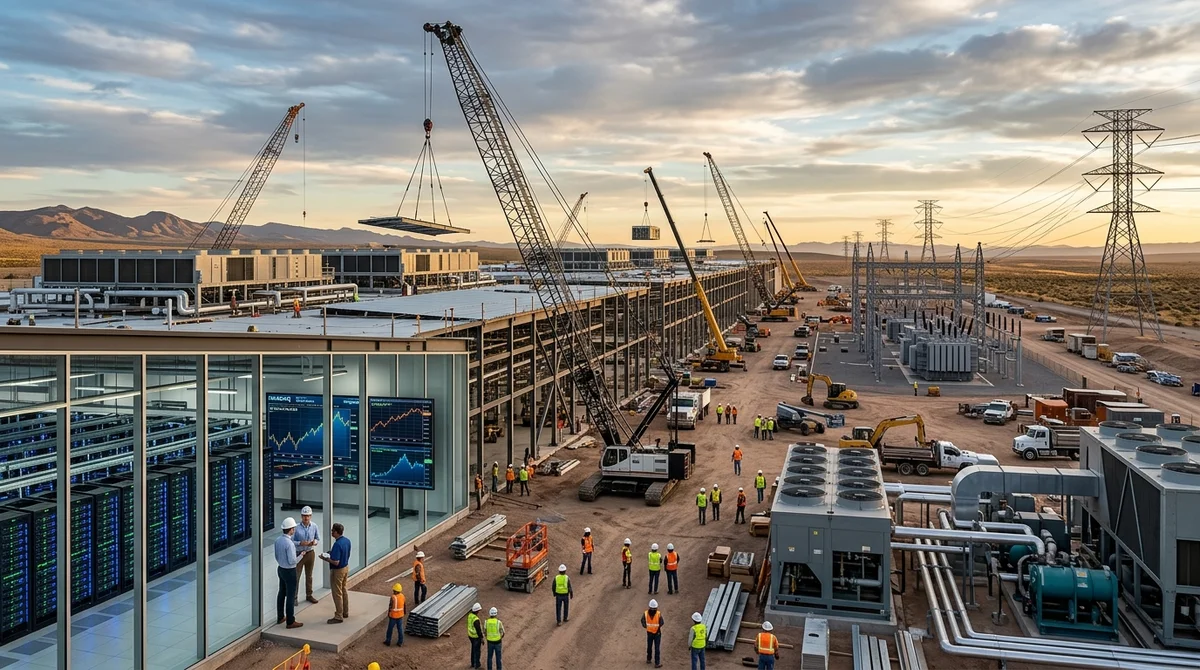
The four largest US tech companies keep raising the bar on artificial intelligence spending: combined capital expenditures at Alphabet, Amazon, Meta and Microsoft could now reach $725 billion in 2026. Almost none of that money goes into apps. Instead, it funds physical infrastructure: the data centers, servers, networking gear and power that AI runs on.
A new ceiling for capex
As recently as February, the combined 2026 spending outlook for these companies stood at an already nearly unthinkable $650 billion. After first-quarter earnings, the figure climbed again. Alphabet and Meta revised their forecasts upward, Microsoft issued a calendar 2026 target for the first time, and Amazon held to its previously announced plan. As a result, the upper bound of combined capex rose to $725 billion, while the lower bound approached $700 billion. The AI race is no longer just a story about models and products: compute capacity has become the key asset.
The phrase "AI investment" here covers a very tangible set of expenses: building and equipping data centers, buying GPUs and servers, network infrastructure, cooling systems, and connecting new capacity to the power grid. That marks an important shift for the market. Large language models have fully become a capital-intensive industry, where competitive advantage depends not only on model quality but also on who brings new compute clusters online fastest.
Who is raising the stakes
Break the new estimate down by company and each one has its own growth logic, but the common denominator is the same: demand for cloud and AI services has proven strong enough to justify further spending increases. Most telling, these are no longer long-term ambitions several years out but plans being revised in the middle of the year.
- Amazon kept its target at $200 billion. Meanwhile, AWS grew 28% in the first quarter to $37.6 billion, while trailing 12-month free cash flow shrank to $1.2 billion as investment in property and equipment surged.
- Microsoft gave a target of roughly $190 billion for calendar 2026 for the first time. The company also said its AI business has already surpassed a $37 billion annual run rate, and quarterly capex reached $31.9 billion.
- Alphabet raised its forecast to $180–190 billion, up from $175–185 billion. Google Cloud revenue grew 63% in the first quarter to $20 billion, and the company is already warning that spending will rise significantly again in 2027.
- Meta lifted its range to $125–145 billion from $115–135 billion. The company explicitly tied the increase to higher component prices and additional data center costs for future capacity.
Against this backdrop, Amazon looks like the exception: it did not raise its target, but it remains the most aggressive investor in absolute terms even without doing so. For the others, the trajectory is clear: infrastructure spending keeps growing faster than the market was prepared to price in until recently. Even the low end of current forecasts sits around $695 billion, so the psychological $700 billion mark has effectively been reached.
The price of the AI race
No single factor explains the budget growth. On one hand, demand for training and inference compute still outpaces supply. On the other, components themselves are getting more expensive, and so are construction, cooling and grid connections for new data centers. Microsoft specifically noted that about $25 billion of annual spending stems from higher component costs. Meta cites pricier components and additional spending on future capacity. In other words, these companies are paying not only for current demand but also for the right to avoid hitting a shortage a year from now.
"We are confident in the return on these investments because demand signals are strengthening and product usage is growing," —
Amy Hood.
Investors, however, see risk in these numbers as well as an accelerating AI market. The higher the capex, the greater the pressure on free cash flow and margins, especially if payback on new data centers takes longer. Amazon is already showing how quickly this kind of spending eats into free cash flow. At the same time, the earnings reports themselves give the companies arguments in their defense: Google Cloud posted a record quarter, AWS delivered its fastest growth in 15 quarters, and Azure kept growing at 40%. As long as demand holds at this level, Big Tech will keep buying time and capacity at any reasonable price.
What it means
The AI race has fully become an industrial one. The winners will not just be the builders of strong models but also those who can build compute infrastructure faster than everyone else and finance it without derailing their core business. For the market, this signals that AI demand is real right now, but the stakes are rising along with it: the entry ticket to the leaders' club is measured in hundreds of billions of dollars.
*Meta is designated an extremist organization and banned in Russia.
- Nov 2, 2026Meta's Muse assistant keeps dossiers on loved ones and gets root on Ubuntu by default
- Nov 2, 2026The Verge reviewer builds a $50 Meta Muse Charm alternative with Claude Code
- Nov 1, 2026MoneyGate safety layer blocked all 42 fraudulent requests to local AI models
- Oct 31, 2026Open-source LLM gateway KTMS 1.0 plugs your own GPUs into the cloud and survives outages
Key Questions Answered
What are the key details on A new ceiling for capex?
As recently as February, the combined 2026 spending outlook for these companies stood at an already nearly unthinkable $650 billion. After first-quarter earnings, the figure climbed again. Alphabet and Meta revised their forecasts upward, Microsoft issued a calendar 2026 target for the first time, and Amazon held to its previously announced plan. As a result, the upper bound of combined capex rose to $725 billion, while the lower bound approached $700 billion. The AI race is no longer just a story about models and products: compute capacity has become the key asset. The phr
Who is raising the stakes?
Break the new estimate down by company and each one has its own growth logic, but the common denominator is the same: demand for cloud and AI services has proven strong enough to justify further spending increases. Most telling, these are no longer long-term ambitions several years out but plans being revised in the middle of the year. Amazon kept its target at $200 billion. Meanwhile, AWS grew 28% in the first quarter to $37.6 billion, while trailing 12-month free cash flow shrank to $1.2 billion as investment in property and equipment surged. Microsoft gave a target of ro
What are the key details on The price of the AI race?
No single factor explains the budget growth. On one hand, demand for training and inference compute still outpaces supply. On the other, components themselves are getting more expensive, and so are construction, cooling and grid connections for new data centers. Microsoft specifically noted that about $25 billion of annual spending stems from higher component costs. Meta cites pricier components and additional spending on future capacity. In other words, these companies are paying not only for current demand but also for the right to avoid hitting a shortage a year from now
Test Frontier LLMs & Autonomous Agents in One Workspace
Run Claude Opus 5.5, GPT-6, Gemini 3.1, and DeepSeek side-by-side in Nomad AI (nomadnet.ai) — unified model routing, deep research, and multimodal workflows under one subscription.
The AI world, distilled — once a week
Seven stories that actually mattered, hand-picked. No noise, no reposts, no press releases.
Done! Check your inbox for a confirmation.