NotebookLM and Gemini automate quiz creation through Google Apps Script and Forms
Chaining NotebookLM, Gemini and Google Apps Script turns quiz creation from manual busywork into a semi-automated pipeline. The AI first generates questions from selected materials, then Gemini writes the code for Google Forms, and the script creates a finished form in the right Drive folder on its own. The approach is useful for teachers and for people studying on their own.
AI-processed from Habr AI; edited by Hamidun News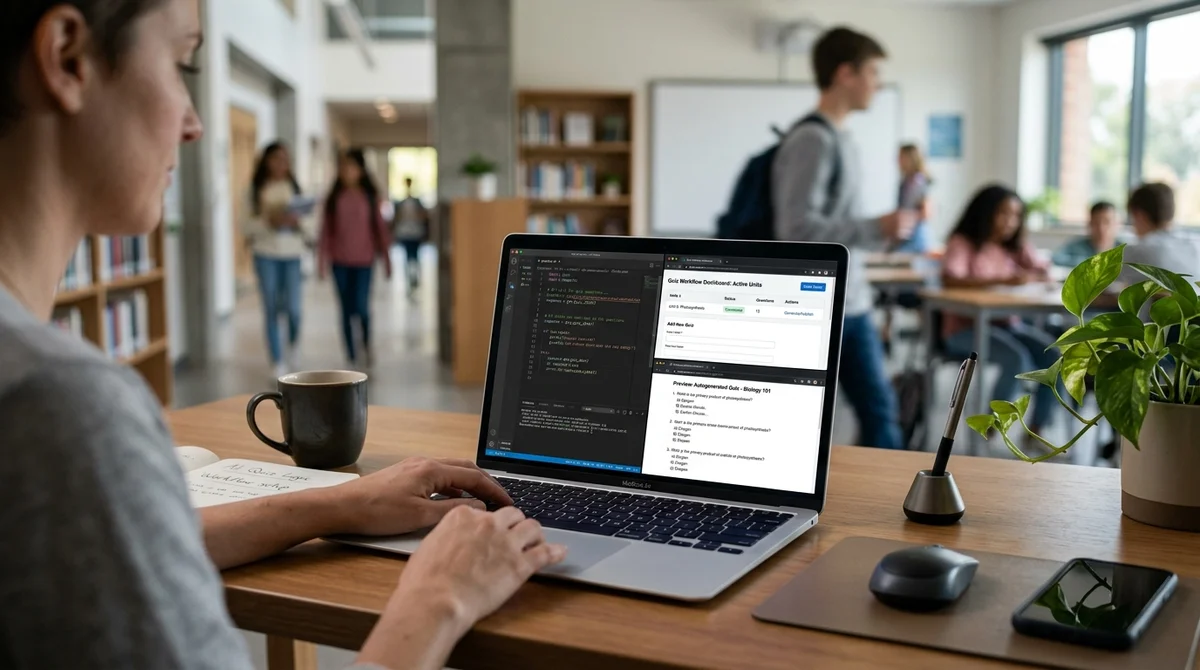
NotebookLM, Gemini and Google Apps Script can be combined into a practical pipeline for creating study quizzes. Instead of typing dozens of questions by hand, a teacher or self-learner gets a semi-automated process: the AI generates the content, and a script immediately turns it into a ready-made Google Form.
Why bother?
The point is not only to save time. Quizzes are used not just to check knowledge but also to reinforce material: when students have to recall a topic from memory, the information sticks better. That makes short quizzes useful both in class and in self-study.
The problem is that with a steady stream of topics, manual preparation quickly turns into drudgery. You have to come up with questions, pick plausible answer options, check the wording, and then move it all into a tool people can actually take the quiz in.
The firmer your grasp of a subject, the more room a creative mind has
to maneuver.
How the pipeline works
The basic setup is built around NotebookLM, where vetted sources on a topic are gathered in advance. This lowers the risk of hallucinations and ties the generated tests more closely to the specific course materials.
Next comes Gemini: it is asked to produce questions and answer options, and then, based on the same set of data, writes code for Google Apps Script. The script creates a new Google Form, switches it to quiz mode, adds the questions, marks the correct answers and assigns points.
- Notes, articles and other study materials are uploaded to NotebookLM.
- Given a prompt, the service builds a set of questions on the chosen topic.
- Gemini turns that set into Google Apps Script code.
- The script automatically creates a Google Form and fills it with the questions.
- The finished form can be fine-tuned right away and sent to students.
At the first stage the process was still partly manual. You had to query NotebookLM separately, copy the results into Gemini, get a script, paste it into the editor, and after running it, move the created form into the right Google Drive folder. Even so, this version saved hours compared with building tests fully by hand, especially for series of similar quizzes on basic topics.
What got better
The next improvement was a tighter link between Google's services. The author found that a NotebookLM notebook can be attached directly to a Gemini chat, which removes one extra step. After that, a single request was enough: ask Gemini to use the notebook's materials, generate questions and immediately output a ready Apps Script that creates the form.
In practice this speeds up the work noticeably: there is less copy-pasting, and the path from lesson topic to finished quiz shrinks to a few minutes.
It was not pure magic, though. The web app idea, which was supposed to turn the process into almost a single button, ran into templates and the parsing of question structure. That version turned out to be interesting but not very useful in real work. The author also stresses an important limit: automation works well for simple tests on basic knowledge, but complex, finely calibrated questions still need manual editing and a final human check.
What this means
This case shows that useful automation in education no longer requires custom development or a paid stack. It is enough to assemble a straightforward low-code process from NotebookLM, Gemini, Google Forms and Apps Script. For teachers, it is a way to produce assessment materials faster; for self-study, it is a convenient way to quiz yourself regularly on a topic without spending time on busywork instead of learning.
- Nov 2, 2026Karpathy builds a YouTube clone with 6454 videos from Hacker News recommendations in two hours
- Nov 2, 2026Karpathy used Claude to build HackerTube from 6,454 videos recommended on Hacker News
- Nov 2, 2026Anthropic needs to grow revenue 32% a year to cover $850 billion in contracts
- Nov 2, 2026Bun creator uses Claude Code to port 750K lines from Zig to Rust in 11 days
Key Questions Answered
Why bother?
The point is not only to save time. Quizzes are used not just to check knowledge but also to reinforce material: when students have to recall a topic from memory, the information sticks better. That makes short quizzes useful both in class and in self-study. The problem is that with a steady stream of topics, manual preparation quickly turns into drudgery. You have to come up with questions, pick plausible answer options, check the wording, and then move it all into a tool people can actually take the quiz in. The firmer your grasp of a subject, the more room a creative min
How the pipeline works?
The basic setup is built around NotebookLM, where vetted sources on a topic are gathered in advance. This lowers the risk of hallucinations and ties the generated tests more closely to the specific course materials. Next comes Gemini: it is asked to produce questions and answer options, and then, based on the same set of data, writes code for Google Apps Script. The script creates a new Google Form, switches it to quiz mode, adds the questions, marks the correct answers and assigns points. Notes, articles and other study materials are uploaded to NotebookLM. Given a prompt,
What got better?
The next improvement was a tighter link between Google's services. The author found that a NotebookLM notebook can be attached directly to a Gemini chat, which removes one extra step. After that, a single request was enough: ask Gemini to use the notebook's materials, generate questions and immediately output a ready Apps Script that creates the form. In practice this speeds up the work noticeably: there is less copy-pasting, and the path from lesson topic to finished quiz shrinks to a few minutes. It was not pure magic, though. The web app idea, which was supposed to turn
Test Frontier LLMs & Autonomous Agents in One Workspace
Run Claude Opus 5.5, GPT-6, Gemini 3.1, and DeepSeek side-by-side in Nomad AI (nomadnet.ai) — unified model routing, deep research, and multimodal workflows under one subscription.
The AI world, distilled — once a week
Seven stories that actually mattered, hand-picked. No noise, no reposts, no press releases.
Done! Check your inbox for a confirmation.