US court doubts ban on federal agencies using Anthropic's AI
A US court has reacted with skepticism to the Trump administration's ban on federal agencies using Anthropic's AI. For the developer of Claude, this is no formality: the company says the restriction could cost it billions of dollars in future revenue. The case matters for the wider market too. Access to the public sector for AI companies is becoming not only a political question but a legal one.
AI-processed from Bloomberg Tech; edited by Hamidun News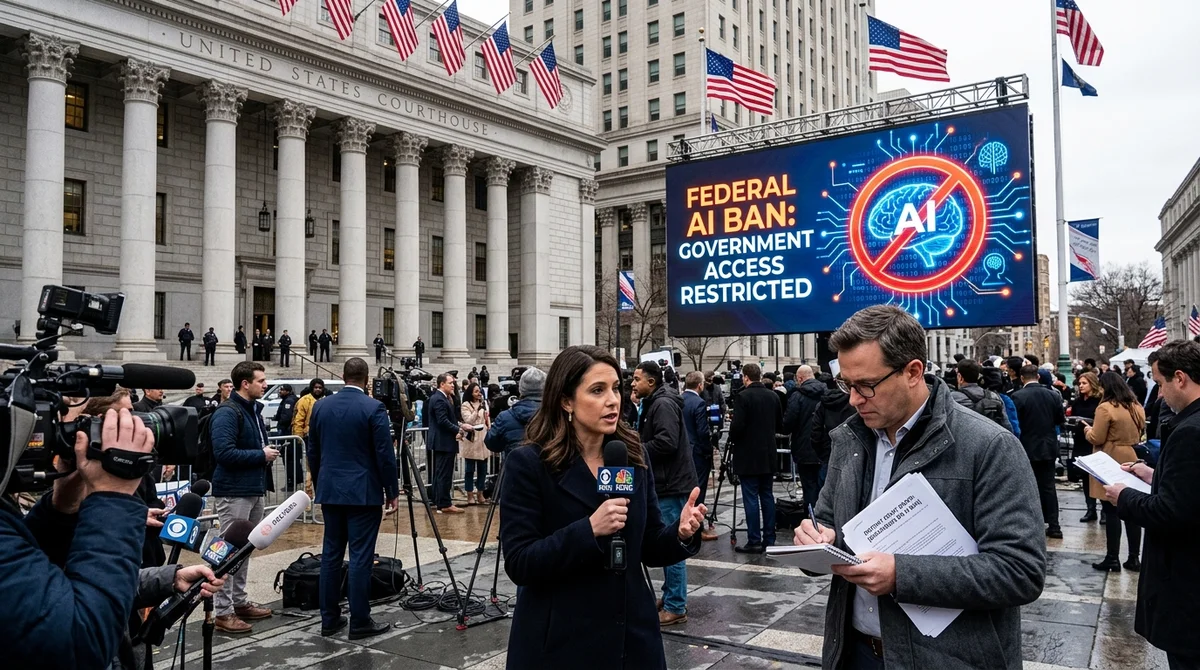
A US court has cast doubt on the Donald Trump administration's ban on federal agencies using Anthropic's AI tools. For the developer of Claude, this is not just a political dispute: the company says the restrictions could cost it billions of dollars in future revenue.
What the dispute is about
The proceedings were triggered by a ban on US federal bodies using Anthropic technology. According to the available description of the case, the company is challenging not a single contract but the administration's overall approach, which has effectively shut it out of an entire class of government customers. This is especially sensitive for Anthropic: the US public sector has long been considered one of the largest and most stable buyers of enterprise software, cloud services and automation tools.
The dispute goes well beyond one company. If federal agencies are barred from using the products of a specific AI developer, it immediately affects the market and how other customers perceive risk. For private companies, such a signal can mean extra vetting, a pause in procurement and more cautious pilots. That is why Anthropic talks about potential losses in the billions of dollars: it is concerned not only with current sales but with a long chain of future deals that could have followed government approval.
A signal from the court
At the hearing, the judge clearly did not accept the administration's arguments without questions. The description of the session says he was skeptical of the justification for the ban and called the situation troubling. This is an important signal, even though there is no final ruling in the case yet. In disputes like this, the court's position at an early stage often shows how convincingly the government can defend its actions and how likely it is that the ban will have to be reviewed or explained anew.
The court's tone matters to Anthropic in several ways. First, the company gets a chance to move the dispute from the political arena to a legal one, where specific reasons and evidence are required. Second, even interim skepticism from the court helps limit reputational damage: the market sees that the ban does not look beyond dispute. Third, the very fact of an open court discussion increases transparency about how exactly the authorities intend to regulate AI companies' access to government customers.
What is at stake for the market
The story around Anthropic matters not only for the company itself but for the entire US AI industry. Government procurement often serves as a marker of trust: if a product is cleared for agencies, it makes negotiations with banks, corporations and large contractors easier. If a supplier is cut off without logic the market can understand, the consequences quickly spread beyond the contract itself. That is why not only lawyers but also teams selling enterprise AI are watching the case closely.
- for Anthropic, this is the risk of losing not one sales channel but an entire segment of customers
- for other AI companies, it is a signal that access to the public sector may depend on more than product quality
- for enterprise customers, it is a reason to look more closely at regulatory risks when choosing a model
- for the authorities, it is a test of whether they can explain restrictions with transparent criteria rather than vague wording
Another important factor is time. The AI market changes too fast, and even a few months of uncertainty can cost a company major contracts, partnerships and integrations. If Anthropic is right about the scale of the damage, the dispute with the government becomes more than a legal problem: it becomes a factor that can affect the pace of the company's growth. For competitors, this is not neutral news either: any such decision shifts the balance of power in the enterprise AI market.
What this means
The court fight over Anthropic shows that the battle for the AI market is no longer waged only in labs and clouds, but also in courtrooms. If the authorities want to restrict specific models' access to government bodies, they will have to explain such decisions in concrete terms. Otherwise, every such ban will turn into a precedent with major consequences for the whole industry.
For Anthropic, the outcome of the case may become a test of its right to compete for one of the most valuable market segments.
- Nov 2, 2026Karpathy builds a YouTube clone with 6454 videos from Hacker News recommendations in two hours
- Nov 2, 2026Karpathy used Claude to build HackerTube from 6,454 videos recommended on Hacker News
- Nov 2, 2026Arca gives AI agents finance tasks lasting up to 10 days, but leaves the trades to humans
- Nov 2, 2026Anthropic needs to grow revenue 32% a year to cover $850 billion in contracts
Key Questions Answered
What the dispute is about?
The proceedings were triggered by a ban on US federal bodies using Anthropic technology. According to the available description of the case, the company is challenging not a single contract but the administration's overall approach, which has effectively shut it out of an entire class of government customers. This is especially sensitive for Anthropic: the US public sector has long been considered one of the largest and most stable buyers of enterprise software, cloud services and automation tools. The dispute goes well beyond one company. If federal agencies are barred fro
What are the key details on A signal from the court?
At the hearing, the judge clearly did not accept the administration's arguments without questions. The description of the session says he was skeptical of the justification for the ban and called the situation troubling. This is an important signal, even though there is no final ruling in the case yet. In disputes like this, the court's position at an early stage often shows how convincingly the government can defend its actions and how likely it is that the ban will have to be reviewed or explained anew. The court's tone matters to Anthropic in several ways. First, the com
What is at stake for the market?
The story around Anthropic matters not only for the company itself but for the entire US AI industry. Government procurement often serves as a marker of trust: if a product is cleared for agencies, it makes negotiations with banks, corporations and large contractors easier. If a supplier is cut off without logic the market can understand, the consequences quickly spread beyond the contract itself. That is why not only lawyers but also teams selling enterprise AI are watching the case closely. for Anthropic, this is the risk of losing not one sales channel but an entire segm
Test Frontier LLMs & Autonomous Agents in One Workspace
Run Claude Opus 5.5, GPT-6, Gemini 3.1, and DeepSeek side-by-side in Nomad AI (nomadnet.ai) — unified model routing, deep research, and multimodal workflows under one subscription.
The AI world, distilled — once a week
Seven stories that actually mattered, hand-picked. No noise, no reposts, no press releases.
Done! Check your inbox for a confirmation.