Apple bets on local AI in M-series chips, not on giant models
Apple is often described as the loser of the AI race, but the company may be making a different bet: not on training giant models, but on cheap local inference. The point is the M-series chips: memory shared by the CPU, GPU and Neural Engine cuts the cost of moving data around and makes on-device model execution more practical for business and edge scenarios. The argument is not that Apple Silicon replaces data centers. It is that a significant part of the AI market lies in applying ready-made models, and that is where local inference can be Apple's strength.
AI-processed from Habr AI; edited by Hamidun News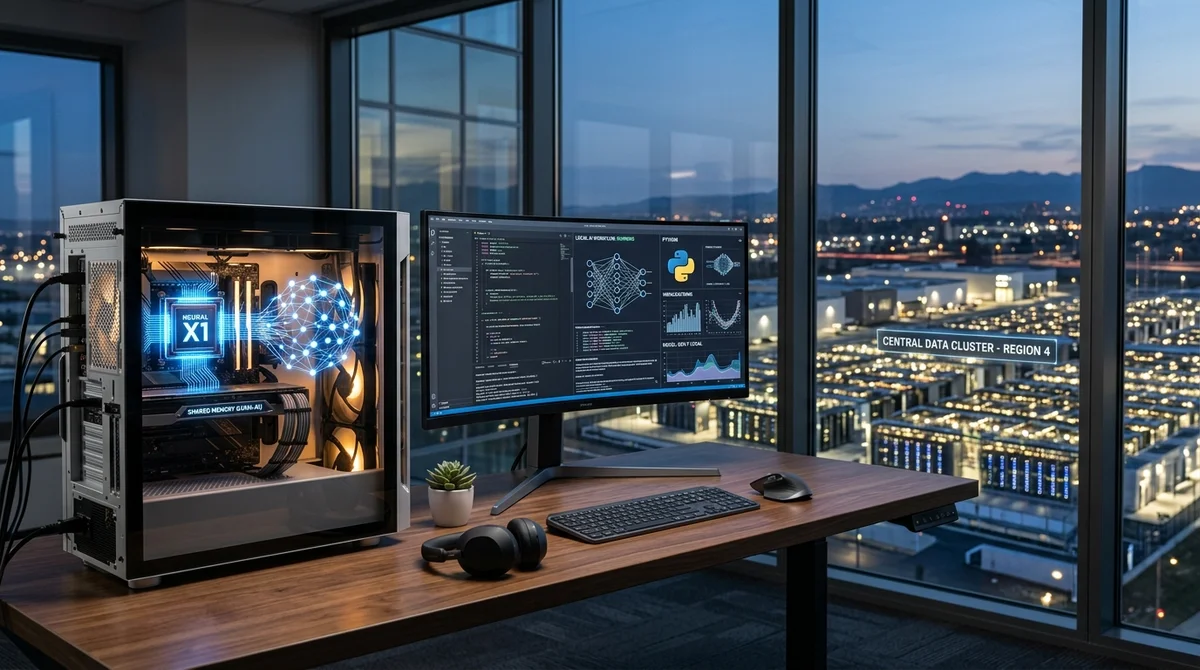
Apple rarely shows up in AI headlines as loudly as OpenAI, Google or NVIDIA. But the claim that the company has lost the race may be too narrow: Apple is betting not on the biggest models, but on inference that runs locally, economically and without constant dependence on the cloud.
The wrong metric
When the market talks about AI, the conversation almost always comes down to the same set of status symbols: how many GPUs a company has, how large its data centers are, what a new training run cost, and whether a model can beat rivals on benchmarks. Against that backdrop, Apple does look odd. Siri has long been a convenient target for jokes, its own large model does not dominate the news, and its integrations with outside systems are seen more as a catch-up move.
But that is the article's central thesis: Apple may be competing not in the race for the biggest model, but in the race for the most practical way to use AI. Look at inference rather than training, and the picture changes. What matters is not cluster size but how fast, cheap and reliably a model can run next to the user — on a laptop, a workstation or another local device.
A bet on chips
The key argument is the architecture of Apple Silicon. In a conventional design, the CPU and GPU work with separate memory pools, and data has to be shuttled constantly between them. This adds latency, burns energy and runs into the bus bandwidth limit. In M-series chips, Apple uses unified memory: the CPU, GPU and Neural Engine work with one shared space. That reduces unnecessary copying and makes the system better suited to inference.
- The CPU, GPU and Neural Engine access shared memory without constantly copying data
- Less is lost in transfers between compute blocks, and energy use is lower
- Running models locally becomes more realistic for everyday tasks
- AI workloads can be moved closer to the user, not just to the cloud
The author singles out the Neural Engine, a specialized block built for the tensor operations that modern AI relies on. The logic is simple: if inference is not general-purpose computing but mostly repetitive matrix operations, it is more efficient to give them dedicated hardware than to try to handle everything with the CPU or GPU alone. In this logic, Apple does not copy NVIDIA's data-center approach, but builds more compact, applied infrastructure on the device side.
Where this is useful
The practical value of this approach is most visible where cost, latency and power consumption matter. That could be edge deployment, back-office automation, local data processing, scenarios with privacy requirements, or workflows where there is no point in sending every request to the cloud.
Yes, a cloud H100 cluster will deliver higher peak performance. But for many real-world tasks, a business needs not a record but predictable economics and the ability to keep the system close at hand.
The approach has limits. Apple Silicon does not abolish data centers and does not make training large models on huge GPU clusters unnecessary. If you need to train frontier models or serve millions of simultaneous users, cloud infrastructure is not going anywhere. The point is different: a significant part of the AI market lies not in training but in applying ready-made models, and that is where local inference may prove to be Apple's strength.
"This is not losing the race.
It is taking part in a completely different race."
What this means
The main idea is simple: Apple does not have to beat NVIDIA or OpenAI by their rules to take an important place in the AI ecosystem. If the market really shifts from demonstrating power to deployments that pay off, the advantage will go to those who can run models closer to the user, more cheaply and at lower cost. For developers and companies, this looks less like hype and more like working infrastructure. And in this version of the race, Apple does have a strong position.
- Nov 2, 2026TensorFold 1.2.0 boosts Qwen3.8-27B throughput on M3 Ultra by 44.2% at 16 streams
- Nov 1, 2026Local models lose to Opus and Codex: 0.21 on a MacBook versus 1.00 for Codex
- Oct 29, 2026Claude Code Edits Video From a Transcript: How the video-use Skill With 30 000 Stars Works
- Oct 29, 2026Stanford AI tool verifies part of Signal's code in half a day for under $500, versus five months of expert work
Key Questions Answered
What are the key details on The wrong metric?
When the market talks about AI, the conversation almost always comes down to the same set of status symbols: how many GPUs a company has, how large its data centers are, what a new training run cost, and whether a model can beat rivals on benchmarks. Against that backdrop, Apple does look odd. Siri has long been a convenient target for jokes, its own large model does not dominate the news, and its integrations with outside systems are seen more as a catch-up move. But that is the article's central thesis: Apple may be competing not in the race for the biggest model, but in
What are the key details on A bet on chips?
The key argument is the architecture of Apple Silicon. In a conventional design, the CPU and GPU work with separate memory pools, and data has to be shuttled constantly between them. This adds latency, burns energy and runs into the bus bandwidth limit. In M-series chips, Apple uses unified memory: the CPU, GPU and Neural Engine work with one shared space. That reduces unnecessary copying and makes the system better suited to inference. The CPU, GPU and Neural Engine access shared memory without constantly copying data Less is lost in transfers between compute blocks, and e
Where this is useful?
The practical value of this approach is most visible where cost, latency and power consumption matter. That could be edge deployment, back-office automation, local data processing, scenarios with privacy requirements, or workflows where there is no point in sending every request to the cloud. Yes, a cloud H100 cluster will deliver higher peak performance. But for many real-world tasks, a business needs not a record but predictable economics and the ability to keep the system close at hand. The approach has limits. Apple Silicon does not abolish data centers and does not mak
Test Frontier LLMs & Autonomous Agents in One Workspace
Run Claude Opus 5.5, GPT-6, Gemini 3.1, and DeepSeek side-by-side in Nomad AI (nomadnet.ai) — unified model routing, deep research, and multimodal workflows under one subscription.
The AI world, distilled — once a week
Seven stories that actually mattered, hand-picked. No noise, no reposts, no press releases.
Done! Check your inbox for a confirmation.