Kandou AI raises $225M from SoftBank and Synopsys as the AI chip race heats up
Kandou AI has closed a $225M round with participation from SoftBank, Synopsys and Maverick Silicon. The AI chip startup is led by a former Goldman Sachs managing director, an unusual profile for this market. The deal shows that investors keep looking for alternatives to today's AI infrastructure leaders, and are willing to bet not only on models but also on the hardware that runs them.
AI-processed from Bloomberg Tech; edited by Hamidun News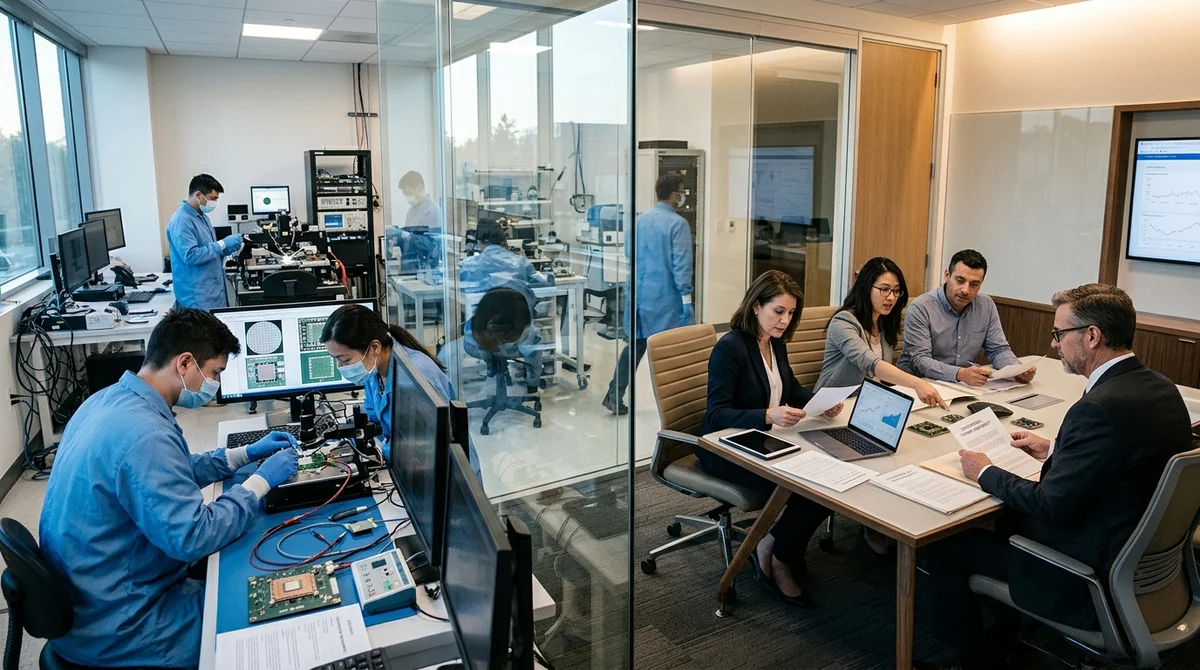
Kandou AI has raised $225M, joining the list of companies now closely watched in the race for AI infrastructure. What matters for the market is not only the size of the round but also who took part: SoftBank, Synopsys and Maverick Silicon all joined the deal.
Who joined the round
Kandou AI is a company working on AI chips, and its chief executive was previously a managing director at Goldman Sachs. That alone makes the story stand out: in the semiconductor business, teams combining financial and technology backgrounds like this rarely end up in the spotlight. The startup has now announced it has raised $225M, and a round of this size shows that investors are still ready to place large bets on the foundational infrastructure for artificial intelligence.
The investor lineup is telling too. SoftBank has long been associated with big technology bets and does not enter deals by accident, especially in a segment with a long development cycle and high capital intensity. Synopsys sits at the core of the semiconductor ecosystem, and its participation reads as a strong industry signal. Maverick Silicon adds weight from the chip market itself. Together, this looks less like speculative interest and more like a bet on a real technology platform.
Why it matters
Over the past two years, AI money has mostly gone to models, clouds and data centers. But without dedicated hardware, specialized accelerators and new architectures, that growth quickly runs into limits on cost, power consumption and compute availability. That is why news of funding rounds in chips now reads as more than ordinary venture financing: it indicates where the market is ready to send the next layer of capital.
In Kandou AI's case, several signals matter at once:
- a large check for a company working in the complex and expensive AI chip segment;
- participation of both financial and strategic investors;
- confirmation of interest in alternative computing platforms, not just software and models;
- growing trust in teams that promise to build the infrastructure layer for the next wave of AI.
Even from a brief description of the deal, it is clear that the market keeps looking for new entry points into AI hardware. That matters across the whole chain, from model developers to enterprise customers, who now weigh not only generation quality but also the cost of running, scaling and maintaining AI services. The more strong hardware players the industry has, the better the chance of reducing dependence on a narrow circle of suppliers and of seeing more flexible configurations.
A signal for the market
The round by itself does not answer every question about Kandou AI's product, the timeline for bringing its solutions to market, or the company's future share of the industry. But the published information is enough to see the main point: investor interest in AI chips is not cooling, and is instead becoming more selective and strategic. Money is going not to teams that simply have the buzzword AI in their description, but to companies that claim a place in the fundamental technology stack.
For SoftBank, such a deal fits a clear logic of seeking big platform stories. For Synopsys, it is also a marker that industry players are watching new architectures and new entrants closely. And for the market as a whole, it is one more reminder: the fight for AI leadership is waged not only at the level of chatbots and models, but much deeper, at the level of chips, design tools and control over the computing base.
What this means
The Kandou AI round shows that AI capital is shifting ever more from showcase applications to infrastructure. If the trend holds, the spotlight will fall not only on model developers but also on companies building new hardware for the next stage of the AI race.
Key Questions Answered
Who joined the round?
Kandou AI is a company working on AI chips, and its chief executive was previously a managing director at Goldman Sachs. That alone makes the story stand out: in the semiconductor business, teams combining financial and technology backgrounds like this rarely end up in the spotlight. The startup has now announced it has raised $225M, and a round of this size shows that investors are still ready to place large bets on the foundational infrastructure for artificial intelligence. The investor lineup is telling too. SoftBank has long been associated with big technology bets and
Why it matters?
Over the past two years, AI money has mostly gone to models, clouds and data centers. But without dedicated hardware, specialized accelerators and new architectures, that growth quickly runs into limits on cost, power consumption and compute availability. That is why news of funding rounds in chips now reads as more than ordinary venture financing: it indicates where the market is ready to send the next layer of capital. In Kandou AI's case, several signals matter at once: a large check for a company working in the complex and expensive AI chip segment; participation of bot
What are the key details on A signal for the market?
The round by itself does not answer every question about Kandou AI's product, the timeline for bringing its solutions to market, or the company's future share of the industry. But the published information is enough to see the main point: investor interest in AI chips is not cooling, and is instead becoming more selective and strategic. Money is going not to teams that simply have the buzzword AI in their description, but to companies that claim a place in the fundamental technology stack. For SoftBank, such a deal fits a clear logic of seeking big platform stories. For Syn
Test Frontier LLMs & Autonomous Agents in One Workspace
Run Claude Opus 5.5, GPT-6, Gemini 3.1, and DeepSeek side-by-side in Nomad AI (nomadnet.ai) — unified model routing, deep research, and multimodal workflows under one subscription.
The AI world, distilled — once a week
Seven stories that actually mattered, hand-picked. No noise, no reposts, no press releases.
Done! Check your inbox for a confirmation.