White House unveils AI regulation plan: Trump wants a single national standard
The White House has published a framework for a future AI law, effectively kicking off a new battle in Congress. The Trump administration proposes a single federal standard in place of a patchwork of state laws. It promises protections for children and creators, but bets on light-touch regulation, sandboxes for developers, access to data and faster construction of AI infrastructure without higher electricity rates for households. The document is not a bill and changes nothing on its own, but it sets the direction for Congress. The biggest obstacle is its proposed federal priority over state laws.
AI-processed from Bloomberg Tech; edited by Hamidun News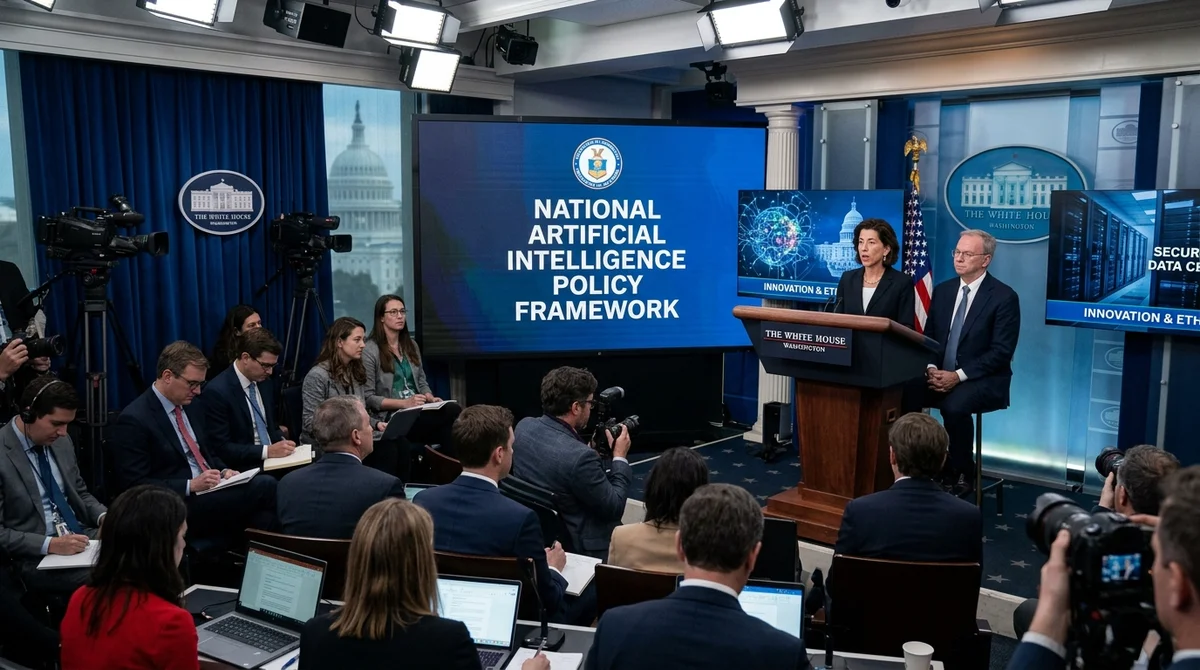
The White House has published a national framework for a future federal law on artificial intelligence. The administration of Donald Trump is offering Congress not a rigid set of prohibitions but a political scaffold: uniform rules for the whole country, fewer barriers for business, and separate measures to protect children, creators and consumers.
What is in the framework
The four-page document is not a bill and changes nothing by itself, but it sets a direction for Congress. The White House has gathered several priorities in it that, in the administration's view, should speed up AI adoption while reducing the most sensitive risks to society. It covers not only models and chatbots but also infrastructure: data centers, the power grid, workforce training and the powers of federal agencies.
- Tools for parents, including controls for privacy, screen time and content
- Age verification and measures against child exploitation and the encouragement of self-harm
- Protecting consumers from higher electricity rates caused by AI data centers
- An approach to copyright and to digital replicas of voice, face and likeness
- Regulatory sandboxes, access to datasets and training in working with AI
There is also a separate emphasis on fraud and national security. The White House wants to strengthen the authorities' ability to fight AI-driven identity forgery and other scams, especially those targeting older people, and to give relevant agencies more technical expertise to assess the capabilities of frontier models. At the same time, the administration says outright that it does not want to create a new federal super-regulator for AI. Instead, it proposes relying on existing bodies and industry standards.
The main fight with the states
The most contentious part of the framework is the idea of federal priority over state laws. The Trump administration argues that the US cannot develop AI under fifty different sets of rules, with California, Colorado, Texas, New York and other states each going their own way. The White House proposes that Congress establish a single, minimally burdensome standard and limit those regional rules that, in Washington's view, hold back the development and adoption of AI.
"This framework will only work with uniform rules across the country," the
White House document states.
But this is where the initiative faces the most political obstacles. Even Republicans do not fully agree on how far to go in loosening rules for large tech companies, and in the Senate the bill would still need Democratic support. With the midterm elections looming, a deal will be harder still: some politicians are betting on protecting consumers, jobs and local communities, which are already fighting over data center construction, their energy use and their environmental impact.
Innovation instead of a new regulator
In spirit, this is one of the lightest federal approaches to AI regulation in recent years. The White House does not propose settling in law the central conflict over training models on copyrighted content. On the contrary, the administration believes the courts should keep working through the fair use question, while Congress should, for now, cautiously consider only licensing mechanisms and collective negotiation of compensation, without prejudging the outcome for the whole industry.
The same approach shows in the section on free speech and innovation. The administration wants to bar federal agencies from pressuring AI platforms over moderation of political content, expand regulatory sandboxes and release more government datasets in a format suitable for training models. At the same time, the White House proposes investing in retraining workers, teaching AI skills within existing education programs, and technical assistance for small businesses, so that the benefits of the AI boom go beyond the largest corporations.
What this means
The White House has made its bet clear: the US needs not new strict limits but a federal framework that removes some regulatory uncertainty and speeds up the race for AI leadership. The key question is no longer whether the administration has a position, but whether Congress can turn this political draft into real legislation without it collapsing in disputes over states' rights, protection of creators and the price of rapid growth.
- Oct 31, 2026Author puts his script before an AI jury: the verdict cost 850 thousand tokens
- Oct 30, 2026Agent traffic on Zocdoc is up 30x since July, and ChatGPT faces two health lawsuits
- Oct 29, 2026OvisOCR3: an 0.8B-parameter model that reads documents better than specialized systems
- Oct 29, 2026Tencent releases Youtu-Parsing-Omni: one model parses documents, audio and video
Key Questions Answered
What is in the framework?
The four-page document is not a bill and changes nothing by itself, but it sets a direction for Congress. The White House has gathered several priorities in it that, in the administration's view, should speed up AI adoption while reducing the most sensitive risks to society. It covers not only models and chatbots but also infrastructure: data centers, the power grid, workforce training and the powers of federal agencies. Tools for parents, including controls for privacy, screen time and content Age verification and measures against child exploitation and the encouragement o
What are the key details on The main fight with the states?
The most contentious part of the framework is the idea of federal priority over state laws. The Trump administration argues that the US cannot develop AI under fifty different sets of rules, with California, Colorado, Texas, New York and other states each going their own way. The White House proposes that Congress establish a single, minimally burdensome standard and limit those regional rules that, in Washington's view, hold back the development and adoption of AI. "This framework will only work with uniform rules across the country," the White House document states. But t
What are the key details on Innovation instead of a new regulator?
In spirit, this is one of the lightest federal approaches to AI regulation in recent years. The White House does not propose settling in law the central conflict over training models on copyrighted content. On the contrary, the administration believes the courts should keep working through the fair use question, while Congress should, for now, cautiously consider only licensing mechanisms and collective negotiation of compensation, without prejudging the outcome for the whole industry. The same approach shows in the section on free speech and innovation. The administration
Test Frontier LLMs & Autonomous Agents in One Workspace
Run Claude Opus 5.5, GPT-6, Gemini 3.1, and DeepSeek side-by-side in Nomad AI (nomadnet.ai) — unified model routing, deep research, and multimodal workflows under one subscription.
The AI world, distilled — once a week
Seven stories that actually mattered, hand-picked. No noise, no reposts, no press releases.
Done! Check your inbox for a confirmation.