Zendesk buys Forethought to strengthen its AI agents for customer service
Zendesk has announced the acquisition of Forethought, a startup that was among the first to bet on autonomous AI for customer support. The company plans to build Forethought's self-improving agents into its Resolution Platform and says the move will accelerate its product roadmap by more than a year. For the customer service market, it's one more sign that the fight is no longer about chatbots but about full-fledged AI agents.
AI-processed from TNW; edited by Hamidun News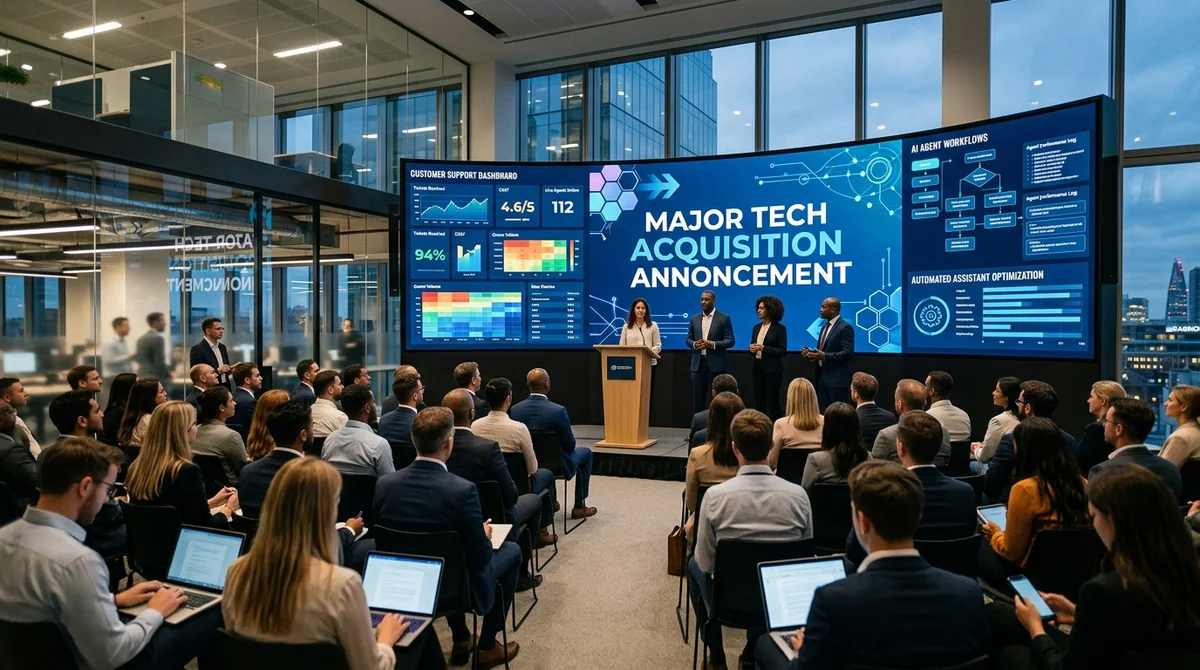
On March 12, 2026, Zendesk announced it is acquiring Forethought, a startup that was among the first to bet on autonomous AI for customer support. For Zendesk, it is the largest deal of its kind in two decades and an attempt to claim the lead in agentic customer service faster.
Why Zendesk wants this deal
Forethought has long been a notable player in the AI support niche. The company first made a splash in 2018, when it won TechCrunch Startup Battlefield. Back then, the idea that AI could hold conversations with customers on its own and resolve tickets without human involvement seemed too bold. But that bet is exactly what Forethought built its business on. The company was founded by Deon Nicholas and Sami Ghoche, who were both just 24 when they started.
The deal terms have not been disclosed, but according to industry publications, it is Zendesk's largest acquisition in roughly twenty years. The company planned to close the deal by the end of March 2026. By then, Forethought had raised $115 million in funding and built a substantial customer base.
Zendesk's logic is simple: the company believes 2026 will be the turning point when AI agents start handling more support requests than human agents. Internally, Zendesk expects the Forethought integration to accelerate its product roadmap by more than a year.
What Forethought brings
Forethought's main asset isn't just chatbots but what it calls self-improving AI. These are agents that aren't limited to rigid, predefined scripts: they learn from every new conversation, build their own procedures, rework steps, and adapt to new situations without constant manual rewrites of the logic. According to the company, by 2025 its system was already handling more than a billion customer interactions per month for Upwork, Grammarly, Airtable, and Datadog.
"The era of simply managing conversations is over," said
Zendesk CEO Tom Eggemeier.
After the integration, Zendesk wants to build Forethought's capabilities into its Resolution Platform, which the company says already resolves more than 80% of customer requests end to end. In practice, this should add several new layers of automation:
- specialized AI agents for B2B, B2C, and internal service scenarios
- self-learning from real conversations, including spotting gaps in workflows
- autonomous execution of complex multi-step procedures
- full automation of voice channels
- integration with enterprise systems even where no ready-made APIs exist
The race for the support market
The deal looks less like a one-off experiment and more like part of a broader consolidation. After its $10.2 billion buyout by Hellman & Friedman and Permira in November 2022, Zendesk noticeably accelerated its AI strategy. In 2024, the company bought Finland's Ultimate, which focused on service automation, and now it is adding Forethought as a stronger agentic AI layer.
Since its founding in 2007, Zendesk has made about a dozen acquisitions but has rarely disclosed the amounts. Known examples include Zopim for $29.8 million in 2014 and BIME for $45 million in 2015.
Meanwhile, the agentic customer service market is quickly filling up with competitors. Salesforce, Intercom, and a whole group of well-funded AI startups are fighting over the same territory. The question is no longer whether autonomous agents will come to customer support, but who will become the standard for businesses.
Buying Forethought gives Zendesk a head start in time and technology, but holding that lead will be harder if competitors catch up on core features before the company can finish the integration and scale the new stack across its customer base.
What it means
The customer support market is moving from conventional chatbots to systems that learn on their own, rework processes, and resolve a growing share of tasks without a human. For enterprise software, the signal is clear: the winners won't be the companies that simply have AI, but those that turn it into a working service agent fastest.
- Nov 2, 2026DeepSeek open-sources Super-agent prototype: p95 task completion time of 15.7 minutes vs. 29.5
- Nov 2, 2026Bun creator uses Claude Code to port 750K lines from Zig to Rust in 11 days
- Nov 2, 2026Microsoft releases 4B model Mage-VL-Cowork, which solves 66.0% of OSWorld-Verified tasks
- Nov 2, 2026Meta's Muse assistant keeps dossiers on loved ones and gets root on Ubuntu by default
Key Questions Answered
Why Zendesk wants this deal?
Forethought has long been a notable player in the AI support niche. The company first made a splash in 2018, when it won TechCrunch Startup Battlefield. Back then, the idea that AI could hold conversations with customers on its own and resolve tickets without human involvement seemed too bold. But that bet is exactly what Forethought built its business on. The company was founded by Deon Nicholas and Sami Ghoche, who were both just 24 when they started. The deal terms have not been disclosed, but according to industry publications, it is Zendesk's largest acquisition in rou
What Forethought brings?
Forethought's main asset isn't just chatbots but what it calls self-improving AI. These are agents that aren't limited to rigid, predefined scripts: they learn from every new conversation, build their own procedures, rework steps, and adapt to new situations without constant manual rewrites of the logic. According to the company, by 2025 its system was already handling more than a billion customer interactions per month for Upwork, Grammarly, Airtable, and Datadog. "The era of simply managing conversations is over," said Zendesk CEO Tom Eggemeier. After the integration, Zen
What are the key details on The race for the support market?
The deal looks less like a one-off experiment and more like part of a broader consolidation. After its $10.2 billion buyout by Hellman & Friedman and Permira in November 2022, Zendesk noticeably accelerated its AI strategy. In 2024, the company bought Finland's Ultimate, which focused on service automation, and now it is adding Forethought as a stronger agentic AI layer. Since its founding in 2007, Zendesk has made about a dozen acquisitions but has rarely disclosed the amounts. Known examples include Zopim for $29.8 million in 2014 and BIME for $45 million in 2015. Meanwhi
Test Frontier LLMs & Autonomous Agents in One Workspace
Run Claude Opus 5.5, GPT-6, Gemini 3.1, and DeepSeek side-by-side in Nomad AI (nomadnet.ai) — unified model routing, deep research, and multimodal workflows under one subscription.
The AI world, distilled — once a week
Seven stories that actually mattered, hand-picked. No noise, no reposts, no press releases.
Done! Check your inbox for a confirmation.