Senators Warren and Hawley Demand Disclosure of Real US Data Center Energy Use
US senators Elizabeth Warren and Josh Hawley have called on the EIA to keep full annual records of data center energy consumption. The agency is currently launching only a voluntary pilot in a few states, including Texas and Washington. The lawmakers argue that without mandatory reporting, it is impossible to plan grid load properly or to prevent a sharp rise in household electricity rates.
AI-processed from The Verge; edited by Hamidun News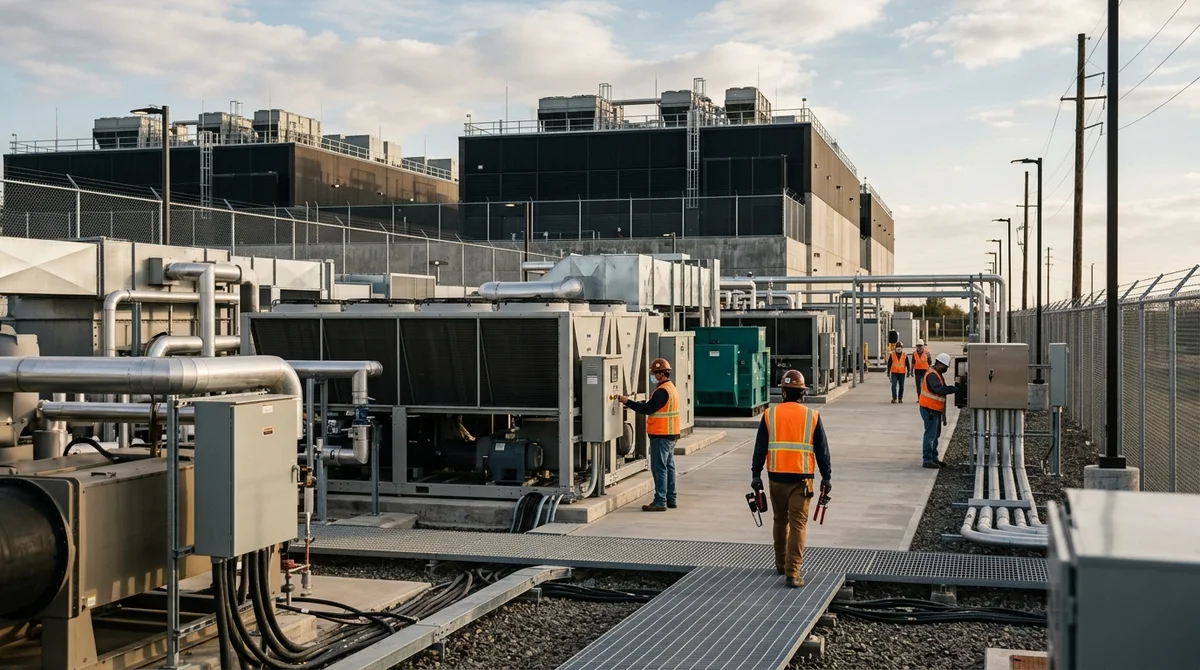
US senators Elizabeth Warren and Josh Hawley are demanding that the US Energy Information Administration begin full-scale tracking of data center energy consumption. In their view, without mandatory, regular reporting the government can neither plan power system load accurately nor protect consumers from rising electricity bills.
Why the senators stepped in
Warren and Hawley sent the EIA a letter urging it to collect comprehensive annual data on data center energy use. The move is telling in itself: a Democratic and a Republican senator are raising the issue together, which suggests the question has gone well beyond the usual disputes over climate or technology policy. It is no longer only about Big Tech, but about who ultimately pays for the fast-growing computing infrastructure.
The senators tie the lack of transparency directly to risks for the power system. If federal authorities do not know how much electricity large data centers actually consume, it is harder for them to forecast demand, plan generation and prepare grid infrastructure in advance in regions where new facilities are arriving. The letter also frames this as an economic issue: incomplete data makes it harder to build a policy that stops large companies from indirectly raising costs for American families.
Data on data center consumption is needed for accurate grid planning
and for decisions that do not raise bills for families.
Why the pilot is not enough
At the same time, the EIA has already announced a pilot program to assess data center energy use. But the scheme has an important limitation: participation is voluntary, and the program covers only part of the country, including Texas and Washington. For the senators, that is not enough, because selective measurements do not give a national picture and do not become a lasting monitoring system. In essence, it is reconnaissance, not a full oversight mechanism.
The core complaint comes down to four points:
- a voluntary model does not guarantee participation by the largest players;
- data from individual states does not show the full load across the country;
- a pilot does not replace regular annual reporting;
- without a disclosure standard, the figures are hard to compare and to use in rate policy.
If companies take part by choice, the resulting statistics will almost inevitably be fragmentary. Some operators will disclose the convenient part of the information, others will limit themselves to the minimum, and still others will stay out of the sample entirely. That is a weak basis for energy planning: grids are built not on rough estimates but on specific loads, commissioning dates for new sites and regional infrastructure bottlenecks. For decisions on multibillion-dollar grid investments, this is clearly not enough.
What is at stake
The dispute over reporting looks technical only on paper. In practice, it is about how cities, states and federal bodies will prepare for rising demand from cloud infrastructure and AI computing capacity. Every new large data center campus is not just buildings full of servers, but an added load on substations, transmission lines, reserve capacity and the local electricity market. And such projects are appearing more and more often.
A full picture of energy consumption is needed for several decisions at once:
- where to reinforce the grid first;
- how much reserve capacity fast-growing regions will need;
- how to assess the impact of large facilities on peak demand;
- who should pay for infrastructure upgrades;
- how to avoid shifting those costs onto households and small businesses.
That is why the senators stress everyday consequences rather than technology fashion. If the government lacks reliable statistics on the biggest consumers, it sees future shortfalls less clearly and reacts to grid overload later. And when upgrades start late, the cost of the mistake is often spread across the whole system, through rates, subsidies or emergency infrastructure spending. For regulators, this is no longer only a question of technology but of public cost.
What this means
In the US, a tougher debate is beginning over whether data centers should disclose their real energy use as systematically as other major pieces of infrastructure. If the senators' pressure works, the industry could face not local voluntary surveys but permanent federal reporting, which would affect both energy planning and the rules of the game for the largest technology companies.
- Oct 31, 2026Author puts his script before an AI jury: the verdict cost 850 thousand tokens
- Oct 31, 2026SciGame Tests Five LLM Agents: Familiar Formulas Get in the Way of Finding Altered Laws
- Oct 30, 2026Agent traffic on Zocdoc is up 30x since July, and ChatGPT faces two health lawsuits
- Oct 29, 2026OvisOCR3: an 0.8B-parameter model that reads documents better than specialized systems
Key Questions Answered
Why the senators stepped in?
Warren and Hawley sent the EIA a letter urging it to collect comprehensive annual data on data center energy use. The move is telling in itself: a Democratic and a Republican senator are raising the issue together, which suggests the question has gone well beyond the usual disputes over climate or technology policy. It is no longer only about Big Tech, but about who ultimately pays for the fast-growing computing infrastructure. The senators tie the lack of transparency directly to risks for the power system. If federal authorities do not know how much electricity large data
Why the pilot is not enough?
At the same time, the EIA has already announced a pilot program to assess data center energy use. But the scheme has an important limitation: participation is voluntary, and the program covers only part of the country, including Texas and Washington. For the senators, that is not enough, because selective measurements do not give a national picture and do not become a lasting monitoring system. In essence, it is reconnaissance, not a full oversight mechanism. The core complaint comes down to four points: a voluntary model does not guarantee participation by the largest play
What is at stake?
The dispute over reporting looks technical only on paper. In practice, it is about how cities, states and federal bodies will prepare for rising demand from cloud infrastructure and AI computing capacity. Every new large data center campus is not just buildings full of servers, but an added load on substations, transmission lines, reserve capacity and the local electricity market. And such projects are appearing more and more often. A full picture of energy consumption is needed for several decisions at once: where to reinforce the grid first; how much reserve capacity fast
Test Frontier LLMs & Autonomous Agents in One Workspace
Run Claude Opus 5.5, GPT-6, Gemini 3.1, and DeepSeek side-by-side in Nomad AI (nomadnet.ai) — unified model routing, deep research, and multimodal workflows under one subscription.
The AI world, distilled — once a week
Seven stories that actually mattered, hand-picked. No noise, no reposts, no press releases.
Done! Check your inbox for a confirmation.