Tesla's Shanghai plant called the «golden key» to Optimus mass production
Tesla China president Wang Hao called the Shanghai Gigafactory the «golden key» to mass production of Optimus robots — the first time a company executive has publicly linked the plant to robot manufacturing. In 2025, the facility produced 851,000 electric vehicles. Tesla has already deployed more than 1,000 Optimus Gen 3 robots at its own facilities and plans to use Shanghai's infrastructure to scale up.
AI-processed from TNW; edited by Hamidun News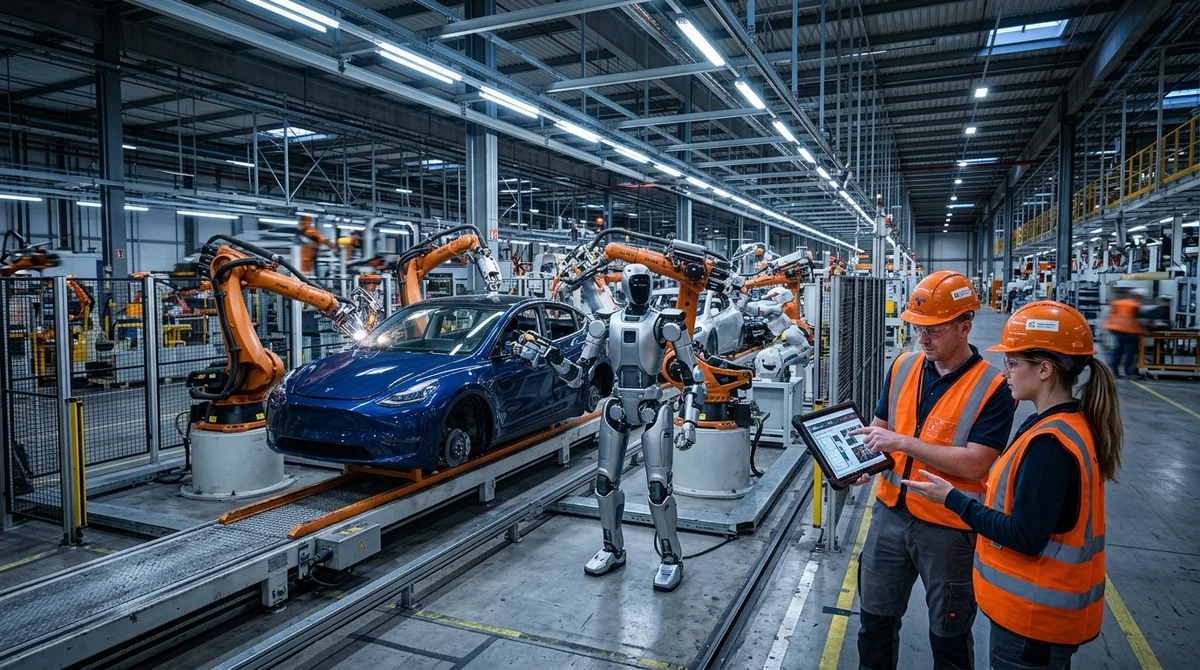
President of Tesla in China Wang Hao publicly called the Shanghai Gigafactory the "golden key" to mass production of Optimus humanoid robots. This is the first statement by a top company executive directly linking the plant to Tesla's robotics ambitions.
Shanghai as a robotics beachhead
The Shanghai Gigafactory is Tesla's largest manufacturing facility outside the United States. In 2025, the plant produced 851,000 electric vehicles, making it a key link in the company's global supply chain. The factory's productivity confirms: industrial-scale infrastructure is already in place here.
Wang Hao spoke at an industry event where he highlighted the competitive advantage of the Shanghai site: proximity to an extensive network of Chinese component suppliers, established logistics chains, and experienced engineering teams. It is precisely this combination, according to him, that makes Shanghai the "golden key" to moving Optimus from the prototype stage to a mass-produced product.
The context is important: until this moment, Tesla had not made any public official statements about the role of the Shanghai facility in its robotics plans. Wang Hao's comment is the first signal of this kind from top management, and it changes how the market perceives the company's strategy.
A thousand robots already deployed
Tesla is not just designing future production — the company has already deployed more than 1,000 Optimus Gen 3 units at its own facilities. The robots perform internal tasks: sorting parts, supporting operations on assembly lines, and moving cargo within workshops. In essence, Tesla's factories themselves are becoming a testing ground for the technology.
- More than 1,000 Optimus Gen 3 robots deployed within Tesla right now
- In 2025, the Shanghai plant produced 851,000 electric vehicles
- Production infrastructure is ready for diversification without significant capital investment
- Local supply chains reduce component costs compared to the United States
- The Chinese market is the world's largest in terms of potential demand for industrial robots
For now, Optimus robots work exclusively within Tesla; however, the company has repeatedly announced plans to begin commercial deliveries to third-party customers. Tesla's CEO previously called Optimus potentially the company's most valuable product — more important than its entire automotive business. The Shanghai facility becomes the starting point in this scenario: serial production will be worked out here first, then exports will begin.
The humanoid race accelerates
Wang Hao made his statement in the context of intensifying competition in the humanoid robot segment. Chinese manufacturers — including Unitree, Fourier Intelligence, and a number of government-backed startups — are actively ramping up production and achieving price leadership through local supply chains.
"The
Shanghai Gigafactory is the golden key to mass production of Optimus," — Wang Hao, President of Tesla in China.
Chinese startups in the past two years have received significant government and venture capital support. According to analysts, the global humanoid robot market could exceed $10 billion by 2030. Tesla, with its manufacturing expertise and already established corporate customer base, is in a strong position — but the speed of the transition to series production remains the key question.
For Tesla, the public linking of a specific plant to its robotics plans is a signal to multiple audiences. Suppliers: prepare for new orders. Investors: strategy is becoming more concrete. Competitors: Tesla is using already created infrastructure rather than building from scratch.
What this means
The Shanghai Gigafactory is transitioning from the role of an EV plant to a strategic center for Tesla's robotics production. The company is consistently building its narrative: first — internal deployment, then — commercial launch. The next question is: when exactly will Optimus go beyond the walls of Tesla factories.
Key Questions Answered
What are the key details on Shanghai as a robotics beachhead?
The Shanghai Gigafactory is Tesla's largest manufacturing facility outside the United States. In 2025, the plant produced 851,000 electric vehicles, making it a key link in the company's global supply chain. The factory's productivity confirms: industrial-scale infrastructure is already in place here. Wang Hao spoke at an industry event where he highlighted the competitive advantage of the Shanghai site: proximity to an extensive network of Chinese component suppliers, established logistics chains, and experienced engineering teams. It is precisely this combination, accordi
What are the key details on A thousand robots already deployed?
Tesla is not just designing future production — the company has already deployed more than 1,000 Optimus Gen 3 units at its own facilities. The robots perform internal tasks: sorting parts, supporting operations on assembly lines, and moving cargo within workshops. In essence, Tesla's factories themselves are becoming a testing ground for the technology. More than 1,000 Optimus Gen 3 robots deployed within Tesla right now In 2025, the Shanghai plant produced 851,000 electric vehicles Production infrastructure is ready for diversification without significant capital investme
What are the key details on The humanoid race accelerates?
Wang Hao made his statement in the context of intensifying competition in the humanoid robot segment. Chinese manufacturers — including Unitree, Fourier Intelligence, and a number of government-backed startups — are actively ramping up production and achieving price leadership through local supply chains. "The Shanghai Gigafactory is the golden key to mass production of Optimus," — Wang Hao, President of Tesla in China. Chinese startups in the past two years have received significant government and venture capital support. According to analysts, the global humanoid robot ma
Test Frontier LLMs & Autonomous Agents in One Workspace
Run Claude Opus 5.5, GPT-6, Gemini 3.1, and DeepSeek side-by-side in Nomad AI (nomadnet.ai) — unified model routing, deep research, and multimodal workflows under one subscription.
The AI world, distilled — once a week
Seven stories that actually mattered, hand-picked. No noise, no reposts, no press releases.
Done! Check your inbox for a confirmation.