Palantir and Project Maven: How AI Helps the US Pick Targets for Strikes on Iran
Palantir is at the center of a new debate over military AI: the Project Maven system is helping the US Army select targets for strikes on Iran faster. Where such analysis once took months and dozens of people, project participants now say a single operator can do the same work in two weeks. The question is how much human verification remains in that speed.
AI-processed from Habr AI; edited by Hamidun News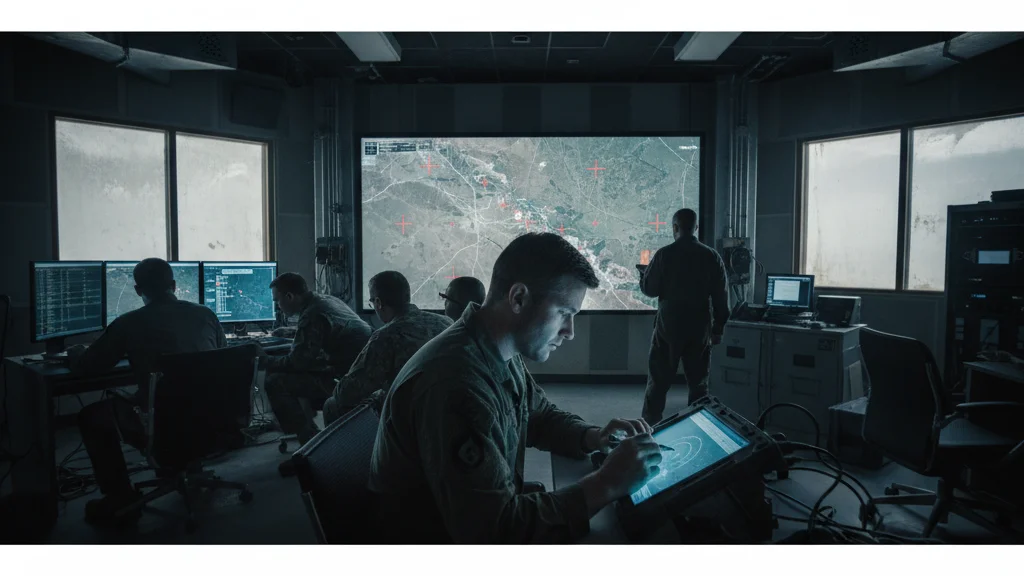

Project Maven, linked to Palantir, has moved to the center of debate after claims that the US Army is using AI to speed up target selection in the war with Iran. The central question is not how fast the system works, but how much human oversight remains in the decision chain.
The scale of the campaign
The news comes on day 32 of the US-Iran war. According to the administration of Donald Trump, the military struck roughly a thousand targets in a single day, and over the month the number of hit objects reached 11 thousand.
These figures matter as more than a measure of the campaign's intensity. They show that the old manual cycle of intelligence gathering, coordinate cross-checking and target status confirmation can no longer keep up with the pace of operations. When the count runs to hundreds and thousands of objects a day, the army inevitably leans on automation.
That is why Project Maven has drawn attention. The article describes it as a military analytics layer, a "Google Earth for war." Each point on the map carries more than a geotag: it has a set of attributes, including coordinates, altitude, object type and a label such as "friend" or "foe." In essence, it is an interface through which an operator gets an already sorted and prioritized picture of the battlefield, rather than raw data from dozens of independent sources.
How Maven works
The point of Maven is not that it presses the strike button itself, but that it sharply shortens the time between observation and decision. Work that once took analysts weeks or months, the system turns into a compressed cycle: collect signals, match objects, flag suspicious targets, and present them to a human in a readable form. This is where Palantir's role becomes key: the company has long built platforms that merge intelligence data, maps, logs, imagery and reports into a single working screen for the military and intelligence services.
- Object coordinates and altitude
- Target type and its possible role
- "Friend" or "foe" label
- Priority for review and strike
- A single map instead of scattered spreadsheets and briefings
Palantir CTO Shyam Sankar described the effect in strictly pragmatic terms: the system lets one person do in two weeks what used to take 50–100 specialists half a year. That sounds like a productivity gain, and it is how such platforms are usually sold to customers, as an "Iron Man suit" for a soldier or analyst. But in a military setting, speed is not a neutral metric. The shorter the target-selection cycle, the less time remains for doubt, extra verification and backing away from a mistake.
"What took 50–100 people half a year, one person now does in two weeks."
Where the main risk lies
The main concern is not that the algorithm has become fast, but that it can give an error the look of a confident decision. If the system misclassifies an object, confuses context or relies on incomplete data, the operator sees a ready-made recommendation on screen. In such an interface, an error does not arrive as chaos but as a neatly packaged suggestion with coordinates and labels. Psychologically, it is harder for a person to argue with a machine that shows a target on a map, assigns it a status and fits it into the overall rhythm of the operation.
There is a second risk: diluted accountability. When a strike passes through a long digital chain of sensors, models, databases, interfaces and final confirmation, it later becomes hard to say exactly where the failure occurred. Was it the analyst, the satellite image, the classifier, the intelligence source, or whoever set the priority too high? The more the military relies on such systems, the more important it becomes to have not only accuracy but transparency: who made the decision, on what data and with what level of confidence.
What this means
The Project Maven story shows that military AI has stopped being an experiment on the fringes of defense and become part of the real decision-making loop. For the industry, this is a signal: the main dispute is no longer whether target selection can be automated, but who is responsible for the consequences when the speed of the algorithm starts to set the tempo of war itself.
- Nov 2, 2026Karpathy builds a YouTube clone with 6454 videos from Hacker News recommendations in two hours
- Nov 2, 2026Karpathy used Claude to build HackerTube from 6,454 videos recommended on Hacker News
- Nov 2, 2026Anthropic needs to grow revenue 32% a year to cover $850 billion in contracts
- Nov 2, 2026Bun creator uses Claude Code to port 750K lines from Zig to Rust in 11 days
Key Questions Answered
What are the key details on The scale of the campaign?
The news comes on day 32 of the US-Iran war. According to the administration of Donald Trump, the military struck roughly a thousand targets in a single day, and over the month the number of hit objects reached 11 thousand. These figures matter as more than a measure of the campaign's intensity. They show that the old manual cycle of intelligence gathering, coordinate cross-checking and target status confirmation can no longer keep up with the pace of operations. When the count runs to hundreds and thousands of objects a day, the army inevitably leans on automation. That is
How Maven works?
The point of Maven is not that it presses the strike button itself, but that it sharply shortens the time between observation and decision. Work that once took analysts weeks or months, the system turns into a compressed cycle: collect signals, match objects, flag suspicious targets, and present them to a human in a readable form. This is where Palantir's role becomes key: the company has long built platforms that merge intelligence data, maps, logs, imagery and reports into a single working screen for the military and intelligence services. Object coordinates and altitude
Where the main risk lies?
The main concern is not that the algorithm has become fast, but that it can give an error the look of a confident decision. If the system misclassifies an object, confuses context or relies on incomplete data, the operator sees a ready-made recommendation on screen. In such an interface, an error does not arrive as chaos but as a neatly packaged suggestion with coordinates and labels. Psychologically, it is harder for a person to argue with a machine that shows a target on a map, assigns it a status and fits it into the overall rhythm of the operation. There is a second ris
Ship AI Faster with Founders, Engineers & Weekly Architecture Reviews
Inside Vibe Club (hamidun.com/club) — weekly live masterminds with Zhemal Khamidun, Tech Radar, full LMS access, and 370+ production Claude Code skills.
The AI world, distilled — once a week
Seven stories that actually mattered, hand-picked. No noise, no reposts, no press releases.
Done! Check your inbox for a confirmation.