Anduril starts building Fury drone fighters at its new Ohio factory
Anduril has started production of its Fury uncrewed fighter at the new Arsenal-1 factory in Ohio. The company expects the first aircraft as early as summer 2026, and at full capacity the line could turn out up to 150 aircraft a year. For the US Air Force, this is one of the key tests of the "wingman" combat drone concept, in which uncrewed aircraft operate alongside crewed fighters.
AI-processed from Bloomberg Tech; edited by Hamidun News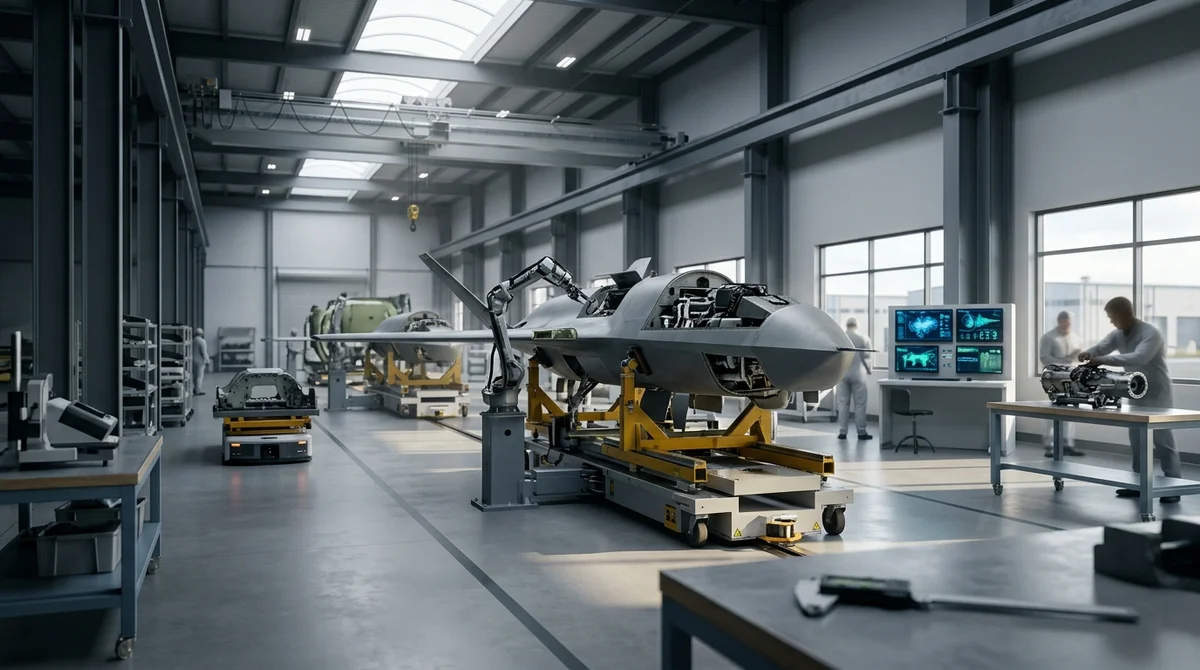
On March 24, 2026, news broke that Anduril had started assembling its Fury uncrewed fighter at the new Arsenal-1 factory in Ohio. The company expects the first aircraft to roll off the line as early as summer 2026. That is an important step for the Collaborative Combat Aircraft program, through which the US Air Force is looking for cheap combat drones it can buy in large numbers and pair with crewed fighters.
What's going into production
Fury, designated YFQ-44A by the US Air Force, is an uncrewed jet designed to fly alongside crewed aircraft. It is meant to absorb some of the risk, carry sensors and weapons, and extend what a combat formation can do. Its rival in the CCA program is General Atomics' YFQ-42A, and the Air Force is expected to decide on the next procurement phase as soon as summer 2026.
For Anduril, Fury is a test of its entire business model rather than one more product. Until now, the company built small batches in California; it is now moving assembly to a dedicated large site near Columbus. Arsenal-1 is designed as a factory that can switch quickly between different systems and ramp up output without lengthy retooling.
How Fury gets built
Anduril isn't betting on a "smart" factory packed with heavy robotics. Instead, it is relying on flexible manual assembly with as little fixed tooling as possible. The first building houses 22 workstations: crews first assemble the airframe, then install the hydraulics, fuel system, and avionics, and in the final stages add the landing gear, wings, and engine before running tests.
"We're deliberately starting without complex tooling and without a scattering of robots," explained
John Malone, Anduril's head of production.
What we already know about the Ohio line:
- the company expects the first aircraft in summer 2026
- the initial target is about 50 aircraft a year
- at full capacity, running three shifts, output could rise to 150 a year
- about 30 employees have already been trained to launch the line
- the company wants about 250 employees on site by the end of 2026
Another key detail: Anduril designed Fury for scalable production from the start. The company says it uses many commercially available components, aluminum instead of harder-to-machine materials wherever possible, and a production business-jet engine with a well-understood supply chain. According to Air & Space Forces Magazine, 94% of the aircraft's components are commercially available.
Why the US Air Force wants it
The US Air Force doesn't see Fury as a replacement for crewed fighters. It sees it as a "wingman" in a human-machine teaming concept. Aircraft like this are supposed to extend range, take on dangerous missions, and add combat mass without the need to build aircraft as expensive as the F-35 or F-22. That is why the Pentagon is watching not only flight performance but also how quickly these systems can be built in large batches.
The program has already moved past glossy renders. In February 2026, the US Air Force reported that the YFQ-44A was taking part in semi-autonomous flight tests under the open A-GRA architecture, and that it had then moved on to the next phase: weapons integration tests with inert munitions. The Air Force also stresses that the decision to use a weapon always stays with a human, even when the aircraft itself performs some tasks autonomously.
If Anduril can prove its flexible assembly approach actually works, it will have a strong argument in the fight for a major production contract. By the end of 2026, the company plans to build not only Fury at the same site but also the Roadrunner interceptor, Barracuda cruise missiles, and another classified system. In other words, Arsenal-1 is being built from day one as a multi-product military factory, not as a line for a single aircraft.
What it means
The Fury launch in Ohio shows that the market for military AI systems is shifting from prototypes to industrial production. For Anduril, it is a chance to grow from a high-profile defense tech startup into a real high-volume weapons manufacturer. For the US Air Force, it is a test of whether a new generation of uncrewed "wingman" fighters can be fielded quickly and relatively cheaply.
- Nov 2, 2026DeepSeek open-sources Super-agent prototype: p95 task completion time of 15.7 minutes vs. 29.5
- Nov 2, 2026Bun creator uses Claude Code to port 750K lines from Zig to Rust in 11 days
- Nov 2, 2026Microsoft releases 4B model Mage-VL-Cowork, which solves 66.0% of OSWorld-Verified tasks
- Nov 2, 2026Meta's Muse assistant keeps dossiers on loved ones and gets root on Ubuntu by default
Key Questions Answered
What's going into production?
Fury, designated YFQ-44A by the US Air Force, is an uncrewed jet designed to fly alongside crewed aircraft. It is meant to absorb some of the risk, carry sensors and weapons, and extend what a combat formation can do. Its rival in the CCA program is General Atomics' YFQ-42A, and the Air Force is expected to decide on the next procurement phase as soon as summer 2026. For Anduril, Fury is a test of its entire business model rather than one more product. Until now, the company built small batches in California; it is now moving assembly to a dedicated large site near Columbus
How Fury gets built?
Anduril isn't betting on a "smart" factory packed with heavy robotics. Instead, it is relying on flexible manual assembly with as little fixed tooling as possible. The first building houses 22 workstations: crews first assemble the airframe, then install the hydraulics, fuel system, and avionics, and in the final stages add the landing gear, wings, and engine before running tests. "We're deliberately starting without complex tooling and without a scattering of robots," explained John Malone, Anduril's head of production. What we already know about the Ohio line: the company
Why the US Air Force wants it?
The US Air Force doesn't see Fury as a replacement for crewed fighters. It sees it as a "wingman" in a human-machine teaming concept. Aircraft like this are supposed to extend range, take on dangerous missions, and add combat mass without the need to build aircraft as expensive as the F-35 or F-22. That is why the Pentagon is watching not only flight performance but also how quickly these systems can be built in large batches. The program has already moved past glossy renders. In February 2026, the US Air Force reported that the YFQ-44A was taking part in semi-autonomous fl
Test Frontier LLMs & Autonomous Agents in One Workspace
Run Claude Opus 5.5, GPT-6, Gemini 3.1, and DeepSeek side-by-side in Nomad AI (nomadnet.ai) — unified model routing, deep research, and multimodal workflows under one subscription.
The AI world, distilled — once a week
Seven stories that actually mattered, hand-picked. No noise, no reposts, no press releases.
Done! Check your inbox for a confirmation.