Nick Bostrom presented a vision of humanity on permanent vacation thanks to AI
Philosopher Nick Bostrom proposed a provocative scenario: advanced AI will solve all global problems — from hunger to disease and climate crises. Humanity would then go into permanent retirement from necessary labor and focus only on self-realization, creativity, and relationships.
AI-processed from Wired; edited by Hamidun News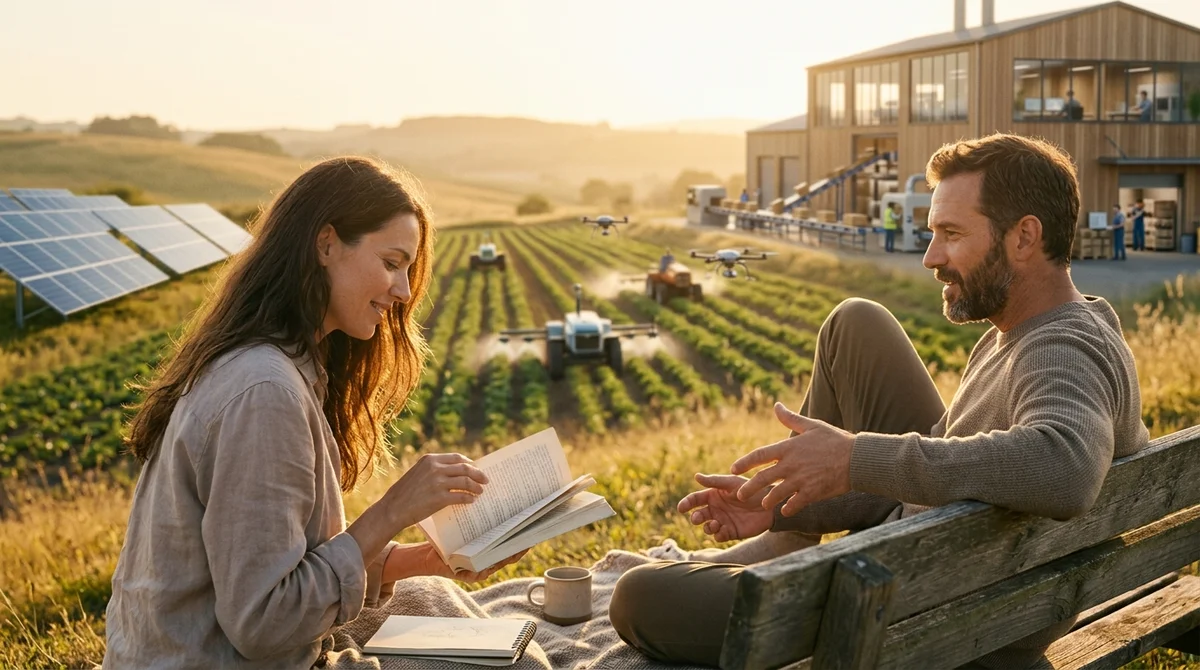
Philosopher and futurist Nick Bostrom presented an unexpected vision of humanity's future: a scenario in which advanced artificial intelligence solves all global problems, allowing people to enter an eternal vacation.
The essence of the "grand vacation" idea
Bostrom's concept begins with a historical observation: humanity has struggled for survival for centuries. We hunted, farmed, built cities, developed medicine — all of it was a war against nature and our own limitations. Technology evolved to ease this struggle. What if, in the end, we create AI advanced enough to finish this work? What if it can solve the remaining problems — hunger, disease, climate catastrophe, inequality? Then humanity can finally retire.
But Bostrom clarifies: this is not a utopia of laziness and idleness. The "grand vacation" is a transition to a life where survival is guaranteed by the system, and people can choose what to do. Creativity, deep relationships, travel, studying sciences, philosophy, sports, art — all of this becomes possible when you don't need to earn a living.
What tasks AI will take
Bostrom suggests that advanced AI will handle humanity's main economic work:
- Agriculture — precise management of soil, fertilizers, irrigation; the end of hunger
- Medicine — disease diagnosis, personalized treatment, slowing aging
- Energy — management of renewable sources, network optimization
- Manufacturing — robots and AI take on routine and dangerous labor
- Engineering — infrastructure design, solving climate problems
This allows people to completely withdraw from "necessary work" and focus on what they really want to do.
Critical questions and risks
Bostrom himself is not naive. He is the first to acknowledge serious problems with this scenario. Who controls such an AI and whom does it serve? If it belongs to one corporation or state, they will gain enormous power over humanity. How can we ensure that the AI doesn't diverge in goals from humanity? What will prevent a situation where the AI technically does what it was asked, but the result turns out to be completely different from what was intended? These questions of existential risk have occupied Bostrom throughout two decades of his career.
What this means
Bostrom's vision is not a prediction, but an invitation to dialogue. It suggests: technology itself is not the enemy of humanity. The question is not whether AI will develop, but whether we can make it our ally. If we correctly solve the problems of safety and governance, then the "grand vacation" is a logical and even inevitable result of progress.
- Oct 28, 2026Liquid AI releases LFM2.5-24B-A2B: an agent model with 2B active parameters
- Oct 28, 2026Switzerland's Apertus 1.5 Gains Vision, Hearing and a 262K-Token Context Window
- Oct 28, 2026AWS Launches Multi-Turn RL in SageMaker: gpt-oss-20b Climbs From 15% to 69% for $339
- Oct 28, 2026Microsoft and Hugging Face trained Qwen3.8-27B on database-state rewards: from 38 to 107 tasks
Key Questions Answered
What are the key details on The essence of the "grand vacation" idea?
Bostrom's concept begins with a historical observation: humanity has struggled for survival for centuries. We hunted, farmed, built cities, developed medicine — all of it was a war against nature and our own limitations. Technology evolved to ease this struggle. What if, in the end, we create AI advanced enough to finish this work? What if it can solve the remaining problems — hunger, disease, climate catastrophe, inequality? Then humanity can finally retire. But Bostrom clarifies: this is not a utopia of laziness and idleness. The "grand vacation" is a transition to a life
What tasks AI will take?
Bostrom suggests that advanced AI will handle humanity's main economic work: Agriculture — precise management of soil, fertilizers, irrigation; the end of hunger Medicine — disease diagnosis, personalized treatment, slowing aging Energy — management of renewable sources, network optimization Manufacturing — robots and AI take on routine and dangerous labor Engineering — infrastructure design, solving climate problems This allows people to completely withdraw from "necessary work" and focus on what they really want to do.
What are the key details on Critical questions and risks?
Bostrom himself is not naive. He is the first to acknowledge serious problems with this scenario. Who controls such an AI and whom does it serve? If it belongs to one corporation or state, they will gain enormous power over humanity. How can we ensure that the AI doesn't diverge in goals from humanity? What will prevent a situation where the AI technically does what it was asked, but the result turns out to be completely different from what was intended? These questions of existential risk have occupied Bostrom throughout two decades of his career.
Test Frontier LLMs & Autonomous Agents in One Workspace
Run Claude Opus 5.5, GPT-6, Gemini 3.1, and DeepSeek side-by-side in Nomad AI (nomadnet.ai) — unified model routing, deep research, and multimodal workflows under one subscription.
The AI world, distilled — once a week
Seven stories that actually mattered, hand-picked. No noise, no reposts, no press releases.
Done! Check your inbox for a confirmation.