Cerebras IPO: the year's main event in the AI infrastructure market
Cerebras Systems carried out the year's largest IPO. The company develops specialized chips for training AI models, competing with NVIDIA. At the Spark Summit conference, CEO Andrew Feldman discusses plans to expand in the AI infrastructure market. Also featured: why Cisco shares posted their biggest gain since 2011.
AI-processed from Bloomberg Tech; edited by Hamidun News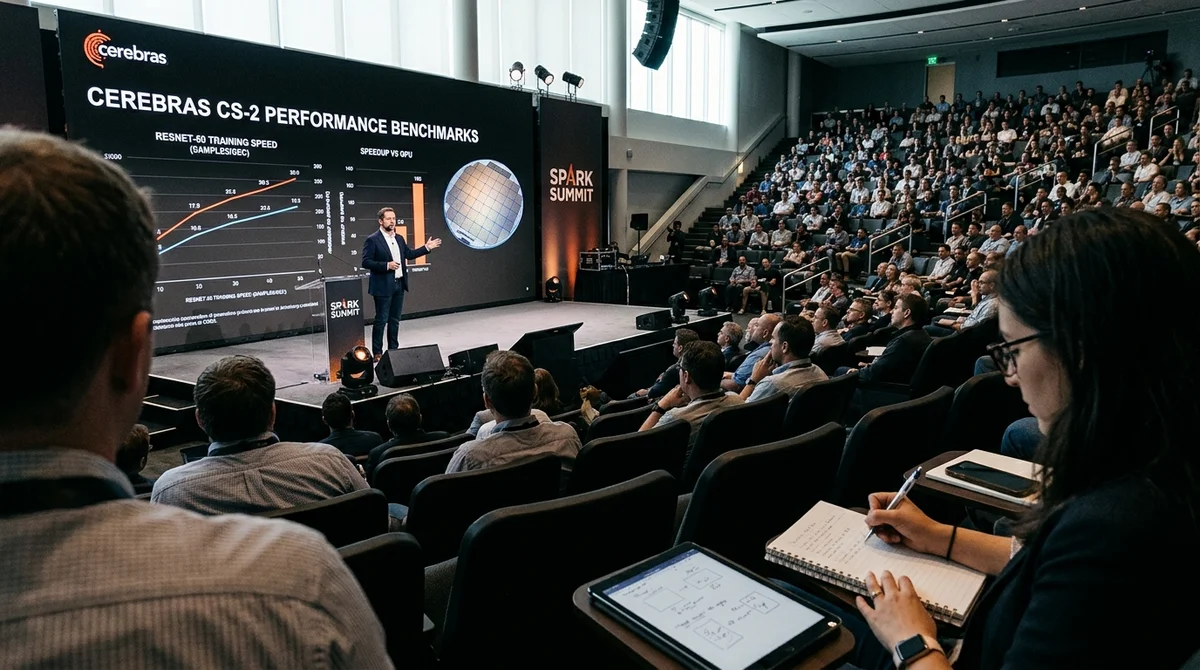
Cerebras Systems conducted the largest IPO this year — this is the main event in the race for leadership in the AI-infrastructure market. The company developed revolutionary specialized processors for training large neural networks, becoming a direct competitor to NVIDIA in a sector where monopoly seemed unshakeable.
Wafer-Scale Engine: a different approach to AI chips
Cerebras is known for its Wafer-Scale Engine (WSE) — an innovative chip that fundamentally differs from traditional NVIDIA solutions. Instead of using general-purpose graphics processors, Cerebras optimized the architecture directly for neural network requirements. At the Spark Summit conference in California, Cerebras CEO Andrew Feldman presented impressive company metrics. Systems based on WSE train large language models 50% faster than NVIDIA GPU clusters. Meanwhile, energy consumption is reduced by 30% — a critical factor when scaling AI infrastructure in data centers.
Key advantages of Cerebras:
- Training large language models 50% faster
- Reducing energy consumption by 30% compared to GPU clusters
- Full compatibility with popular frameworks (PyTorch, TensorFlow)
- Integration with cloud platforms AWS, Google Cloud, and Azure
- Lower total cost of ownership for data centers
How the market is changing: Cisco, politics, and competition
Cerebras' IPO is not the only sign of shifts in the market. Cisco shares rose to their highest level since 2011 after quarterly results were released. For the first time in a decade and a half, the network giant's stock is demonstrating such growth. This reflects recovering demand for high-speed networking equipment and routers necessary for building AI infrastructure.
A meeting between President Trump and Chinese leader Xi Jinping adds geopolitical uncertainty. Trade restrictions between the US and China could slow Chinese companies' access to cutting-edge chips and technologies. This simultaneously creates opportunities for non-American manufacturers, such as Cerebras, to occupy a niche in Europe and Asia.
"The AI-infrastructure market is increasingly fragmenting, and this is good for competition.
NVIDIA will remain the leader, but there will be more competitors," Bloomberg analysts commented.
Other players at Spark Summit: from 5G to health-tracking
At the same California conference, Caroline Hyde conducted interviews with CEOs of Ericsson and Oura. Ericsson, the Swedish telecommunications giant, develops network solutions for 5G and 6G — infrastructure on which AI applications will run at the network edge (edge AI). Oura, a Finnish medtech startup, focuses on personal devices for health tracking — an alternative to Apple Watch. The company uses AI to analyze sleep and physical condition in real time.
Both examples show how different segments of the tech industry are adapting to the era of generative AI: from network infrastructure to consumer gadgets.
What this means for the market
Cerebras' IPO confirms that investors are actively seeking alternatives to NVIDIA's monopoly and are willing to invest substantial money in specialized AI infrastructure. The year 2026 could become a turning point for the processor market. NVIDIA will remain the leader by volume, but its share of the growing pie will decline. For data centers and cloud providers, there is now a choice, and this means lower prices and accelerated innovation.
- Oct 28, 2026A 2015 CNN Beat GPT-6 Astra and Claude Fable 5.1 at Skin Cancer Diagnosis
- Oct 28, 2026Google taught an LLM to “sleep”: SLEEP consolidates knowledge into weights, up to 10 million tokens
- Oct 28, 2026Keystone removes the model name from code: open-source LLM gateway adds 0.64 ms
- Oct 28, 2026Wired Tested 6 AI Agents in a Day: Dots Leads, Gemini Spark Fails at Lunch
Key Questions Answered
What are the key details on Wafer-Scale Engine: a different approach to AI chips?
Cerebras is known for its Wafer-Scale Engine (WSE) — an innovative chip that fundamentally differs from traditional NVIDIA solutions. Instead of using general-purpose graphics processors, Cerebras optimized the architecture directly for neural network requirements. At the Spark Summit conference in California, Cerebras CEO Andrew Feldman presented impressive company metrics. Systems based on WSE train large language models 50% faster than NVIDIA GPU clusters. Meanwhile, energy consumption is reduced by 30% — a critical factor when scaling AI infrastructure in data centers.
How the market is changing: Cisco, politics, and competition?
Cerebras' IPO is not the only sign of shifts in the market. Cisco shares rose to their highest level since 2011 after quarterly results were released. For the first time in a decade and a half, the network giant's stock is demonstrating such growth. This reflects recovering demand for high-speed networking equipment and routers necessary for building AI infrastructure. A meeting between President Trump and Chinese leader Xi Jinping adds geopolitical uncertainty. Trade restrictions between the US and China could slow Chinese companies' access to cutting-edge chips and techno
What are the key details on Other players at Spark Summit: from 5G to health-tracking?
At the same California conference, Caroline Hyde conducted interviews with CEOs of Ericsson and Oura. Ericsson, the Swedish telecommunications giant, develops network solutions for 5G and 6G — infrastructure on which AI applications will run at the network edge (edge AI). Oura, a Finnish medtech startup, focuses on personal devices for health tracking — an alternative to Apple Watch. The company uses AI to analyze sleep and physical condition in real time. Both examples show how different segments of the tech industry are adapting to the era of generative AI: from network i
Build & Ship Production AI Agents Without Boilerplate Code
Start your free 72-hour trial at Hamidun Academy (academy.hamidun.com) — interactive lessons on Claude Code & Cursor, live Tech Radar, and production agent templates.
The AI world, distilled — once a week
Seven stories that actually mattered, hand-picked. No noise, no reposts, no press releases.
Done! Check your inbox for a confirmation.