Cerebras founder Feldman made $3.2 billion from AI-chip IPO
Cerebras, an AI-chip maker, completed the year's biggest tech IPO. Its CEO Andrew Feldman increased his net worth to $3.2 billion. For the founder of four startups, it is the biggest success of his career.
AI-processed from Bloomberg Tech; edited by Hamidun News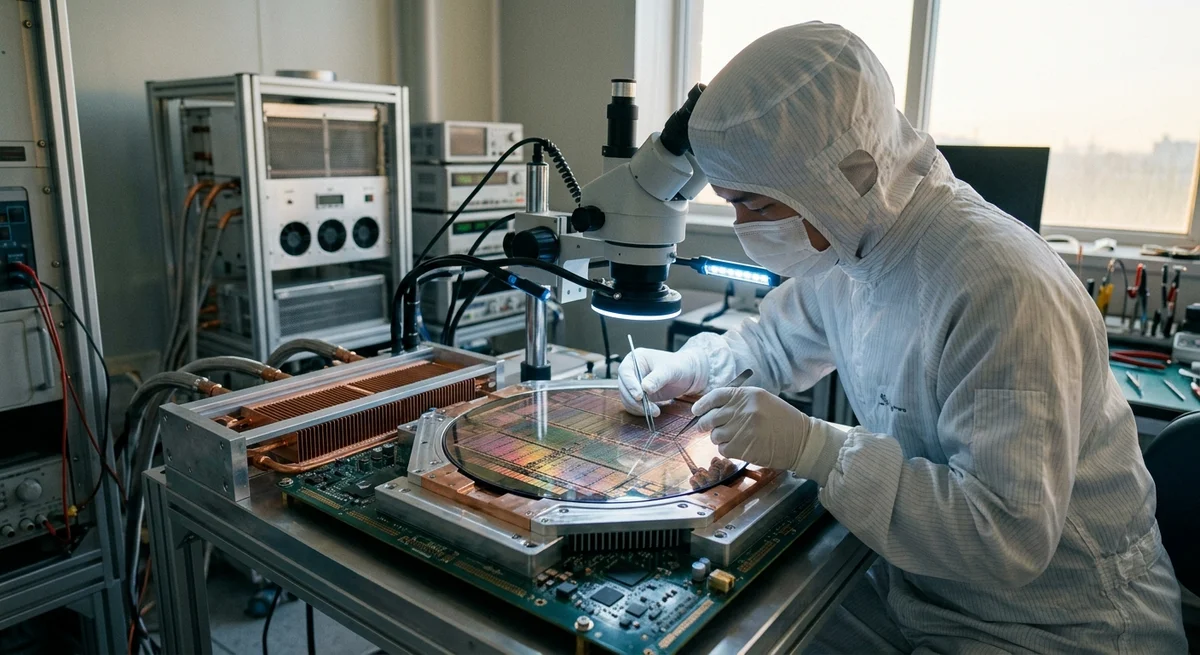
Cerebras, a manufacturer of next-generation specialized AI chips, conducted its IPO on Thursday — making it the largest technology sector stock offering by volume this year. For founder Andrew Feldman, it marks the pinnacle of a serial entrepreneur's career.
Path Up
Feldman is no newcomer to building technology companies. Having grown up literally on the Stanford campus, he has already founded, developed and sold three startups, one of which he took public. But Cerebras' debut overshadows all his previous achievements.
The company specializes in revolutionary AI chips — Wafer Scale format chips. Instead of cutting silicon wafers into small pieces, Cerebras uses an entire wafer as one giant chip. This is a fundamentally new approach to AI accelerator architecture.
At the time of IPO, the value of Feldman's personal stake was $3.2 billion — a record fortune earned from a single IPO during his career.
Alternative to Nvidia
The standard approach in the industry (Nvidia, Intel and others) — cutting silicon into standard coin-sized chips. Each chip works independently, and complex communication systems are needed to synchronize between them. This is proven technology, but it has limitations for rapidly growing AI models.
Cerebras chose the opposite path. Instead of many small chips in one system — one massive chip that accommodates billions of transistors. This architecture solves several critical problems:
- Communication between cores happens an order of magnitude faster (minimal latency in data paths)
- Training of large neural networks accelerates 20-50% compared to GPU farms
- Power consumption in data centers drops noticeably (less data transmission loss)
- Cooling architecture is simplified (one heat source instead of dozens)
- Developers find it easier to optimize code for a unified architecture
What This Means
Cerebras' IPO confirms a gathering trend: the AI infrastructure market is expanding far beyond Nvidia. Companies are emerging with radically different approaches to AI computing architecture. Investors are voting for them with their money.
For Nvidia, it's a signal: monopoly dominance is ending, competition is accelerating. Data centers that are currently procuring GPUs for LLM training will begin to consider alternatives. Even if Cerebras captures only 5-10% of the AI accelerator market, that means tens of billions of dollars shifting from Nvidia to competitors.
- Oct 28, 2026Liquid AI releases LFM2.5-24B-A2B: an agent model with 2B active parameters
- Oct 28, 2026PyTorch 2.15 speeds up MoE models on Mac by 5–6.5x and adds FP8
- Oct 28, 2026Anthropic files S-1 for IPO at $2 trillion valuation: 85% margin, profitable Q2
- Oct 28, 2026NVIDIA Kumo Relational Beats Supervised ML on 41 Tasks Without Any Training
Key Questions Answered
What are the key details on Path Up?
Feldman is no newcomer to building technology companies. Having grown up literally on the Stanford campus, he has already founded, developed and sold three startups, one of which he took public. But Cerebras' debut overshadows all his previous achievements. The company specializes in revolutionary AI chips — Wafer Scale format chips. Instead of cutting silicon wafers into small pieces, Cerebras uses an entire wafer as one giant chip. This is a fundamentally new approach to AI accelerator architecture. At the time of IPO, the value of Feldman's personal stake was $3.2 billio
What are the key details on Alternative to Nvidia?
The standard approach in the industry (Nvidia, Intel and others) — cutting silicon into standard coin-sized chips. Each chip works independently, and complex communication systems are needed to synchronize between them. This is proven technology, but it has limitations for rapidly growing AI models. Cerebras chose the opposite path. Instead of many small chips in one system — one massive chip that accommodates billions of transistors. This architecture solves several critical problems: Communication between cores happens an order of magnitude faster (minimal latency in data
What This Means?
Cerebras' IPO confirms a gathering trend: the AI infrastructure market is expanding far beyond Nvidia. Companies are emerging with radically different approaches to AI computing architecture. Investors are voting for them with their money. For Nvidia, it's a signal: monopoly dominance is ending, competition is accelerating. Data centers that are currently procuring GPUs for LLM training will begin to consider alternatives. Even if Cerebras captures only 5-10% of the AI accelerator market, that means tens of billions of dollars shifting from Nvidia to competitors.
Ship AI Faster with Founders, Engineers & Weekly Architecture Reviews
Inside Vibe Club (hamidun.com/club) — weekly live masterminds with Zhemal Khamidun, Tech Radar, full LMS access, and 370+ production Claude Code skills.
The AI world, distilled — once a week
Seven stories that actually mattered, hand-picked. No noise, no reposts, no press releases.
Done! Check your inbox for a confirmation.