Python microframework: training AI agents without freezing the interface
A developer has released a microframework for training AI agents with wxPython + Gymnasium. The main point: the interface stays responsive even during long training runs in separate processes. It supports plugins, progress charts, and packaging into a single .exe file.
AI-processed from Habr AI; edited by Hamidun News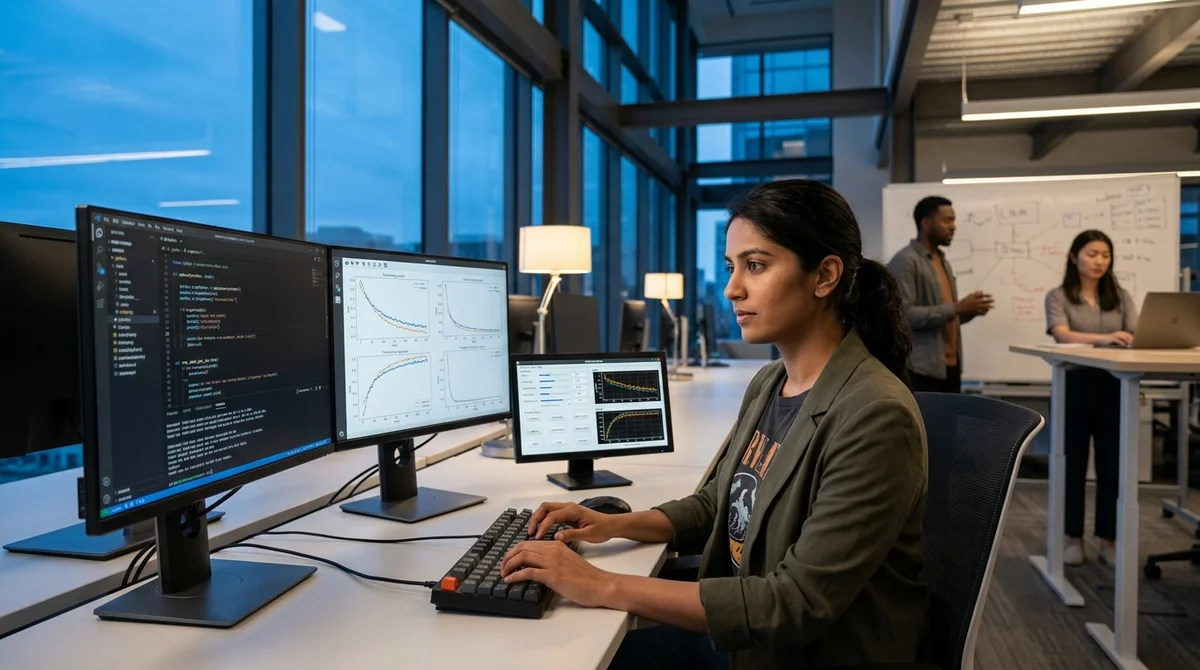
A developer created a microframework for parallel training of AI agents that solves a classic Python developer problem: GUI freezing during lengthy training. Computations are delegated to separate service processes, so the GUI remains fully responsive.
How it works
The key idea of the solution is separation: the main process is responsible only for the GUI (wxPython), while all computations run in separate services. When the neural network is training, the user can freely click the interface, change settings, and view graphs in real time. This is a standard pattern for desktop applications, but in the context of ML model training, it is often ignored in favor of development speed. The framework works with environments from Gymnasium (the standard library for reinforcement learning) and allows adding custom ones through plugins. Training can proceed through the classical gradient-based approach or through genetic algorithms (neuroevolution) using DEAP.
Key features
- Real-time visualization of progress through Matplotlib graphs
- Plugin architecture for adding new Gymnasium environments
- Support for neuroevolution through DEAP genetic algorithms
- Multiprocessing paradigm for scaling across multiple processor cores
- Building into a single .exe through PyInstaller with automatic CI/CD
Practical applications
Such a tool is useful for experimenting with reinforcement learning on a local machine. You can train an agent directly in a desktop application, save the results, build everything into a single executable file, and share it with a colleague without needing to install dependencies. This accelerates the experimentation cycle, especially in research projects and hackathons.
What this means
The project demonstrates that even narrowly specialized ML tools can be convenient to develop if user experience is carefully considered. When the interface doesn't freeze, the speed of experiments grows noticeably — there's no need to open a terminal in a separate window and run scripts from the command line.
- Oct 28, 2026AdaPRA lifts Qwen 80B by 24.5 points on data science leaderboards
- Oct 28, 2026AOS-Bench: Agents Separated by 0.6 Points in Isolation Deliver 54% and 68% of the Same Tasks
- Oct 28, 2026CuraLoc finds bugs in repositories with a single plan and uses 90% fewer tokens
- Oct 28, 2026Wired Tested 6 AI Agents in a Day: Dots Leads, Gemini Spark Fails at Lunch
Key Questions Answered
How it works?
The key idea of the solution is separation: the main process is responsible only for the GUI (wxPython), while all computations run in separate services. When the neural network is training, the user can freely click the interface, change settings, and view graphs in real time. This is a standard pattern for desktop applications, but in the context of ML model training, it is often ignored in favor of development speed. The framework works with environments from Gymnasium (the standard library for reinforcement learning) and allows adding custom ones through plugins. Traini
What are the key details on Key features?
Real-time visualization of progress through Matplotlib graphs Plugin architecture for adding new Gymnasium environments Support for neuroevolution through DEAP genetic algorithms Multiprocessing paradigm for scaling across multiple processor cores Building into a single .exe through PyInstaller with automatic CI/CD
What are the key details on Practical applications?
Such a tool is useful for experimenting with reinforcement learning on a local machine. You can train an agent directly in a desktop application, save the results, build everything into a single executable file, and share it with a colleague without needing to install dependencies. This accelerates the experimentation cycle, especially in research projects and hackathons.
Build & Ship Production AI Agents Without Boilerplate Code
Start your free 72-hour trial at Hamidun Academy (academy.hamidun.com) — interactive lessons on Claude Code & Cursor, live Tech Radar, and production agent templates.
The AI world, distilled — once a week
Seven stories that actually mattered, hand-picked. No noise, no reposts, no press releases.
Done! Check your inbox for a confirmation.