SEO in the ChatGPT era: how to find traffic when search is secondary
Search engines are losing their monopoly. Users now ask ChatGPT, уточняют in Alice, check Perplexity, and watch YouTube. SEO has not died, but it has become distributed: you need to be present everywhere people look for answers.
AI-processed from Habr AI; edited by Hamidun News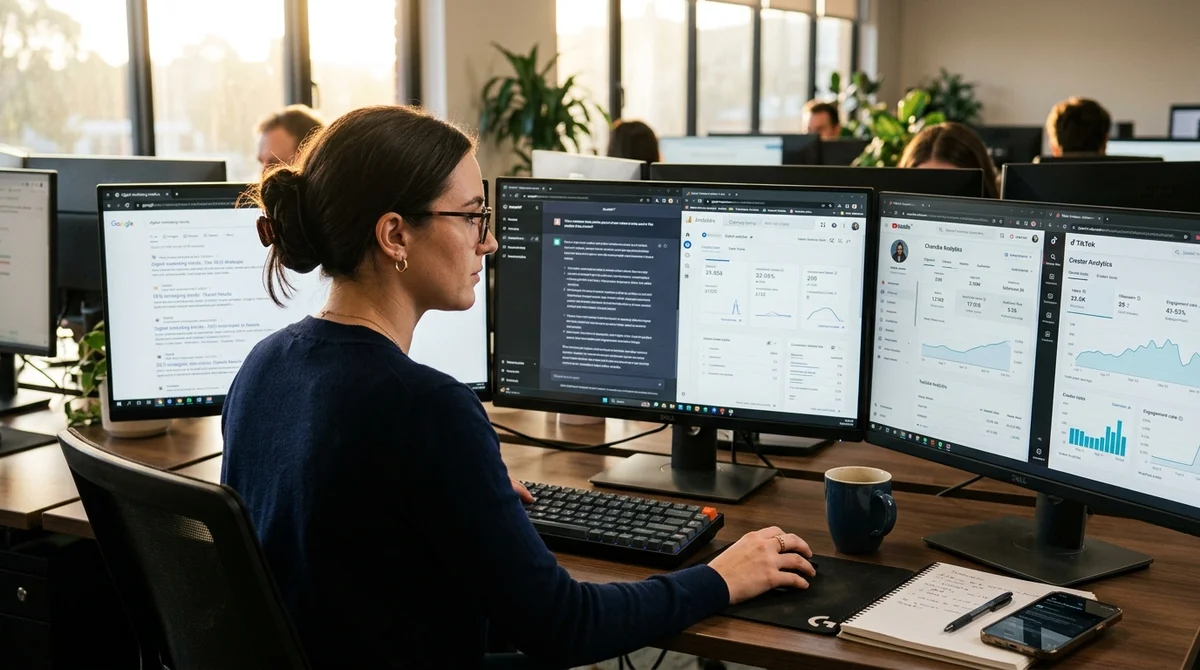
Traditional internet search is disappearing before our eyes. Users no longer go to Google or Yandex search bars — they ask ChatGPT, clarify with Alexa, verify with Perplexity, scroll through video answers on YouTube, check maps, and rely on AI-generated responses. For businesses, this means: SEO didn't die, but it became completely different.
Search is now everywhere, but not on a single page
Search used to be monolithic: one search bar, one results list, ten blue links. Now it's a dozen channels simultaneously. Users get ready-made answers directly from AI without needing to click on websites.
They search for videos on YouTube. Recipes and ideas on Pinterest. Maps and reviews of places on Yandex.
Maps and Google Maps. Opinions and recommendations on Telegram channels, Reddit, social media. This isn't just fragmentation — it's a complete remaking of the user journey from question to answer.
For SEO specialists, this is a complication: previously, the strategy was linear — rank higher in Google, get into the top, receive clicks. Now you need to think about visibility everywhere simultaneously. This is no longer search in the classical sense — it's distributed traffic from multiple sources.
Keywords no longer decide everything
Classical SEO was built on one pillar: find the right keyword, optimize the page for it, build links, get a ranking boost. The system worked for ten years. But the algorithms changed.
Google and Yandex now look not just at keywords, but at content depth, authority, relevance. Neural networks ignore keywords in the traditional SEO sense altogether — they analyze context, meaning, source authority. A new ranking criterion has emerged: can an AI give a direct answer from your text?
If yes — you're in luck, because AI recommends your source specifically. If no — you'll simply be ignored in favor of more relevant text. Behavioral factors, backlinks, and content depth have become more important.
And the content itself should be written not for the search engine, but for people — clearly, useful, comprehensive.
Where to seek traffic in the new landscape
Strategy is now not one, but multiple:
- YouTube — video answers rank higher than text, the algorithm multiplies reach
- Social media — Instagram, TikTok, Telegram generate organic traffic and social signals for search engines
- AI platforms — appearing in answers from ChatGPT, Perplexity, Claude (a new window to the internet)
- Authority and links — mentions and inbound links have become even more important for ranking
- Niche communities — Reddit, specialized forums, Slack communities (high trust level)
The main change in logic: it doesn't matter what position you're at in Google if the user already got a comprehensive answer in ChatGPT and won't click further.
What does this mean
SEO has evolved from optimization to distribution. This is neither good nor bad — it's the reality of the 2026 internet. Websites are no longer the center of the traffic universe. They're one channel in a larger system. Those who win are those who understand this system and create content not for algorithms, but for people — in any form, on any platform, everywhere people search for answers.
- Oct 28, 2026Keystone removes the model name from code: open-source LLM gateway adds 0.64 ms
- Oct 28, 2026Wired Tested 6 AI Agents in a Day: Dots Leads, Gemini Spark Fails at Lunch
- Oct 28, 2026Anthropic Turns Claude Code Into a Platform: Claude Mods Flip the Agent Harness
- Oct 28, 2026Liquid AI releases LFM2.5-24B-A2B: an agent model with 2B active parameters
Key Questions Answered
What are the key details on Search is now everywhere, but not on a single page?
Search used to be monolithic: one search bar, one results list, ten blue links. Now it's a dozen channels simultaneously. Users get ready-made answers directly from AI without needing to click on websites. They search for videos on YouTube. Recipes and ideas on Pinterest. Maps and reviews of places on Yandex.Maps and Google Maps. Opinions and recommendations on Telegram channels, Reddit, social media. This isn't just fragmentation — it's a complete remaking of the user journey from question to answer. For SEO specialists, this is a complication: previously, the strategy was
What are the key details on Keywords no longer decide everything?
Classical SEO was built on one pillar: find the right keyword, optimize the page for it, build links, get a ranking boost. The system worked for ten years. But the algorithms changed. Google and Yandex now look not just at keywords, but at content depth, authority, relevance. Neural networks ignore keywords in the traditional SEO sense altogether — they analyze context, meaning, source authority. A new ranking criterion has emerged: can an AI give a direct answer from your text? If yes — you're in luck, because AI recommends your source specifically. If no — you'll simply b
Where to seek traffic in the new landscape?
Strategy is now not one, but multiple: YouTube — video answers rank higher than text, the algorithm multiplies reach Social media — Instagram, TikTok, Telegram generate organic traffic and social signals for search engines AI platforms — appearing in answers from ChatGPT, Perplexity, Claude (a new window to the internet) Authority and links — mentions and inbound links have become even more important for ranking Niche communities — Reddit, specialized forums, Slack communities (high trust level) The main change in logic: it doesn't matter what position you're at in Google i
Test Frontier LLMs & Autonomous Agents in One Workspace
Run Claude Opus 5.5, GPT-6, Gemini 3.1, and DeepSeek side-by-side in Nomad AI (nomadnet.ai) — unified model routing, deep research, and multimodal workflows under one subscription.
The AI world, distilled — once a week
Seven stories that actually mattered, hand-picked. No noise, no reposts, no press releases.
Done! Check your inbox for a confirmation.