A robot running a Google LLM: how a 270M-parameter model learned to control movement
An engineer integrated a compact Google language model (270 million parameters) into a tracked robot with a manipulator arm and trained it to operate in simulation. The model learned to make its own decisions about movement and grasping objects. The experiment shows that compact LLMs can control complex robotic systems.
AI-processed from Habr AI; edited by Hamidun News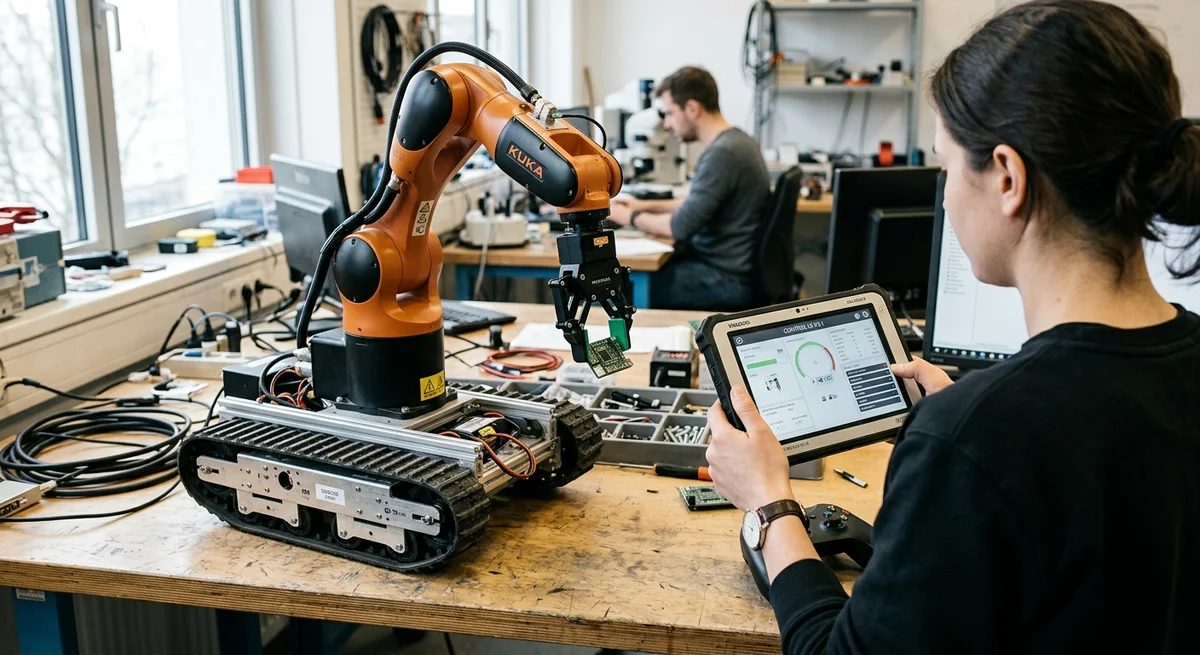
An engineer integrated a compact, open Google language model (270 million parameters) into a tracked robot with a manipulator arm and trained the model to control the robot's movements entirely in simulation. The experiment shows that compact LLMs can learn to control complex physical systems without massive compute.
Why a compact LLM
Google has released a series of compact Gemini Nano models designed for devices with limited compute. A 270-million-parameter model is no monstrous GPT-4. It is a neat, elegant tool that can run directly on the robot's embedded hardware without calling out to cloud servers.
This setup offers several critical advantages for robotics. First, the model runs locally and needs no internet connection, so the robot is fully autonomous. Second, it responds without network latency, which matters when milliseconds decide the outcome of an operation. Third, power consumption is low: the robot's battery lasts longer, and the electronics don't overheat.
The author chose this model because its performance is entirely sufficient for decision-making when controlling physical systems. A compact model learns faster than giant LLMs and needs less training data.
Training in a virtual environment
The entire experiment ran in simulation, a virtual environment where physics and dynamics behave as they do in reality. The tracked robot with its manipulator didn't move through a real room but through a computer model. That let the author quickly test thousands of behavior variants without risking damage to expensive real hardware.
The language model received data on the robot's state (track positions, rotation angle, manipulator coordinates, the image from a virtual camera) and learned to decide on its own how to act. The model learned the following skills:
- Track control: when to engage the tracks, in which direction and at what speed
- Navigation and orientation: how to turn and orient itself in space
- Manipulation: how the arm should approach, grasp and move objects
- Coordination: how to coordinate body and arm movement to complete complex tasks
The model learned by trial and error: it attempted an action, saw the result in simulation and adjusted its behavior. The process isn't instant, but after hundreds of thousands of iterations the model found effective control strategies. In the end, it learned to perform purposeful manipulation — grasping objects, moving them, stacking them — exactly as if the robot were physical.
Neuropunk instead of marketing
The author calls the project "neuropunk": an experiment that is both technically interesting and provocative. The philosophy is simple: if you take an open model, load it into a robot and let it learn freely in simulation, can it become a useful workforce?
Skeptics would usually say "no," arguing that robotics needs a specialized architecture, billions of parameters and megabytes of data. The author's answer: no — it can. And it works.
It doesn't take huge parameter counts, specialized architectures or endless data. A compact 270-million-parameter model is enough to learn, under simulated conditions, to control a nontrivial mechanical system: a robot with tracks and a manipulator performing manipulation in three-dimensional space. The paradox is that compact models are often more versatile than specialized tools.
What it means
The experiment blurs the line between "pure" language models and control of physical systems. Tomorrow, compact LLMs could genuinely control industrial manipulators, autonomous platforms and mobile robots on site — in factories, warehouses, agriculture and logistics. No cloud calls, no network latency, open licenses and an affordable price.
That is, of course, once models learn to reliably transfer knowledge from simulation to reality, so-called sim-to-real transfer. And that has already begun.
- Nov 2, 2026Karpathy builds a YouTube clone with 6454 videos from Hacker News recommendations in two hours
- Nov 2, 2026Karpathy used Claude to build HackerTube from 6,454 videos recommended on Hacker News
- Nov 2, 2026Anthropic needs to grow revenue 32% a year to cover $850 billion in contracts
- Nov 2, 2026Bun creator uses Claude Code to port 750K lines from Zig to Rust in 11 days
Key Questions Answered
Why a compact LLM?
Google has released a series of compact Gemini Nano models designed for devices with limited compute. A 270-million-parameter model is no monstrous GPT-4. It is a neat, elegant tool that can run directly on the robot's embedded hardware without calling out to cloud servers. This setup offers several critical advantages for robotics. First, the model runs locally and needs no internet connection, so the robot is fully autonomous. Second, it responds without network latency, which matters when milliseconds decide the outcome of an operation. Third, power consumption is low: t
What are the key details on Training in a virtual environment?
The entire experiment ran in simulation, a virtual environment where physics and dynamics behave as they do in reality. The tracked robot with its manipulator didn't move through a real room but through a computer model. That let the author quickly test thousands of behavior variants without risking damage to expensive real hardware. The language model received data on the robot's state (track positions, rotation angle, manipulator coordinates, the image from a virtual camera) and learned to decide on its own how to act. The model learned the following skills: Track control
What are the key details on Neuropunk instead of marketing?
The author calls the project "neuropunk": an experiment that is both technically interesting and provocative. The philosophy is simple: if you take an open model, load it into a robot and let it learn freely in simulation, can it become a useful workforce? Skeptics would usually say "no," arguing that robotics needs a specialized architecture, billions of parameters and megabytes of data. The author's answer: no — it can. And it works. It doesn't take huge parameter counts, specialized architectures or endless data. A compact 270-million-parameter model is enough to learn,
Test Frontier LLMs & Autonomous Agents in One Workspace
Run Claude Opus 5.5, GPT-6, Gemini 3.1, and DeepSeek side-by-side in Nomad AI (nomadnet.ai) — unified model routing, deep research, and multimodal workflows under one subscription.
The AI world, distilled — once a week
Seven stories that actually mattered, hand-picked. No noise, no reposts, no press releases.
Done! Check your inbox for a confirmation.