Nyobolt raises $60M and becomes a unicorn thanks to batteries for SymBot
Nyobolt raised $60 million in a Series C round and reached a $1 billion valuation. The startup has developed batteries that charge in minutes and withstand 20,000 cycles. Investor Symbotic is already installing these batteries in SymBot, its autonomous robots for warehouse automation.
AI-processed from TNW; edited by Hamidun News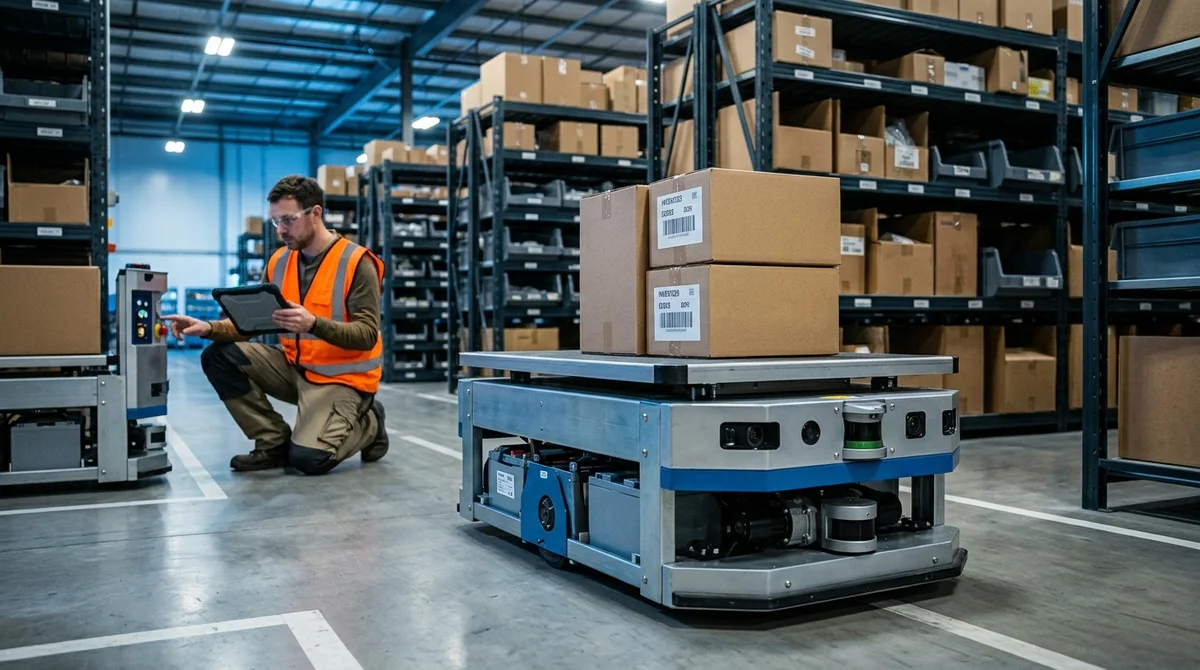
Nyobolt, a British startup based in Cambridge, has closed a $60 million Series C round at a $1 billion valuation. It is the company's first time reaching unicorn status, and it did so not with AI software or a platform, but with physical batteries that already power real autonomous machines in commercial settings.
Batteries that last 20,000 cycles
Nyobolt's main achievement is a battery with extremely fast charging. The company's batteries charge fully in just a few minutes, and under laboratory conditions even in a few seconds. They also withstand 20,000 full charge-discharge cycles without noticeable capacity degradation. For comparison, a standard lithium-ion battery starts losing capacity after just 1,000–3,000 cycles and needs replacing.
The round was led by Symbotic, a NASDAQ-listed company specializing in AI-driven robotics. It is not just an investor but already a customer and partner: Symbotic installs Nyobolt batteries in its SymBot, autonomous mobile robots for automating warehouses and logistics centers.
Why the battery solves the problem
In an automated warehouse, battery lifespan directly determines the economics. SymBots work around the clock: they move goods between departments, sort cargo and feed items onto conveyors. If a robot has to stop to charge every 4–6 hours, productivity will drop by 20–30%, and the automation investment will not pay off within the promised timeframe.
Nyobolt's batteries address this problem head-on:
- A robot can work a full shift (12–16 hours) without recharging
- A fast overnight recharge fully restores capacity by morning
- Long lifespan (20,000 cycles = ~5–7 years of intensive use) lowers the cost of ownership
- The battery's compact size saves weight and space in the robot's design
- Stable performance throughout its life, with no drop-off at the end
How this changes the market
Until now, investment in battery technology has mostly gone to electric vehicles. Tesla, Panasonic and CATL are fighting for share in the EV market, where the money is big but the competition is brutal. Nyobolt chose a different path: a narrow market (warehouse robotics), but with higher margins and less competition.
Symbotic chose
Nyobolt not for big words, but because the batteries already work in real warehouses and prove their value through performance figures.
What this means
Over the next 3–5 years, batteries will become as much of a business factor in robotics as processors were in the 2010s. The company that gives warehouse robots a week of autonomy, or a battery that lives 100,000 cycles, will win the market. Symbotic chose Nyobolt because it is not a promise but a working system. For the startup this is safer: the customer pays not for the future but for today, for real robots in real warehouses.
- Nov 2, 2026Karpathy builds a YouTube clone with 6454 videos from Hacker News recommendations in two hours
- Nov 2, 2026Karpathy used Claude to build HackerTube from 6,454 videos recommended on Hacker News
- Nov 2, 2026Arca gives AI agents finance tasks lasting up to 10 days, but leaves the trades to humans
- Nov 2, 2026DeepSeek open-sources Super-agent prototype: p95 task completion time of 15.7 minutes vs. 29.5
Key Questions Answered
What are the key details on Batteries that last 20,000 cycles?
Nyobolt's main achievement is a battery with extremely fast charging. The company's batteries charge fully in just a few minutes, and under laboratory conditions even in a few seconds. They also withstand 20,000 full charge-discharge cycles without noticeable capacity degradation. For comparison, a standard lithium-ion battery starts losing capacity after just 1,000–3,000 cycles and needs replacing. The round was led by Symbotic, a NASDAQ-listed company specializing in AI-driven robotics. It is not just an investor but already a customer and partner: Symbotic installs Nyobo
Why the battery solves the problem?
In an automated warehouse, battery lifespan directly determines the economics. SymBots work around the clock: they move goods between departments, sort cargo and feed items onto conveyors. If a robot has to stop to charge every 4–6 hours, productivity will drop by 20–30%, and the automation investment will not pay off within the promised timeframe. Nyobolt's batteries address this problem head-on: A robot can work a full shift (12–16 hours) without recharging A fast overnight recharge fully restores capacity by morning Long lifespan (20,000 cycles = ~5–7 years of intensive
How this changes the market?
Until now, investment in battery technology has mostly gone to electric vehicles. Tesla, Panasonic and CATL are fighting for share in the EV market, where the money is big but the competition is brutal. Nyobolt chose a different path: a narrow market (warehouse robotics), but with higher margins and less competition. Symbotic chose Nyobolt not for big words, but because the batteries already work in real warehouses and prove their value through performance figures.
Test Frontier LLMs & Autonomous Agents in One Workspace
Run Claude Opus 5.5, GPT-6, Gemini 3.1, and DeepSeek side-by-side in Nomad AI (nomadnet.ai) — unified model routing, deep research, and multimodal workflows under one subscription.
The AI world, distilled — once a week
Seven stories that actually mattered, hand-picked. No noise, no reposts, no press releases.
Done! Check your inbox for a confirmation.