China's Quant Funds Draw Billions as AI Beats Human Traders
Quant funds in China are booming: AI algorithms consistently beat human traders on returns, and investors are piling money into the funds. Demand is so high that managers struggle to handle the inflow of new capital, and some funds are limiting the money they accept. AI-based quant strategies are becoming the new standard in China's financial market.
AI-processed from Bloomberg Tech; edited by Hamidun News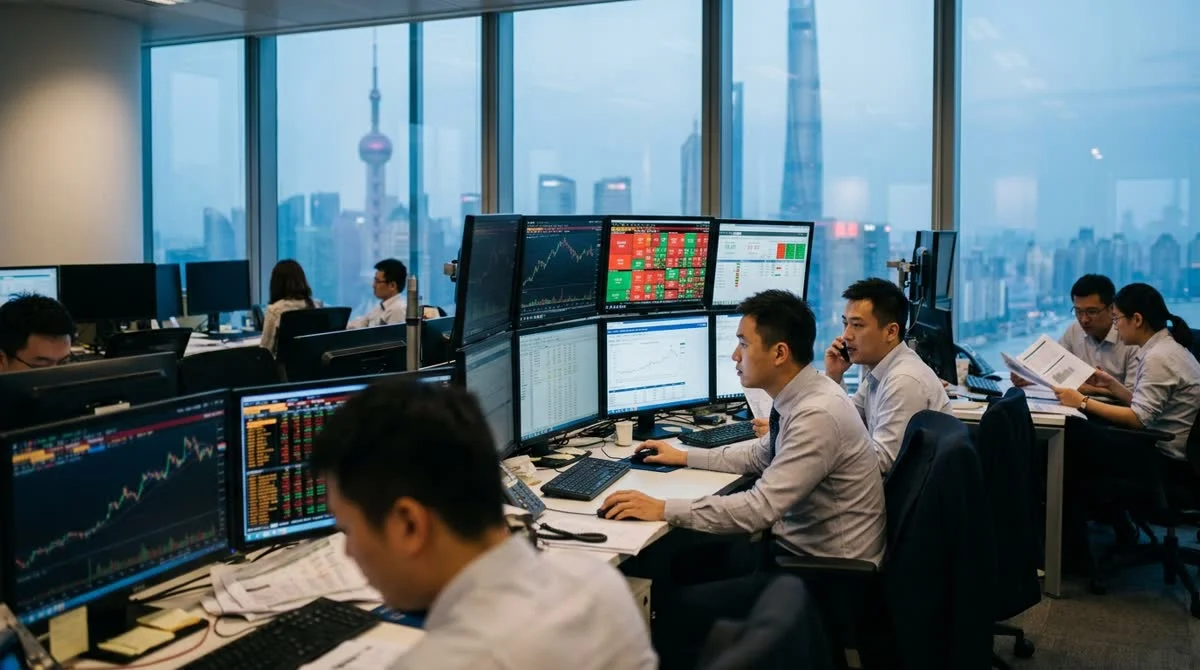
An unprecedented wave of investment is washing over quant funds in China. On July 2, 2026, Bloomberg reported that AI algorithms consistently outperform human traders on returns, and capital from across the market has rushed toward the winners.
Why investors are choosing quant strategies
AI systems win at trading for structural, not random, reasons. They process thousands of market signals at once, never tire, do not panic during volatility and do not make decisions under emotional pressure. Where an experienced manager spends minutes analyzing a pattern, an algorithm does it in milliseconds, around the clock, without the cognitive errors typical of humans.
Quant funds use machine learning, neural networks and alternative data analysis: transaction patterns, satellite images of infrastructure sites, news feeds in several languages, and social media signals. Combining these sources gives the algorithms an information edge over traditional managers, who work with publicly available reports and analysis.
The result is predictable: money votes for algorithms. Demand for quant products in China exceeds supply by such a margin that managers struggle to handle the inflow of new capital. Some funds have been forced to cap the money they accept, a paradox in which a successful strategy limits its own growth.
How China's quant trading market works
The market's largest players are aggressively scaling their computing infrastructure and poaching AI specialists from the tech sector. The race for computing power has become as integral to a fund's business as the traditional hunt for alpha, returns above the market's.
- AI algorithms analyze alternative data: transactions, satellite images, news feeds, geolocation patterns
- Quant funds hire AI developers from tech companies, shifting the professional profile of staff from financial analysis toward data science
- Some funds are closing to new money: when assets grow too large, strategies lose effectiveness
- Competitive advantage is determined by the quality of training data and the power of infrastructure, not by a manager's intuition
What sets the Chinese market apart is its scale and speed of adaptation. Retail and institutional investors are shifting capital toward algorithmic strategies at the same time, creating a self-reinforcing loop: the more money flows into quant funds, the more resources they put into improving their algorithms.
What remains for humans
AI's win in direct trading does not mean professionals are leaving the industry entirely; it means the profession is being transformed. Quant funds still need human expertise: developing trading strategies, managing risk at the system level, interpreting anomalies in algorithm behavior, and tuning models to changing market conditions. All of this requires a deep understanding of the market that algorithms lack.
The human role is shifting from making trading decisions directly to overseeing the automated system and improving it. Placing orders, reacting to news and managing positions in real time have passed to algorithms. This is a fundamental change in the structure of the asset management industry.
What this means
What is happening in China signals a global trend: the financial industry is moving from intuition to computation. Competitive advantage is shifting from analyst skill to data quality and infrastructure performance. The billions flowing into quant funds are a market verdict: AI is becoming the main asset manager of the new generation.
Key Questions Answered
Why investors are choosing quant strategies?
AI systems win at trading for structural, not random, reasons. They process thousands of market signals at once, never tire, do not panic during volatility and do not make decisions under emotional pressure. Where an experienced manager spends minutes analyzing a pattern, an algorithm does it in milliseconds, around the clock, without the cognitive errors typical of humans. Quant funds use machine learning, neural networks and alternative data analysis: transaction patterns, satellite images of infrastructure sites, news feeds in several languages, and social media signals.
How China's quant trading market works?
The market's largest players are aggressively scaling their computing infrastructure and poaching AI specialists from the tech sector. The race for computing power has become as integral to a fund's business as the traditional hunt for alpha, returns above the market's. AI algorithms analyze alternative data: transactions, satellite images, news feeds, geolocation patterns Quant funds hire AI developers from tech companies, shifting the professional profile of staff from financial analysis toward data science Some funds are closing to new money: when assets grow too large,
What remains for humans?
AI's win in direct trading does not mean professionals are leaving the industry entirely; it means the profession is being transformed. Quant funds still need human expertise: developing trading strategies, managing risk at the system level, interpreting anomalies in algorithm behavior, and tuning models to changing market conditions. All of this requires a deep understanding of the market that algorithms lack. The human role is shifting from making trading decisions directly to overseeing the automated system and improving it. Placing orders, reacting to news and managing
Ship AI Faster with Founders, Engineers & Weekly Architecture Reviews
Inside Vibe Club (hamidun.com/club) — weekly live masterminds with Zhemal Khamidun, Tech Radar, full LMS access, and 370+ production Claude Code skills.
The AI world, distilled — once a week
Seven stories that actually mattered, hand-picked. No noise, no reposts, no press releases.
Done! Check your inbox for a confirmation.