Waymo vs. Children: School Incident Threatens the Future of Robotaxis
Waymo is facing a serious crisis of trust. In San Francisco, one of the company's driverless cars struck a child right outside an elementary school. The injuries were minor, but federal regulators at the NHTSA opened an investigation immediately. It comes as the service is expanding aggressively in Los Angeles and Austin. For the industry, it is a warning. The argument that algorithms drive better than humans will now have to be proven in courtrooms and before regulatory commissions. If Waymo cannot demonstrate systemic safety, the scaling of robotaxis could stall for years, as it did for competitor Cruise.
AI-processed from Futurism; edited by Hamidun News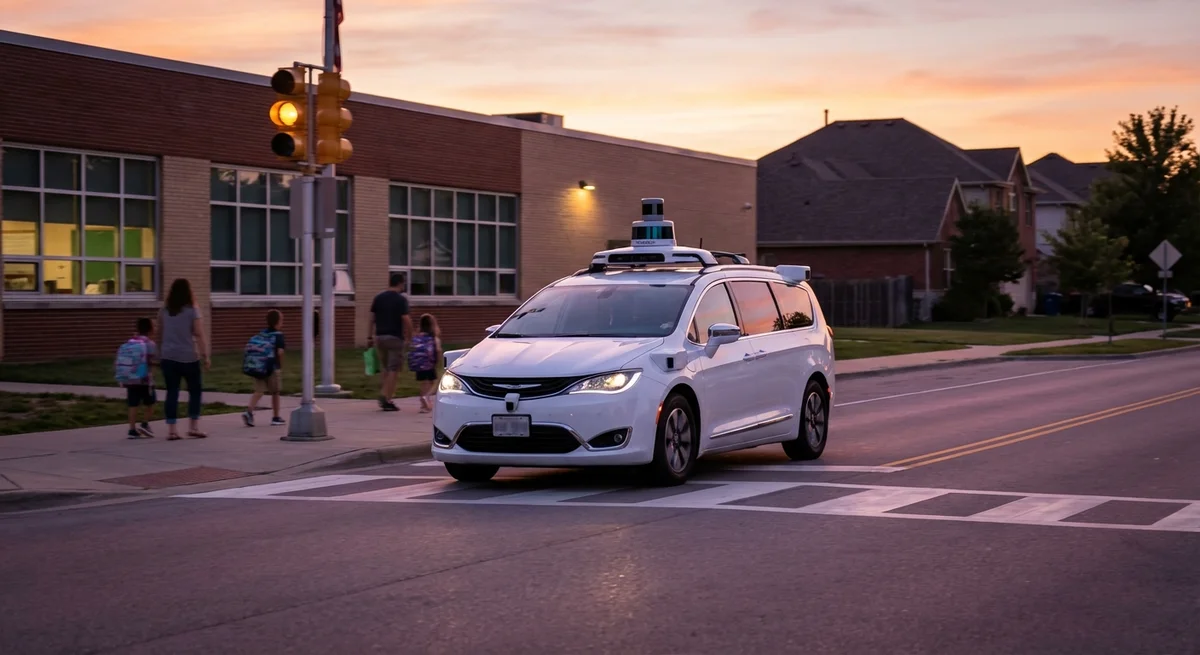
For a long time, Waymo was the straight-A student of the self-driving class, the one everyone pointed to when the industry needed a justification for its existence. While rival Cruise stumbled from scandal to scandal, blocked ambulances and made absurd mistakes, Google's driverless cars threaded carefully through the hilly streets of San Francisco. But the idyll ended in the place people feared most: the zone around an elementary school. An incident in which a robotaxi struck a child instantly turned a technological triumph into the subject of a federal investigation and fresh grounds for skepticism.
This is not just a random accident that can be written off as statistical noise. For Waymo, it is an existential challenge. Until now, the company has successfully promoted the claim that its system sees the world better, wider and faster than any human driver. But scenarios involving children, so-called "edge cases", have always been the Achilles' heel of autonomous driving. Small stature, unpredictable movement and sudden appearances on the roadway baffle even the most advanced neural networks, including those trained on millions of miles of ordinary traffic. Now the National Highway Traffic Safety Administration (NHTSA) is trying to determine how systemic the problem is, and whether it is time to impose forced restrictions on the service.
Regulators have started digging deeper, and this is not the first investigation into Waymo in recent months. But this case carries the greatest reputational risk. If it turns out that the LIDAR sensors or cameras misinterpreted the child's movement, or, worse, that the decision-making algorithm ignored school-zone signs, the company will have to rethink the logic of its entire software. For Alphabet, Waymo's parent company, the timing could hardly be worse. It has only just begun an aggressive expansion in Phoenix and Los Angeles, trying to prove to investors that a decade of investment in autonomy will finally start to pay off. Any delay now means losing billions of dollars.
Remember what happened to Cruise after its car dragged a pedestrian along the asphalt. The company lost its licenses almost immediately, replaced its entire leadership and was forced to hit the brakes in every city where it operated. Waymo is in a more stable position for now, but the credit of public and official trust is not unlimited. Discontent is already growing in San Francisco: firefighters complain about blocked hydrants, and residents about pointless stops in the middle of busy intersections. Every new incident feeds the fears of those who believe city streets have become a testing ground for corporations, with residents serving as unwitting guinea pigs.
In the coming months, expect a gripping battle of data. Waymo will defend itself with numbers, arguing that human drivers hit children thousands of times more often, and do so while intoxicated or inattentive. But in the world of high technology, public perception often weighs more than dry statistics. A machine's mistake is seen as a systemic failure of human ingenuity, while a human's mistake is seen as a tragic but understandable accident. If Waymo cannot convince regulators that its systems are absolutely safe around the most vulnerable road users, the era of ubiquitous robotaxis may arrive considerably later than we were promised.
Bottom line: Can Waymo prove this was an accident, or should we expect licenses to be revoked en masse for all driverless operators?
- Nov 2, 2026Karpathy builds a YouTube clone with 6454 videos from Hacker News recommendations in two hours
- Nov 2, 2026Karpathy used Claude to build HackerTube from 6,454 videos recommended on Hacker News
- Nov 2, 2026Anthropic needs to grow revenue 32% a year to cover $850 billion in contracts
- Nov 2, 2026Bun creator uses Claude Code to port 750K lines from Zig to Rust in 11 days
Test Frontier LLMs & Autonomous Agents in One Workspace
Run Claude Opus 5.5, GPT-6, Gemini 3.1, and DeepSeek side-by-side in Nomad AI (nomadnet.ai) — unified model routing, deep research, and multimodal workflows under one subscription.
The AI world, distilled — once a week
Seven stories that actually mattered, hand-picked. No noise, no reposts, no press releases.
Done! Check your inbox for a confirmation.