Musk Assembles the Puzzle: Why SpaceX, Tesla and xAI Want to Become One
Elon Musk is discussing a merger of SpaceX, Tesla and xAI. The goal is simple: build a single ecosystem in which xAI's AI drives Tesla's autonomous vehicles and communicates through Starlink satellites. Today, Musk's companies often swap engineers and data informally, off the books, which angers investors and has landed him in court. A merger would legitimize the practice and turn scattered startups into a monolithic empire. The main question is how publicly traded Tesla would coexist with private SpaceX and xAI under regulators' scrutiny.
AI-processed from TechCrunch; edited by Hamidun News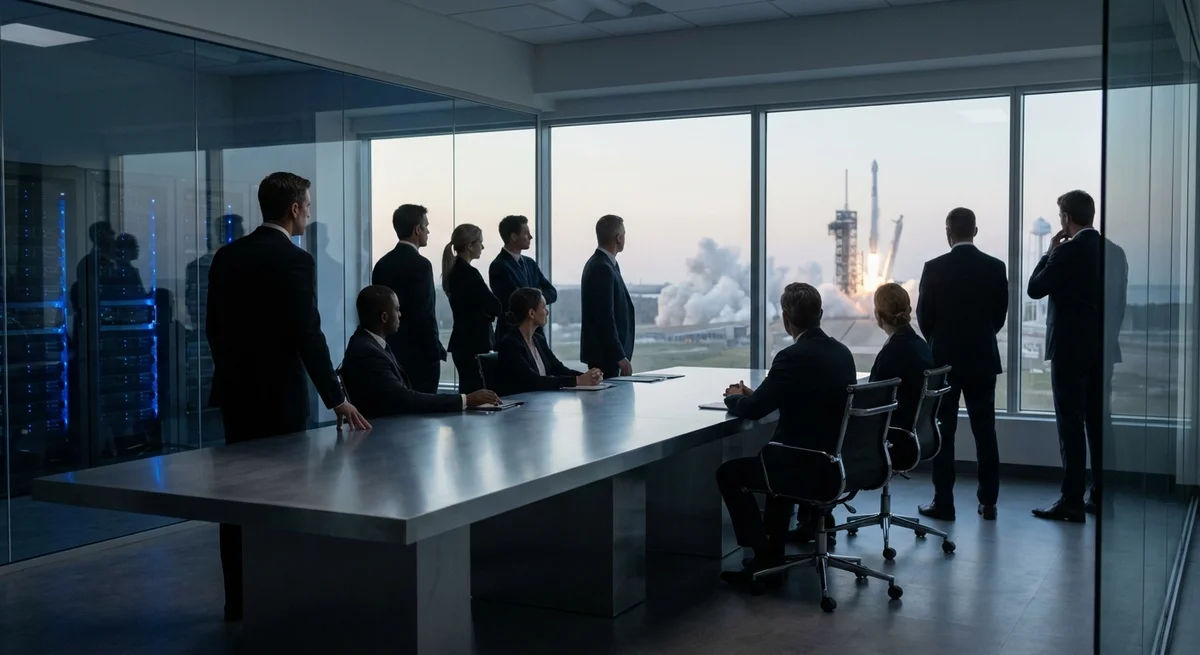
Imagine running the world's best space company, its most valuable automaker and an AI startup trying to catch up with OpenAI, all at once. Sooner or later, you tire of shuffling money and engineers from one pocket to another and risking yet another lawsuit from unhappy shareholders. Elon Musk seems to have reached exactly that conclusion. Reports of possible merger talks among SpaceX, Tesla and xAI are not just a financial reshuffle, but an attempt to create the first vertically integrated empire of physical intelligence in history.
The context matters more than the rumors themselves. For the past several years, Musk has effectively treated his companies as a single organism. Tesla engineers helped build SpaceX factories, while xAI specialists trained the Grok chatbot on data from the social network X. This raised a host of legal questions. Tesla investors have already sued, accusing Musk of diverting talent and resources to his private ventures. A merger solves the problem in one stroke: every engineer would work for the common good of "Musk's Empire," and no one could accuse him of a conflict of interest.
What would actually change for the technology? Musk is building a closed loop. Tesla provides the "body" in the form of Optimus robots and self-driving cars. xAI supplies the "brain": neural networks capable of understanding the physical world. SpaceX and Starlink provide the "nervous system": global low-latency connectivity anywhere on the planet and beyond it. In this scheme, the Grok chatbot stops being a mere toy on a social network and becomes an operating system for the material world. If the combination happens, Musk would gain access to a colossal volume of sensor data from vehicles and satellites, something Google and Microsoft have never had.
Of course, regulators stand in the way of this ambitious plan. Tesla is a public company whose shares trade on an exchange, while SpaceX and xAI remain private and are worth hundreds of billions of dollars. Valuing such a deal without short-changing minority shareholders is a nearly impossible task. On top of that, the US Securities and Exchange Commission (SEC) already has little love for Musk. Any attempt to combine the assets would trigger a flood of investigations into monopolization and market manipulation. But Musk has proved more than once that rules are, to him, merely annoying obstacles on the road to Mars.
Why does this matter right now? We are at a point where software finally meets hardware. For AI to become truly useful, it has to leave the browser. Musk understands that the split between an "automaker" and a "software company" is outdated. He needs a single proving ground for AGI. If the merger happens, we will see the birth of a structure that controls transportation, communications and intelligence at the same time. That is a challenge not only to competitors, but to the very idea of government control over technology.
The bottom line: will this mega-holding become the salvation of Musk's ambitions, or turn into a lumbering giant weighed down by debt and litigation?
- Nov 1, 202616 models tested on 7 search tools: Exa averaged 10.5 out of 14, SearXNG about 3
- Nov 1, 2026OpenAI Rewrites GPT Behavior Rules: Five Values and a Chain of Command
- Oct 29, 2026Gemini 4 Carbon tops independent rankings, but only cyber defenders can use it
- Oct 29, 2026Study: A Single Random Failure Makes AI Agents Abandon a Working Tool 11.6% of the Time
Test Frontier LLMs & Autonomous Agents in One Workspace
Run Claude Opus 5.5, GPT-6, Gemini 3.1, and DeepSeek side-by-side in Nomad AI (nomadnet.ai) — unified model routing, deep research, and multimodal workflows under one subscription.
The AI world, distilled — once a week
Seven stories that actually mattered, hand-picked. No noise, no reposts, no press releases.
Done! Check your inbox for a confirmation.