Nvidia and OpenAI: A Billion-Dollar Friendship Without the Drama
Jensen Huang personally denied rumors of a conflict with OpenAI. The Nvidia chief called reports of his displeasure "nonsense" and confirmed plans for a major investment. The ambitions did have to be scaled back, though: the $100 billion figure that appeared in headlines was not confirmed. It is an important signal for the market: the alliance between the leading chipmaker and the leader in LLMs remains unbroken, despite internal friction and competition. Nvidia cannot afford to lose its biggest customer, and OpenAI badly needs new H200 and Blackwell chips to train the next generations of models.
AI-processed from The Verge; edited by Hamidun News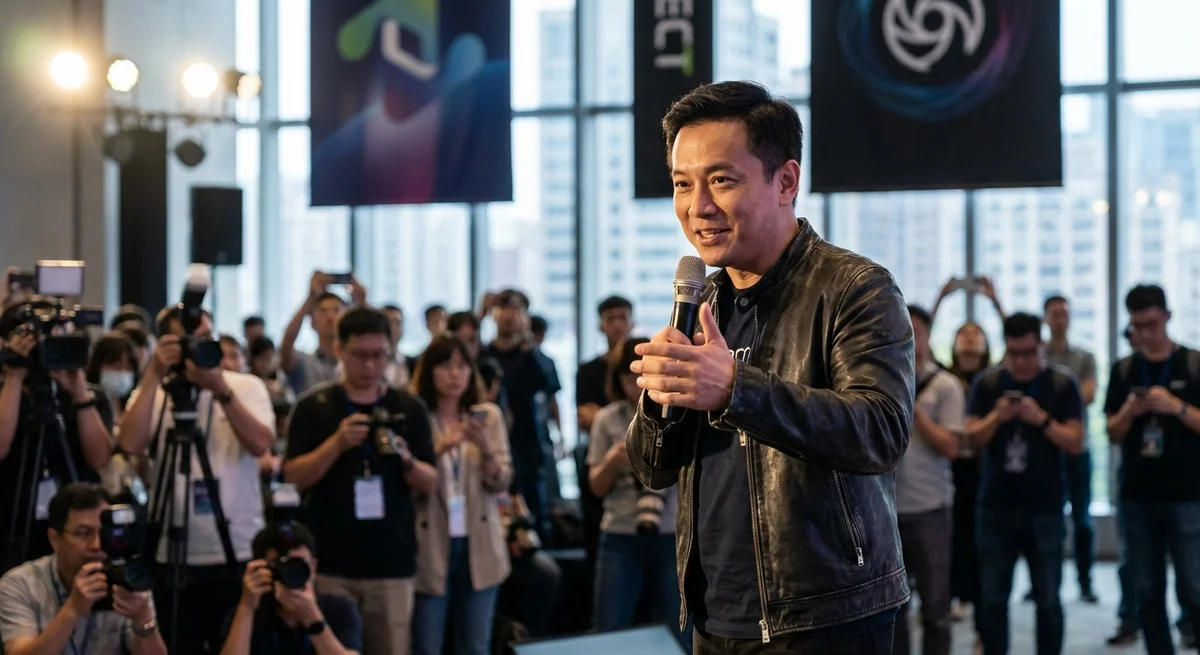
In big tech, gossip travels faster than weights update in a neural network. For the past few weeks, the industry has whispered that something has gone wrong between Nvidia and OpenAI. Jensen Huang was said to be unhappy with how Sam Altman manages resources, or even to hold a grudge over OpenAI's attempts to develop its own chips. In Taipei, however, Huang set the record straight, calling such rumors complete nonsense. The head of the "green giant" confirmed that Nvidia still believes in Altman's project and plans to put serious money into it.
The context here runs much deeper than who is having lunch with whom. Nvidia and OpenAI are arguably the most important symbiosis in the modern history of computing. OpenAI generates the demand that has the whole world lining up for H100 chips, while Nvidia supplies the hardware base without which ChatGPT would have stayed a curiosity from academic papers. When talk began that Nvidia might pull out of a deal for OpenAI's new funding round, the market tensed up. Investors started to wonder: had Huang seen signs of decline at OpenAI, or decided that rivals like Anthropic would make more profitable partners?
The most interesting part of the appearance was the numbers. The press had earlier floated an astronomical $100 billion. For scale, that is more than the market capitalization of many companies in the S&P 500. Asked directly whether Nvidia was ready to write such a check, Huang said no. That makes sense. Even for a company now worth three trillion dollars, putting a hundred billion into a single customer is not an investment but a reckless gamble. Still, Huang stressed that the investment will be "huge." It likely means hundreds of millions or a couple of billion dollars as part of the overall round, which would still make Nvidia one of the key stakeholders.
Why is Huang explaining himself at all? The answer lies in Nvidia's strategy. The company stopped being just a graphics card maker long ago. Today it is a full platform. By investing in its largest customers, Nvidia builds a kind of closed ecosystem: it gives OpenAI money, and OpenAI spends it on chips from the same Nvidia. It looks like a perpetual motion machine of AI-era capitalism. If OpenAI keeps leading, Nvidia secures sales of its most expensive, highest-margin products for years to come. Any rumor of a rift hits the shares of both companies, so it was critically important for Huang to give a "peacemaking" speech right now, as OpenAI prepares for its next stage of scaling.
It helps to remember that the relationship between these giants is not a love match but cold calculation. OpenAI is actively looking for ways to reduce its dependence on Nvidia, hiring engineers to develop its own hardware. Huang, for his part, sees this clearly and understands that dominating the market with a 90% share forever is not going to work. But as long as Blackwell is the best product on the market and GPT-5 demands unprecedented compute, they will have to stick together. All this talk of "displeasure" is most likely just noise around tough negotiations over supply quotas for new accelerators.
The bottom line: Nvidia is staying in the game and continues to back OpenAI financially, but without fanaticism and without the fantastical $100 billion. Will Sam Altman be able to keep Huang's loyalty once his own chips move past the design stage?
- Nov 2, 2026Arca gives AI agents finance tasks lasting up to 10 days, but leaves the trades to humans
- Nov 2, 2026Meta's Muse assistant keeps dossiers on loved ones and gets root on Ubuntu by default
- Nov 1, 2026Local models lose to Opus and Codex: 0.21 on a MacBook versus 1.00 for Codex
- Nov 1, 2026Kimi scores 96.2% on a 1C database analytics test and emerges as a fallback if Claude access is blocked
Test Frontier LLMs & Autonomous Agents in One Workspace
Run Claude Opus 5.5, GPT-6, Gemini 3.1, and DeepSeek side-by-side in Nomad AI (nomadnet.ai) — unified model routing, deep research, and multimodal workflows under one subscription.
The AI world, distilled — once a week
Seven stories that actually mattered, hand-picked. No noise, no reposts, no press releases.
Done! Check your inbox for a confirmation.