Musk's Orbital Data Center: One Million Satellites Against the Laws of Physics and Common Sense
Elon Musk has taken aim at a project that borders on science fiction: one million satellites to deploy AI computing capacity directly in orbit. The idea is to tap virtually endless solar energy and the natural cooling of vacuum. Skeptics call it another bubble, but the engineering logic is simple: Earth is running out of room for giant GPU farms and cheap electricity. If Starlink was the warm-up, this project is an attempt to monopolize the computing of the future and sidestep the limits of terrestrial infrastructure.
AI-processed from HuXiu (虎嗅); edited by Hamidun News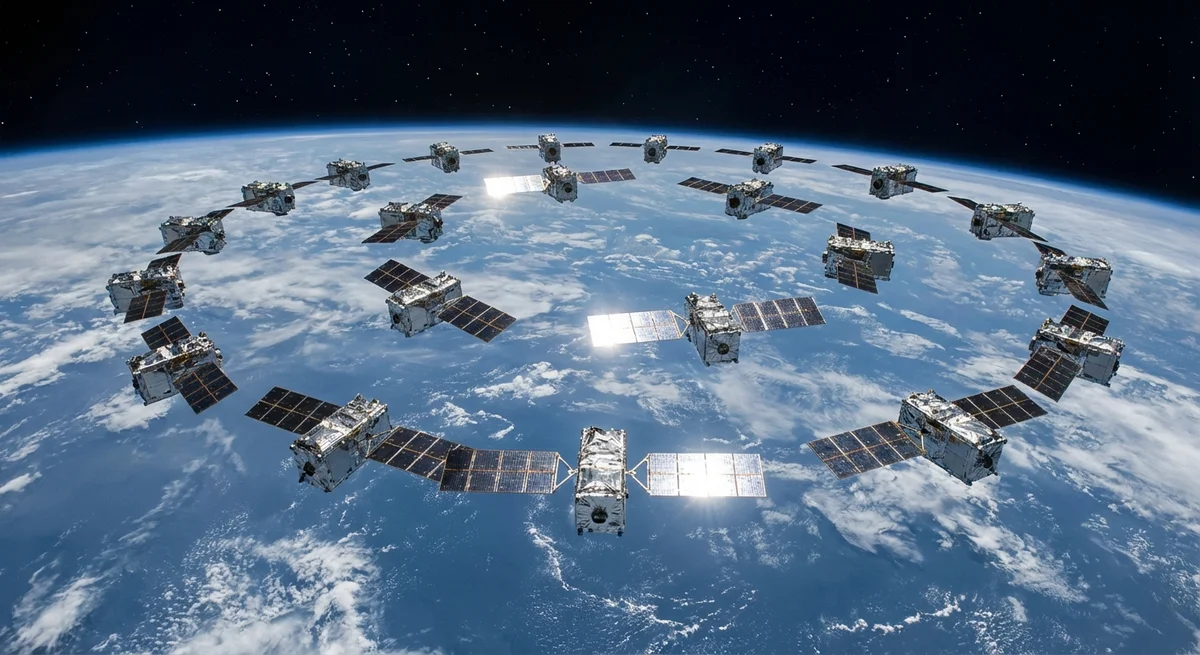
Imagine the sky soon becoming not just a home for stars but a giant, humming motherboard. Elon Musk is once again making the industry nervously scratch its head, announcing plans to launch one million satellites. This is not simply an expansion of Starlink to bring internet to every hut, but a full-fledged "million satellites" project aimed at building a distributed data center for AI right in orbit. At this scale, the line between brilliant engineering and grand bluff blurs faster than Falcon 9 stages enter the atmosphere.
Why haul servers into space at all, when you can build them in Texas? The answer lies in two things that have become scarce in the LLM boom: electricity and cooling. Modern clusters of thousands of H100s consume as much power as small cities and need colossal volumes of water for cooling. Musk proposes an elegant, if insane, way out. In space, solar panels work more efficiently, knowing neither clouds nor night, and the cold of space, that very "cold wind of the Universe", solves the problem of chip overheating. It is an attempt to build infrastructure where there is no power-grid bureaucracy and no environmental activists angry about local rivers being drained to cool neural networks.
Context matters more here than the number itself. After Starlink proved viable, turning from a gamble into a dominant force, Musk realized that orbit is not just a transit route but new real estate. One million objects is tens of times more than has been launched in all of human history. That raises legitimate questions about Kessler syndrome and light pollution, but Musk seems more concerned about the shortage of computing capacity for his xAI. If you cannot find enough outlets on Earth, you create your own outlets in the sky.
Still, skepticism is warranted as never before. Critics point to data latency and to radiation, which relentlessly destroys electronics outside the atmosphere. Servers in space do not live long, and servicing them is impossible. So Musk is betting on a "disposable" architecture: server satellites must be so cheap and so numerous that a thousand failing per week does not affect overall performance. This radically changes the approach to hardware: we move from reliability to redundancy.
What does this mean for the market? If the project is realized even at 10%, we will see the birth of the world's first sovereign compute cloud that answers to the laws of no country. It is an ideal refuge for AI, which could train and operate beyond the reach of regulators. Musk is not just building a data center; he is building a new digital jurisdiction, where sunlight serves as fuel and vacuum as borders.
The bottom line: will these million satellites become reality, or remain a tool for pumping SpaceX and Tesla stock? For now, physics says "hard", and Musk's track record says "don't bet against him". Will Claude and Gemini soon be querying data from orbit?
- Nov 2, 2026Karpathy builds a YouTube clone with 6454 videos from Hacker News recommendations in two hours
- Nov 2, 2026Karpathy used Claude to build HackerTube from 6,454 videos recommended on Hacker News
- Nov 2, 2026Arca gives AI agents finance tasks lasting up to 10 days, but leaves the trades to humans
- Nov 2, 2026Anthropic needs to grow revenue 32% a year to cover $850 billion in contracts
Test Frontier LLMs & Autonomous Agents in One Workspace
Run Claude Opus 5.5, GPT-6, Gemini 3.1, and DeepSeek side-by-side in Nomad AI (nomadnet.ai) — unified model routing, deep research, and multimodal workflows under one subscription.
The AI world, distilled — once a week
Seven stories that actually mattered, hand-picked. No noise, no reposts, no press releases.
Done! Check your inbox for a confirmation.