A Trillion Dollars at Stake: Why the Market Stopped Fearing AI Spending
The US stock market went through a classic bout of "AI panic." After the cloud giants announced plans to spend a combined $650 billion on chips and data centers, investors wiped $1 trillion off their market value in alarm. The fear quickly gave way to a sober reading of reality: in the AI arms race, there is no second place. By Friday, shares of Microsoft, Alphabet and Amazon were rising again. That suggests the market is willing to forgive enormous spending as long as it buys dominance in the future. Big Tech has effectively laid the foundation of a new economy, and the price of admission to this club keeps climbing.
AI-processed from 3DNews AI; edited by Hamidun News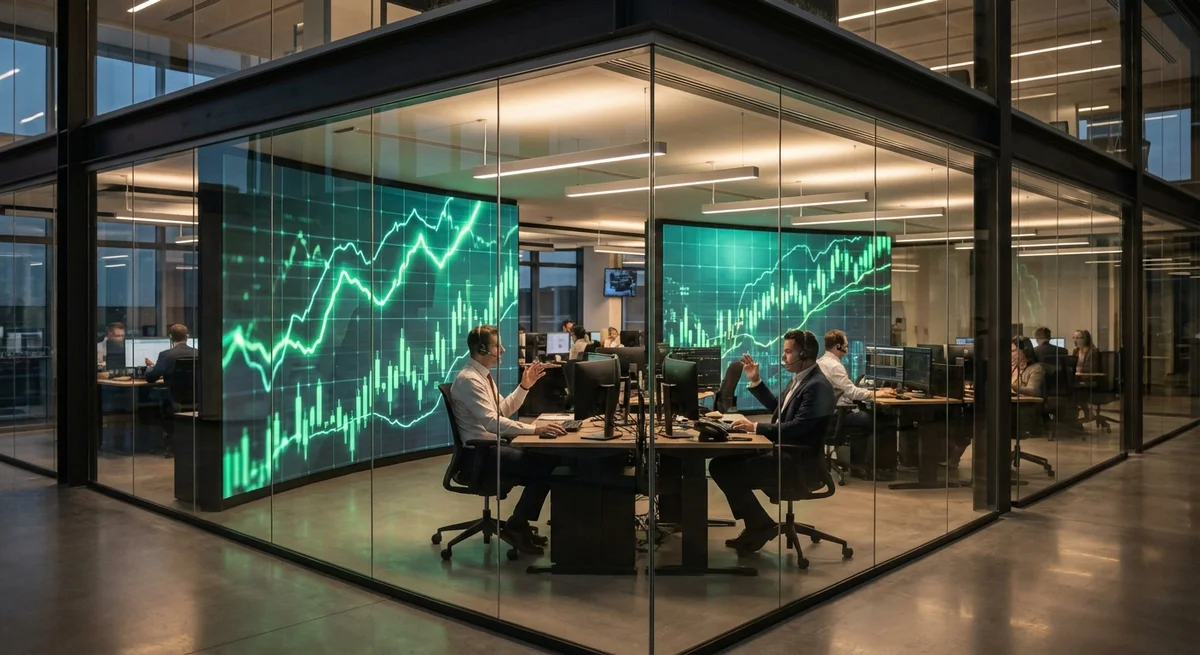
Imagine you sit down at a restaurant, order dinner, and at the end the bill covers not just the food but also a new kitchen, the lot next door and a head chef's training in Paris. That is roughly how investors felt last week, when the largest US tech companies laid out their financial plans. The cloud giants — Microsoft, Alphabet and Amazon — said outright that their capital expenditures this year will top a staggering $650 billion. The market reacted like a moody teenager: within three days, the combined market capitalization of these companies fell by a trillion dollars. It was not just a correction but a full-blown vote of no confidence in the "AI bubble."
By Friday, however, sentiment had shifted sharply and shares were climbing again. Why did panic give way to buying? It comes down to context that investors at first preferred to ignore. We are in what could be called an "infrastructure hangover." The companies are not spending on abstract ideas but on very concrete hardware from Nvidia and on data centers that will consume electricity on the scale of small countries. Investors feared the return on this investment (ROI) was a long way off, but then remembered an old Silicon Valley truth: in tech races, the survivor is not the most frugal player but the one who staked out territory first.
Look at history and you will see such cycles recur constantly. Amazon once spent billions on logistics centers while analysts laughed; today that infrastructure is its main asset. The situation now is identical, but the stakes are many times higher. The companies are not just buying GPUs, they are building the foundation for the next decade. Without this spending they risk turning into the next Yahoo or Nokia — companies that once dominated but missed the turn toward mobile or cloud computing. The market realized that $650 billion is not a CEO whim but an insurance premium for the right to stay in the game.
The speed at which confidence returned is also striking. It signals that there is still plenty of liquidity in the market, and that faith in AI as the main driver of economic growth remains unshaken. The trillion-dollar drop turned out to be merely a temporary sell-off for those who believe in the long-term trend. Skeptics will, of course, keep pointing out that revenue from AI itself does not yet cover even a tenth of this spending. But in Big Tech, revenue often follows dominance, not the other way around. What we are watching now is an attempt to buy that dominance at any price before competitors do the same.
The link between hardware spending and share price gains has become almost linear. As long as Nvidia reports record profits and cloud providers confirm demand from their customers, investors will grumble but keep buying. The current rebound shows that the market has accepted a new reality: there will be no cheap AI. Either you spend hundreds of billions developing your own models and the infrastructure for them, or you use someone else's and pay rent to those who were not afraid to take the risk. In this all-in game, going all-in is the only strategy that looks logical to a board of directors.
Ultimately, the trillion dollars that briefly evaporated from balance sheets has come home. It was an important stress test for the whole industry. It showed that even the most frightening figures in financial reports cannot outweigh the fear of missing the next technological revolution. We are entering an era in which business efficiency will be measured not only by profit in the current quarter but also by the number of teraflops a company can throw at training its neural networks.
The takeaway: the market has accepted that the AI race is a long game, in which huge spending is not a sign of madness but a necessary condition of survival. Will the companies be able to monetize this infrastructure before investors' patience finally runs out?
- Nov 2, 2026Anthropic needs to grow revenue 32% a year to cover $850 billion in contracts
- Nov 2, 2026Microsoft releases 4B model Mage-VL-Cowork, which solves 66.0% of OSWorld-Verified tasks
- Nov 1, 2026Google's StreamVibe video agent beats other models by 10.7% on response timing and quality
- Oct 30, 2026Mistral opens Large 4 weights: strong at code, but Chinese models score 32 to its 26
Test Frontier LLMs & Autonomous Agents in One Workspace
Run Claude Opus 5.5, GPT-6, Gemini 3.1, and DeepSeek side-by-side in Nomad AI (nomadnet.ai) — unified model routing, deep research, and multimodal workflows under one subscription.
The AI world, distilled — once a week
Seven stories that actually mattered, hand-picked. No noise, no reposts, no press releases.
Done! Check your inbox for a confirmation.