AI gold rush hits healthcare as OpenAI and Anthropic storm the market
Healthcare has become the new epicenter of AI activity. In the past week, OpenAI acquired the startup Torch, Anthropic introduced Claude for medicine, and MergeLabs raised $250 million. Huge sums are flowing into the sector, but experts warn about the risks of hallucinations and inaccurate medical data. Developers still have to prove their technology is safe for diagnosis and treatment before AI can become a standard fixture in hospitals.
AI-processed from TechCrunch; edited by Hamidun News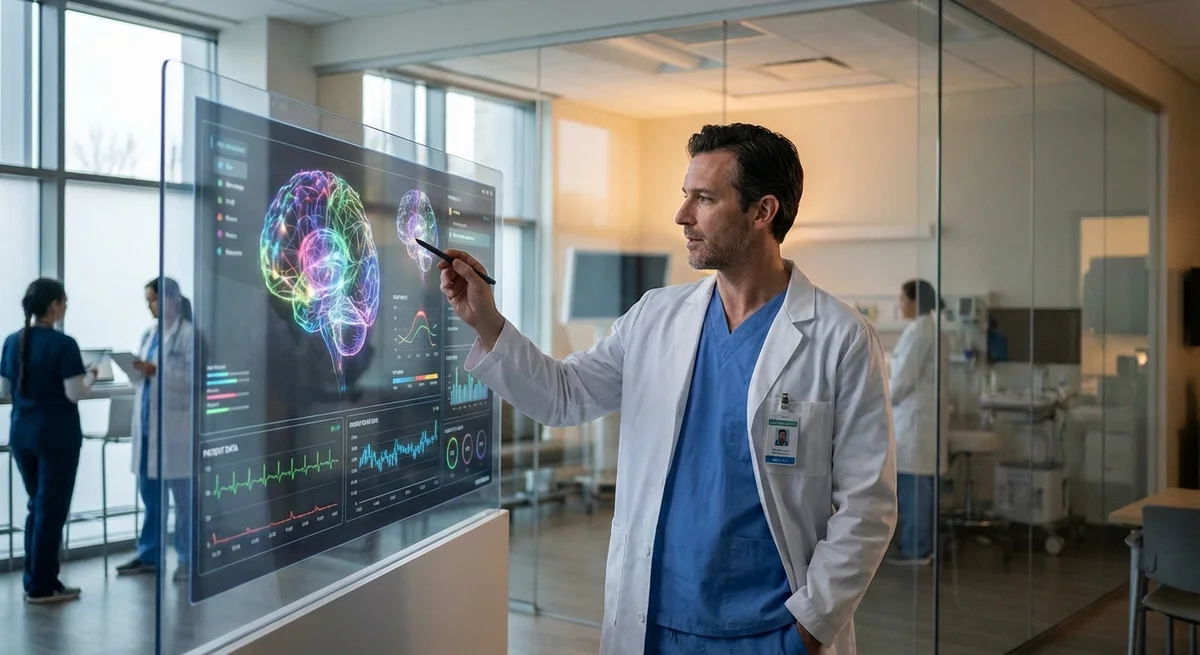
An AI gold rush is sweeping through healthcare, drawing in leading tech giants and venture investors. Over the past week, a series of landmark events took place: OpenAI, a pioneer of generative AI, acquired the medical startup Torch, which specializes in patient data analysis. At the same time, Anthropic, another major AI player, introduced a new Claude model adapted specifically for medical needs. Meanwhile, MergeLabs, backed by OpenAI founder Sam Altman, raised a hefty $250 million seed round at an $850 million valuation. These events point to an unprecedented inflow of capital and technology into a sector that promises revolutionary changes in diagnosis, treatment and healthcare management.
Healthcare has always attracted innovation thanks to its critical importance and the sheer volume of its data. But deploying advanced technologies such as AI brings a set of unique challenges. Medical information demands the highest accuracy and reliability, because errors can have fatal consequences. Against that backdrop, the latest moves by OpenAI and Anthropic to build specialized AI tools for medicine are a logical step, but also a risky one. OpenAI's acquisition of Torch may signal a push toward deeper integration of AI into the analysis of medical images and patient histories. Anthropic's Claude for medicine hints at more capable tools for clinical decision support, patient interaction and administrative automation.
A closer look at these trends shows that companies are working actively on models that can process complex medical data such as X-rays, lab results and electronic health records. The goal is for AI to help doctors reach diagnoses faster, choose the most effective treatment and predict disease outcomes. The investment in MergeLabs, aimed at developing AI in healthcare, reflects investors' faith in the field's potential.
Despite the optimism, however, industry experts voice serious concerns. The main problem remains so-called AI "hallucinations": the tendency to generate false or fabricated information. In medicine, this can lead to wrong diagnoses, incorrect prescriptions and, as a result, worse outcomes for patients.
There is also the problem of access to high-quality, representative medical data for training models, as well as questions of privacy and information security.
The consequences of this "gold rush" may cut both ways. On one hand, AI has the potential to significantly improve the efficiency and accessibility of care, reduce the workload on medical staff and speed up scientific discovery. On the other, the risks tied to AI safety and accuracy call for an extremely cautious approach. Before medical institutions can fully entrust diagnosis and treatment tasks to AI, developers will need to pass rigorous clinical trials and obtain the relevant regulatory approvals. They will also have to show that AI systems are not only accurate, but also ethical, transparent and accountable.
In conclusion, the current surge of AI companies into healthcare opens a new era in medicine, full of both enormous opportunities and serious challenges. Success will depend on tech companies' ability to overcome technical and ethical barriers and ensure their solutions are safe and reliable. Only after AI proves its value and safety in clinical practice can it become an integral part of the modern hospital, transforming healthcare for millions of people worldwide.
- Nov 2, 2026Arca gives AI agents finance tasks lasting up to 10 days, but leaves the trades to humans
- Nov 2, 2026Meta's Muse assistant keeps dossiers on loved ones and gets root on Ubuntu by default
- Nov 1, 2026Local models lose to Opus and Codex: 0.21 on a MacBook versus 1.00 for Codex
- Nov 1, 2026Kimi scores 96.2% on a 1C database analytics test and emerges as a fallback if Claude access is blocked
Test Frontier LLMs & Autonomous Agents in One Workspace
Run Claude Opus 5.5, GPT-6, Gemini 3.1, and DeepSeek side-by-side in Nomad AI (nomadnet.ai) — unified model routing, deep research, and multimodal workflows under one subscription.
The AI world, distilled — once a week
Seven stories that actually mattered, hand-picked. No noise, no reposts, no press releases.
Done! Check your inbox for a confirmation.